

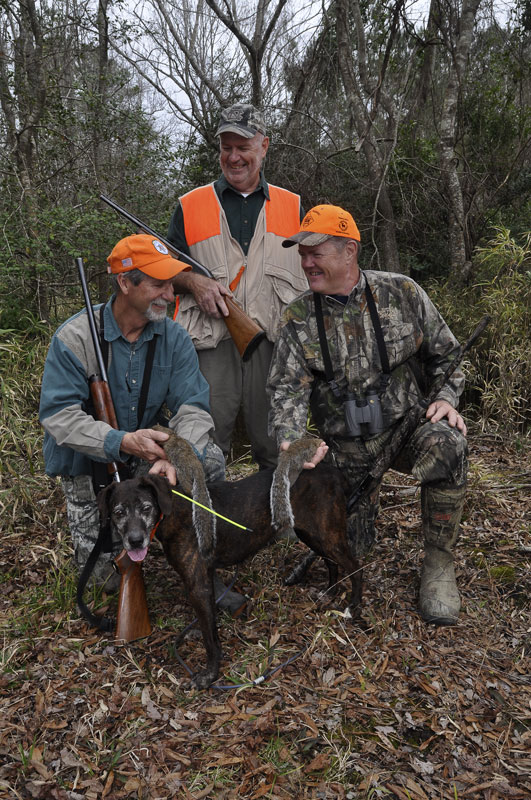
Inject some extra excitement into your small-game hunting by using dogs to find and tree squirrels. It’ll help fill your vest with bushytails.
Three hunters drained their coffee cups down to the dregs before heading into a hardwood forest in farming country near Rocky Point, N.C., in Pender County, close to the home of 67-year-old Preston Casteen, a retired aircraft engineer.
Casteen was holding a dog leash that might have been better described as a dynamite fuse. On the opposite end was tethered a brindle-coated dog, chuffing her breaths, straining at her collar, itching to be set free to follow her nose.
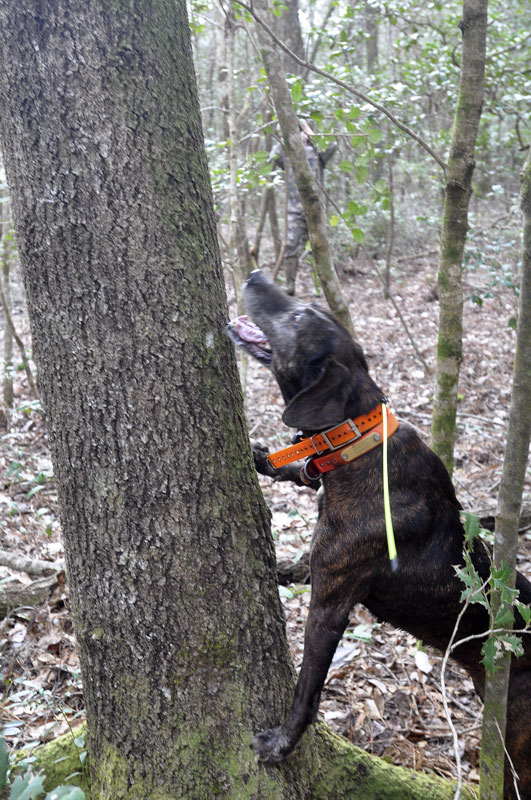
“This is Cammie,” Casteen said. “She is an original mountain cur. At 9 years old, she is an experienced dog. My other dog is Penny, a young puppy. She’s out in there in the woods, somewhere. I will have to check her location with the GPS tracking collar she’s wearing if we don’t hear from her soon. She’s still in training and may not be of much use.”
Along for the morning’s squirrel hunt were Wayne Batson, a 53-year-old retiree from Atlantic Seafood and Bill White, 55, a retired school teacher. All three carried semi-automatic shotguns loaded with No. 5 or 6 lead shot, although Casteen said he sometimes used a .22 rifle for head-shooting squirrels.
“It keeps you from having to pick shot out of the meat when eating barbecued squirrels,” he said.
Penny was burning off puppy energy, running around the edges of woodlots bordered by the brown dormancy of agricultural fields. Casteen collected her and put her back in her pen before unclasping the leash holding Cammie, who is partly owned by Batson. Besides sharing the expense of her upkeep, the two hunters share the pride of her accomplishments, as well as the enjoyment of hunting with her. Eventually, Penny will follow in her footsteps, and another cur will come along to fill hers.
“On a good morning, we may shoot 12 to 14 squirrels,” Casteen said. “On an average morning, we bag seven or eight. It depends upon the type of woods and how hard they have been hunted. If it’s a mature forest with hollow trees, a lot of squirrels run into holes to escape. Middle-aged, mixed stands of pines and hardwoods are best.”
“The success of a hunt also depends upon how late in the season you are hunting,” Batson said. “We do most of our hunting after deer season ends, because deer hunters don’t like squirrel hunters disturbing the woods. They think it alarms the deer, making them more difficult to hunt.”
This particular hunt took place on Feb. 27, 2019. Deer season had long since ended, and the hunt began in Casteen’s backyard. The goal was not to bag a lot of squirrels, because he uses his home territory as a training area for the dogs. However, he said it was not difficult to get permission to hunt squirrels nearly anywhere he asked once deer season was out.
“Listen,” Casteen said. “Cammie’s treed a squirrel.”
The hunters made their way through the shirt-ripping briers and pants-slapping switch cane of the understory, with dew from sweetgum saplings raining down as they pushed them aside.
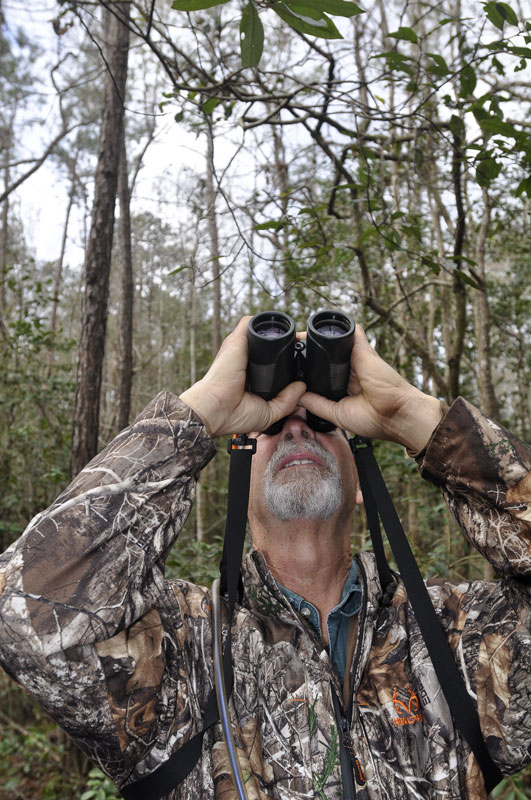
Cammie was biting and barking at the base of a tree, signaling that a squirrel was up there, somewhere. White keeps binoculars on an elastic harness that keeps them from dangling and snagging vines yet instantly available for viewing aloft.
“There he is,” he said. “He’s moving around the tree.”
Casteen shook a sapling on one side of the tree, while the other hunters remained in their positions on the opposite side. The squirrel spooked at the commotion and moved around the tree, presenting a shot. White fired, and the squirrel fell. A streak of brown, Cammie was on it the instant it thumped the ground. As Casteen took it from her and pocketed it in his game vest, she took off again, sniffing the woods for the trail of the next squirrel.
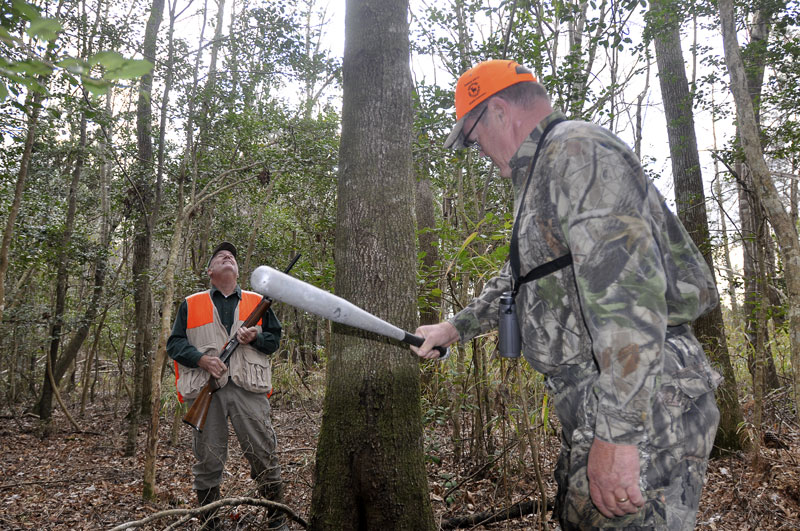
It didn’t take long for her to pick up hot scent. The squirrel treed but took off. Leaping from limb to limb, tree to tree, it stopped several times, However, no one got off a shot, and it escaped into a hole high in a tall oak. White beat on the trunk with an aluminum ball bat, to no avail.
“Sometimes a squirrel can’t stand the sound of tapping on the trunk of a hollow tree and runs out of the hole,” he said. “It works often enough that it’s worth a try, though, as long as you want to go to the trouble of carrying a bat. It’s something else to carry that can slow you down.”
The squirrel stuck tight. The hunters continued on, but, not so much hunting themselves as following Cammie’s lead. She treed another squirrel that escaped, then another that presented a good opportunity. Casteen instructed another hunter to shoot it with a scoped .22 rifle.
“I have been hunting squirrels since I was 12 and had a feist dog,” Casteen said. “I hunted them before school on our family farm. I also hunt deer and other game, but I have never outgrown the joy of hunting squirrels with a dog. “
White began hunting squirrels with Casteen and Batson in 2018, while Batson has been hunting squirrels for many years.
“I hunt with Preston on Saturdays, mostly,” Batson said. “I recently had knee surgery, and it slowed me down some, but hunting squirrels with a dog can be done at a leisurely pace. Once the dog is barking up a tree, the squirrel usually stays put, and you can take your time getting there to shoot it.”
All the hunters agreed that, while still-hunting squirrels without a dog is an early morning or late-afternoon pursuit, anyone can hit the woods anytime behind a dog and have a great hunt. They prefer getting together to drink coffee and eat breakfast and begin hunting around 8:30 or 9 a.m., which gives the squirrels some time to move around and leave scent. Mornings are also cooler than afternoons. Even in February, long walks in the woods can make hunters sweat and take a toll on the performance of an animated tree dog.
Another great result of a hunt, besides plain, all-out fun, is eating. Casteen prepares squirrels for the table several different ways. He cooks them in a smoker, placing chicken on top to allow the fat to drip onto them for flavoring and tenderizing them. He also boils them, de-bones them and mixes them into rice. Another favorite method is slathering them with barbecue sauce, placing them on trays and baking them in an oven.
Obviously, hunting squirrels with a dog produces so many squirrels Casteen has been able to experiment with various recipes. However, Batson is more pragmatic in his cooking techniques.
“I don’t go usually to a lot of trouble to cook them,” he said. “I like them fried.”
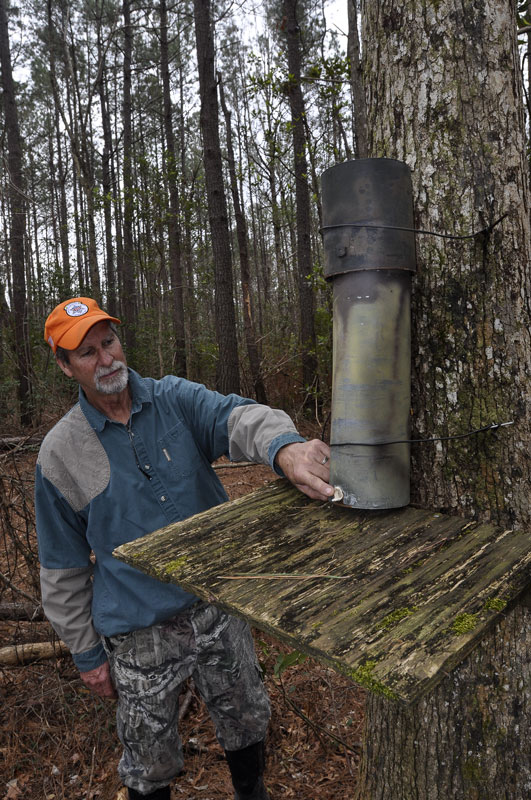
Stovepipe squirrel feeder fast-paces dog training
Preston Casteen attracts squirrels to his dog-training area with a feeder. made of a 2-foot section of sheet metal stove pipe with an internally mounted, sheet plug on the bottom. The plug can be a stovepipe plug, homemade plug or paint can of correct diameter to fit inside the stove pipe. It is held in place with sheet-metal screws or rivets. He drills a hole near the bottom and inserts a 3/4-inch diameter PVC or galvanized steel plumbing nipple to serve as a spout.
The top of the feeder is a upside-down metal paint can. It keeps water from entering though the top and is quick and easy to remove and replace when adding corn or checking the corn level in the feeder.
While squirrels may gnaw a plastic nipple, a metal one lasts a long time and is easy to replace. A galvanized nipple cannot be damaged by squirrels’ teeth, but it is more expensive and a bit more difficult to install. Either nipple is held in place with threaded fittings. If the feeder was made of PVC pipe, squirrels would gnaw holes in it to get to the corn.
The feeder is placed on a plywood platform, with the platform and feeder attached to a tree at one end of the pen. When squirrels sit on the plywood to feed, the dog sees them and becomes familiar with them. If it is worth its salt as a squirrel dog, it soon begins barking and learns to tree them.

Be the first to comment