

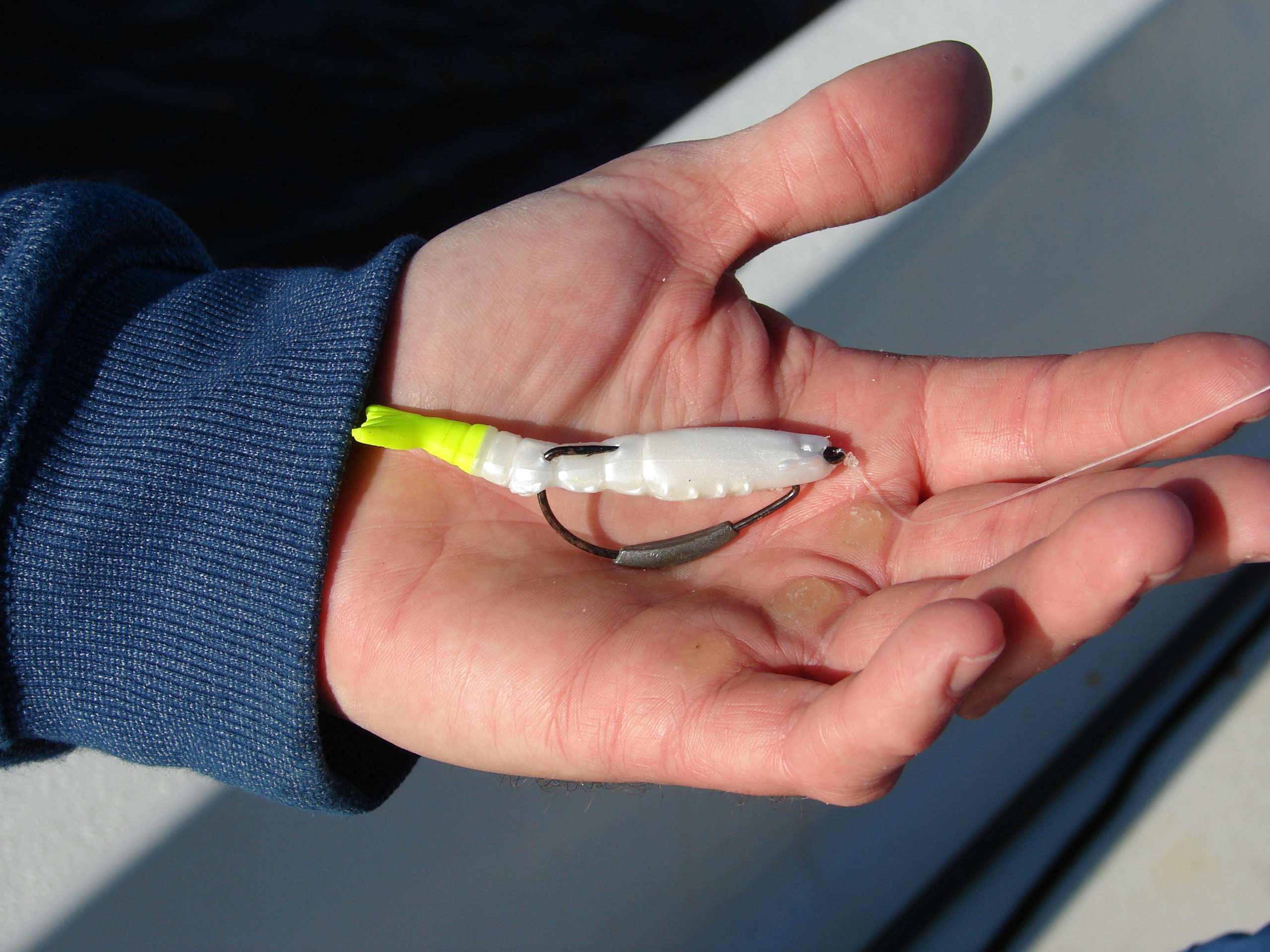
It is usually important to keep your redfish baits and lures near the bottom, but guide Rick Patterson said in late winter and early spring there is a marine vegetation growing in almost all of the bays and creeks that will keep your hooks fouled. The growth usually begins sometime in February and gets worse as the sunlight increases and the water warms.
Patterson likes to cast soft plastics and especially scented soft baits. A regular jighead with an exposed hook will “grass up” in the first few feet of a retrieve and lose its appeal. Patterson combats this by switching to flutter hooks — aka swimbait or wide-gap worm hooks — instead of jigheads.
Most bays are only a couple of feet deep, so having enough weight to reach the bottom isn’t an issue. Patterson said 1/16- or 1/8-ounce is usually plenty, and 1/4-ounce will reach bottom in the deeper holes, channels and creeks.
Flutter hooks are effective because they can be inserted in the bait so the shank of the hook helps shed grass on the bottom, and the point of the hook is lightly tucked into the top of the bait so grass will slide over it. When a fish grabs the bait, the hook point pops free and grabs the fish’s jaw.
Patterson’s favorite soft lure is a 3-inch Gulp! shrimp; he will use a 4-inch model if the smaller ones aren’t available, but he said the smaller ones are usually better, especially in colder water when fish don’t want to expend their energy chasing larger baits.
Patterson uses 3/0 and 4/0 wide-gap flutter hooks and rigs the shrimp so the hook eye extends out its head and the shank drops out of the body just below the head and re-enters up through the body about two-thirds of the way back. The hook point is then lightly inserted in the shrimp’s back so it can’t snag grass. He uses a twitching retrieve that pops the shrimp off the bottom a few inches and then lets it flutter back down.

Be the first to comment