
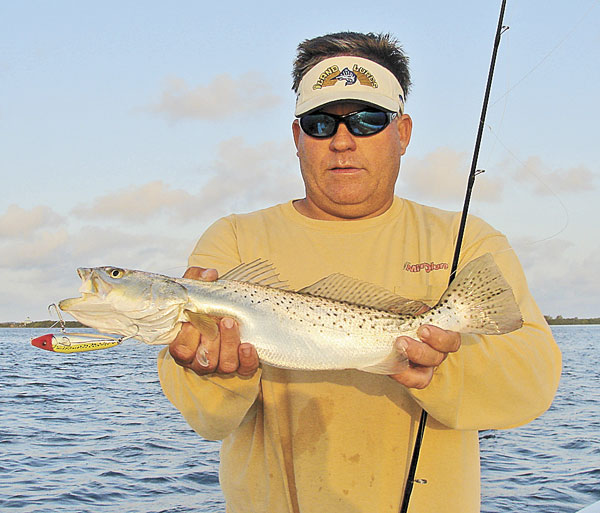
After last month’s column on weedless spoons, my phone began ringing and inbox began stacking up with requests to go to the other extreme. If spoons are most effective when bumped slowly along the bottom in inshore areas, what works best when retrieved across the top?
That’s a legitimate question and a real good time of the year to be asking it. Even better, the answer is simple and just what it would seem to be. Topwater lures are the choice and account for many trout, red drum, and stripers.
These lures float on the surface, which makes them easy to use in shallow water and around oysters and rocks. They create a lot of commotion when worked across the surface, and that attracts fish and either tempts or antagonizes them into biting, either to feed or just kill the intruder.
Some very good fishermen believe that topwater lures tend to attract larger fish and go in that direction. Still other fishermen use topwater lures as search baits, trying to locate fish with them. If a fish makes a pass at a topwater bait and misses, they immediately switch baits to catch the fish. Still other fishermen mark the spots where they have missed passes on topwater baits and come back later in a stealth mode with subsurface baits.
Catching fish on topwater lures can be very exciting and very frustrating, because sometimes fish make multiple passes at a bait without being snagged by the hooks. Many topwater lures are fished with a zig-zag or “walking-the-dog” motion, and fish, especially red drum, have a decided tendency to zig when the bait zags. They blow up all kinds of water, which it is exciting to watch, but it’s frustrating having them miss.
Other topwater lures are fished in a straight line and rely on a concave face to create pops and gurgles to attract fish. Fish sometimes miss these lures, striking just as the fisherman flicks the rod tip to pop the lure again. Even though the frustration level can be high, the excitement level makes topwater fishing addicting. If you ever experience a successful day, you’ll try it again — I’ll promise you that.
Fishing topwater lures that swim in a straight line is pretty simple. It’s just a matter of creating a little slack in the line and twitching the rod tip so the lure can be popped without moving it too far or too fast. This is the same principle as using popping cork, except the lure makes the pop.
The topwater lures that swim side-to-side aren’t quite as easy to master, but they really aren’t hard. The technique is the same slack-line pop as with the in-line lures, but it’s done holding the rod tip low. The difficult part is developing a rhythm that keeps the lure moving. Most fishermen can find this rhythm in a single outing. They may not be able to dance, but they usually have enough rhythm to “walk the dog” with a fishing lure.
Different fishermen have different feelings about the rod, reel and line combos best suited for fishing topwater lures. For years, “walking the dog” was difficult with spinning tackle because reels reversed so much before stopping. Now, with instant anti-reverse, that is no longer an issue, and fishermen who have difficulty with baitcasting reels can still fish topwater lures effectively. Some feel that medium-action rods with monofilament line produce the best action, but my favorite is a light, slow-action rod and braided line. It’s easier for me to consistently feel the action of the light-tipped rod without any stretch in the line.
One of my good friends, who is a very successful fisherman, prefers monofilament for topwater lures because of the stretch when making a hookset. He says the stretch delays the hookset just enough for the fish to really get the lure in its mouth when the line comes tight. It sure works for him, so it may work for you.
I prefer one of the superbraid lines for topwaters. I somehow have disconnected the sight and feel from fishing topwater and do not strike at seeing the fish hit the lure. I don’t attempt to set the hook until I feel resistance, and my hookup ratio is pretty good. Sure, it’s hard not to set the hook when you see that wake push up behind a topwater lure, but until you feel it, the fish doesn’t have it. I also feel the lack of stretch in the braid allows me to better control the action of my lure, and I can fish the same lure at any speed and intensity from slow and subtle to quick and rambunctious.
However, one thing we all agree on is that the way to get the most action from a topwater lure is to attach it to the line with a loop knot. hey just don’t work anywhere near the same if tied with a knot that tightens on the eye of the lure.
The credit for starting this type of topwater fishing is usually given to the Heddon Zara Spook, and I believe this is correct. It was for freshwater fish, and many pike, striper and bass fishermen have enjoyed fishing with Zara Spooks. My introduction to them was with stripers. Before the current US 17 Bridge was built in New Bern, there was a field of cut-off pilings near the New Bern side, where some warehouses had been many years earlier. From late spring until late fall, stripers would gather in those pilings every afternoon to feed. A Zara Spook cast among them in last 30 minutes before dusk was going to get hit. That’s where I learned the true value and meaning of “taking the dog for a walk.”
Along the Southeast coast, the three most-popular topwater baits are MirrOlures (www.mirrolure.com), Rapala Skitterwalks (www.rapala.com) and Zara Spooks (www.heddonlures.com). MirrOlure has probably refined saltwater topwater lures more than anyone and offers the widest variety of options, but Zara Spooks and Rapala Skitterwalks are also very popular.
Zara Spooks rely more on the zig-zag motion and a click from the hooks to attract fish. Many fishermen bring their freshwater Zara Spooks to brackish and saltwater to catch fish, but the company is making Saltwater Super Spooks and Saltwater Super Spook Jrs. expressly for saltwater fishermen. The full-size version is five inches long and is primarily for larger fish. The smaller is a versatile size at 3½ inches and continues the Zara Spook heritage of producing a variety of fish.
The Rapala Skitterwalk Saltwater Model is the SSW 11. It is 4-3/8 inches long, weighs 5/8th of an ounce, contains a large internal rattle and is available in a variety of colors. It is a favorite of many fishermen, and there is no doubt this lure has accounted for many specks, reds and stripers.
MirrOlure produces a variety of topwater lures in their Classic, Luminescence and Series III lines. The Classic line has been around the longest and includes all the standard colors, using a light scale pattern and a trademark mirror inside the lure. The Series III line features a natural scale pattern combined with a holographic finish, and the Luminescence line combines a bold flash with a natural baitfish pattern.
The variety of topwater lures in these lines includes the He Dog, Top Dog, She Dog, Top Dog, Jr., Top Pup, She Pup and MirrOmullet. The He Dog (95MR) and Top Dog (94MR) are 4¾ inches long and weigh three-quarters of an ounce. Just slightly smaller, the Top Dog Jr. (84MR), and She Dog (83MR) are four inches long and weigh a half-ounce. The Top Pup (74MR) and She Pup (75MR) are 3½ inches long and weigh three-eights of an ounce. The newest addition is the MirrOmullet (16MR) and it is only available in the Luminescence line. It is three inches long and weighs three-eighths of an ounce.
MirrOlures have other differences also. The Top Dog, Top Dog Jr and Top Pup have been around the longest and use a low-frequency rattle in an echo chamber to help attract fish. They sit a little lower in the water to help transmit the lower frequency. They usually produce best in calm and clear water conditions.
The He Dog, She Dog and She Pup are made of a new and different plastic that is more buoyant, so they float higher in the water. They also feature twin rattles, which make their sound at a higher frequency. I learned first-hand they will produce on some days when the lower frequency of one of the Top Dog series won’t. MirrOlure recommends using them in murky or choppy conditions.
MirrOlure also makes a Poppa Dog (87MR) that combines the 4-inch and half-ounce size of the Top Dog Jr. and She Dog shape with a rattle and cupped lip for even more noise. this can sometimes spur non-aggressive fish into action.
Last but not least is the MirrOmullet. This is their newest and smallest topwater lure and it is designed to imitate a finger mullet in calm water. The rattle is much smaller and subtle. While the MirrOmullet will still “walk the dog,” it is a more subtle presentation for smaller and calmer water. Even being subtle, it still gets smashed regularly when used in the proper situation.
Topwater fishing is exciting and fun — no doubt about it. Many fish respond to topwater lures, but my favorite is puppy drum. With their mouth located on the bottom of the head, they have to roll to hit a surface lure. That’s something to see in itself, but if they miss, they usually get mad and come back harder the next time. I hate to handle the treble hooks, but the show and excitement from using topwater lures makes it worth it. Check it out for yourself.

Be the first to comment