

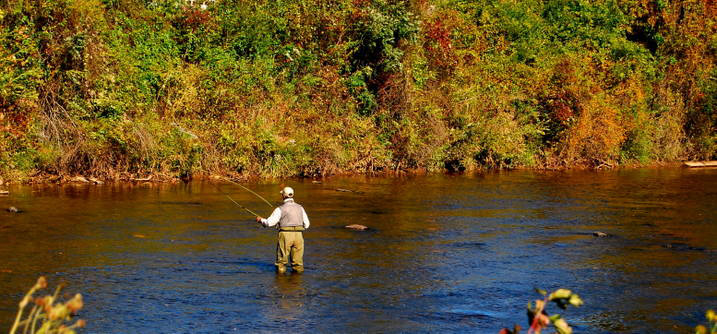
Delayed-harvest water offers winter opportunity
Winter fishing is often iffy in the mountains. Get out on a stream on one of those rare, warm sunny days, and you’ll likely hit a Blue-Winged Olive or midge hatch, and the trout will be hitting. But if it’s one of those too-often cold, dreary days, you’ll spend much of your time trying to get a nymph in front of a trout’s nose and getting very little response. Trout just aren’t very active in old weather. Most often, it’s a matter of getting a fly to the trout instead of the trout coming to a fly.
Winter fishing can be productive if you know where to go, and the best places are the delayed-harvest streams. North Carolina has 29 streams and two small lakes in 18 counties designated as delayed-harvest waters, approximately 64 miles of prime fishing waters, so finding a delayed-harvest stream is not difficult. They can be found as far west as Graham and Clay counties and as far east as Surry County. The list includes two streams added in 2013: Big Snowbird Creek in Graham County and Fires Creek in Clay County.
Unlike streams that depend on natural reproduction, delayed-harvest streams are literally loaded with trout. They may be hatchery-raised, but they’re still trout. All delayed-harvest streams were heavily stocked in October and November with rainbow, brook, and a smaller number of brown trout.
Delayed-harvest streams have two seasons. The catch-and-release season runs from Oct. 1 to June 6. After that, hatchery-supported regulations are in effect, and fishers may keep up to seven fish per day of any size and use just about and kind of lure or bait. During the catch-and-release season, fishing is restricted to artificial flies or lures with a single hook, and all trout must be released even if you injure one. Nature will take care of the remains.
The Tuckasegee River in Jackson County is the premier delayed-harvest stream, with four miles of water that was stocked with more than 19.000 trout in October and November. No matter what the weather is like, you’re almost guaranteed a good day of catching fish regardless of your skill level. Access is excellent. North River and South River roads, both paved, run adjacent to the river. Pull-offs are numerous. Additionally, the new Locust Creek Access Area on old Cullowhee Road off NC 107 provides boating access to the upper section of the delayed-harvest part of the river.
In Macon County, the Nantahala River’s delayed-harvest waters also offer good winter fishing opportunities. The Nantahala is not as heavily stocked, but it provides more of a mountain stream fishing experience than the Tuckasegee, which is primarily a valley stream.
Far to the east, a two-mile section of the Ararat River in Mt. Airy is an excellent stream for winter fishing. Kin Hodges, a biologist with the N.C. Wildlife Resources Commission, said the stream’s low elevation — approximately 1,000 feet above sea level — gives it an advantage over high-elevation streams.
“The Ararat should stay a bit warmer and provide good fishing further into the winter months than many other delayed-harvest streams,” Hodges said of the stream, which was added to the delayed-harvest program last year.
The delayed-harvest section is between the NC 103 bridge and US 52. Mt. Airy recently completed a stream-restoration project on more than two miles of river to help stabilize the banks and improve stream habitat. A greenway trail along the river was added to improve public access. The delayed-harvest section can be accessed from Riverside Park on NC 103, H.B. Rowe Environmental Park on Hamburg Road, and Tharrington Elementary School Park upstream of US 52.
The Commission usually stops stocking hatchery-supported waters in early summer, and by winter, most of these streams are fished out. Delayed-harvest streams are a good alternative for both hatchery-supported waters and wild trout waters — if you’re interested more in catching fish than merely fishing.
Another excellent stream for winter fishing is the Oconaluftee River on the Cherokee Indian Reservation. The Cherokee Game and Fish Commission stocks its Enterprise Waters throughout the winter. State fishing licenses are not recognized. Fishers must obtain a tribal fishing permit, which allows the fisher to keep up to 10 fish per day.
The Oconaluftee Enterprise Waters also include a trophy fish-ing section restricted to catch-and-release fly fishing. This part of the stream is heavily stocked with rainbow, brook, and some golden trout that are in the 5- to 6-pound range; some are even larger. A special permit in addition to the regular tribal permit is required. The stream is open year-round.
If you’re more interested in catching fish than just fishing, plenty of opportunities are available regardless of the season.

Be the first to comment