

If the summer doldrums are getting you down, try the inshore barracuda wrecks at the Southeast Coast.
Fishermen come in contact with barracudas an awful lot at the North Carolina coast.
Rarely is it a happy meeting — at least for the fisherman or his catch.
“Ninety percent of the time, you don’t want to see a barracuda,” said Capt. Rick Bennett or Rodman Charters in Wrightsville Beach. “They usually show up when you’re reeling in the prettiest king mackerel you’ve had on all day. Then he cuts it in half, and the part that’s left isn’t worth keeping.”
Ah, the barracuda. A torpedo-shaped predator who shows up when he’s least expected and least desired.
Capt Rod Bierstedt of OnMyWay Charters in Wilmington said it’s hardly a coincidence an angler is almost always the loser when a big ’cuda appears.
“They’re notorious for biting off fish — biting ’em right in half,” Bierstedt said. “Just about the time you get a king played out, they hit. I think they time it that way.
“Their jaw pressure is just mind-boggling. You think about how hard it is to cut through that backbone when you’re steaking out a king, and he cuts all the way through it with one chomp.
“And they won’t hit junk fish. I’ve never had them cut a bonito in half or an old grunt or ringtail — something you don’t want to keep. They know how to eat gourmet: Spanish mackerel, kings, your high-end bottom fish like grouper, snapper and sea bass.
“A lot of people think when they get bitten off, it was a shark, but 90 percent — or more — of the fish bitten off are got by barracudas. I’ve had ‘em hang out under the boat; you see their nose sticking out, just waiting.”
Bennett (910-799-6120) has a handful of great barracuda tales he delights in telling.
“I was at 23-Mile Rock one day, king fishing, and a lady in my party get on a real smoker (king),” he said. “He took 250 yards of line just like that, then he stopped dead — with emphasis on the word ‘dead.’ She reeled in what was left, and he’d cut the king off right behind the dorsal fin — about mid-way back in the thick part. What was left weighed 27 pounds. That king would have weighed 45 or 50 pounds. Think about what the barracuda must have looked like.
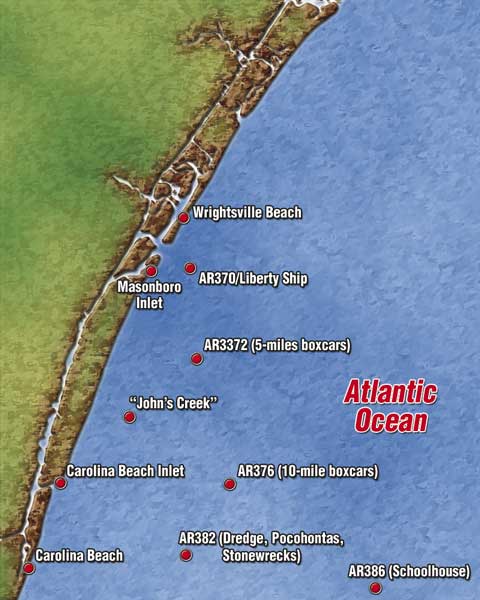
“I was sitting on John’s Creek (a popular inshore reef between Carolina Beach Inlet and Masonboro Inlet), and I had a grandson and grandfather (fishing with him),” he said. “We were catching sea bass pretty good, and the grandson had pulled one up 20 feet off the bottom, then a big ’cuda hit him and came about 5 feet out of the water.
“I was watching the kid to see his reaction, and his jaw just dropped. I talked to his grandfather about 6 months later, and he told me his grandson was still talking about it.
“It’s times like that, you cuss ’em, but in the dog days of August and September, when all you want is some action, you can always go to the Liberty Ship and catch a barracuda.”
Bennett has targeted barracuda — Bierstedt too, and both admit it. There’s just something about a 50- or 60-pound fish, 5-feet long, with tremendous power and the agility of a trapeze artist. Hook one and you’re almost guaranteed an aerial display that would rival a billfish — plus a tough, dogged fight.
And they’re around for the better part of four months each year, well within the range of most inshore or nearshore fishermen.
Ledges, wrecks and reefs — the places fishermen flock to in search of tasty gamefish — attract barracudas once the water warms up to tepid level. It must be the fine table fare that a big ’cudas adore. A reef holding mackerel and sea bass probably makes a barracuda shiver with delight — like an overeater looking at a buffet table.
“Usually, they arrive in this area as soon as the water temperature gets up past 80 degrees,” Bennett said. “They’ll show up anywhere, but primarily they want to be around an artificial or natural reef or a wreck — things that will attract the smaller fish they feed on. They don’t get on rocks nearly as much.
“They’ll stay around until the water cools down, and usually that’s in October.”
Bierstedt (919-798-6093) said the first barracuda sightings are generally in June, at offshore ledges. As the water warms, more fish show up and move to inshore ledges, wrecks and reefs — anywhere from Bennett’s favorite, the Liberty Ship, just a mile or so off Masonboro Inlet, to the WR-4 buoy and 23-Mile Rock — a good run on a nice day from Masonboro Inlet or Carolina Beach Inlet.
Bierstedt and Bennett said ’cudas are commonly encountered at the Liberty Ship (AR 370), the 5-Mile and 10-Mile Boxcars (AR 372 and AR 376), the “Schoolhouse” reef (AR 386), and the three wrecks that make up AR 382 — the Dredge, Pocohontas and Smith.
And they’re just as likely to show up at one of those places as any other. Bierstedt’s favorite is the Schoolhouse; Bennett’s is the Liberty Ship.
Of course, that’s when they want to catch them on purpose.
“You can take a live menhaden to the Schoolhouse and you’re about guaranteed to catch one,” said Bierstedt. “They stay right on top of the wreck or reef — directly over it. Divers, when they go down there, say they’re all over the wreck, looking for an easy meal. When you slow troll a live bait down there, it’s like ringing the dinner bell. I caught a 40-pounder a couple of years ago trolling a ballyhoo around the Liberty Ship.
“They’ll come all the way to the beach. They’ll hang around the piers, and guys who are king fishing will catch one once in a while. They’re thick at the Schoolhouse or any of those reefs and wrecks from 10 miles on out.”
Bennett has three distinct strategies for catching barracuda: live bait, trolling and casting. He trolls and casts with the same lure, a length of rubber surgical tubing that covers a strand of wire, with treble hooks at one end and in the middle.
Bennett usually cuts his surgical tubing in 12- to 15-inch sections and uses green, red and orange — with red the most productive color. He’s got Sevenstrand wire inside the tubing, with a 1/0 extra-strong treble at the business end and another pushed through the tubing at about the midpoint. He rigs a half- to 1-ounce egg sinker at the end of the rig and uses a 6- to 8-ounce, cigar-shaped trolling weight, a few feet up the line to keep the bait down.
“The egg sinker at the head gives the tube a crazy action as it comes through the water. I’ll troll about 6 or 7 knots, with the tube about halfway from the surface to the structure,” Bennett said. “You just troll back and forth across the reef or wreck, staying close to it, and they’ll go crazy. But you need some stout tackle — 25- to 40-pound class tackle — to keep the barracuda from cutting you off on the wreck.”
Bennett also likes to fish his surgical-tube rig with heavy spinning tackle, casting across the structure, letting it sink toward the bottom, and then reeling it in with a steady retrieve. The lure, thanks to the egg sinker, provides its own action. An added attraction to casting is that, at inshore reefs and wrecks in relatively shallow water, anglers often can see well in the water column and actually spot barracuda, cruising lazily along. Then, it’s a matter of casting well in front of the fish, letting the bait sink and then retrieving it so it crosses in front of him, tempting him to strike.
When he’s live-baiting for barracuda, Bennett ties on a standard king rig, except he upsizes his wire and hooks.
“It’s a king rig — on steroids,” he joked about the No. 6 wire and pair of No. 2 treble hooks.
“You fish a big, old menhaden just right over the wreck, just drift it, turn it loose and hold on,” he said. “The fun part, in my opinion, is that you get to watch him eat it. Of course, after he’s hooked, that’s really fun, but it’s fun to watch him take it.
“He’ll just swim over to it, grab hold, shake his head a couple of times, and when he feels the hook, he’ll usually leap 5 feet out of the water. A lot of times, they’ll jump twice before you ever know you’ve got him. They’re a very acrobatic, powerful fish.”
One of Bierstedt’s most-productive ways of catching barracuda involves a little bit of revenge.
“I’ve caught ’em because they’re bad about eating a whole king,” he said. “So if I’ve had a 15-pound king cut in half, I’ll just take what’s left and go back and chuck it out, just drop what’s left of the carcass. A lot of times, they’ll be swimming around, looking for what’s left, and you just hope he goes ahead and eats the head.”
Bennett said that a half-dozen or more barracuda are liable to call a single reef or wreck “home” at any given time.
“Once they show up around here, they’re here in good numbers all summer,” he said.
Bierstedt said a wreck or reef can hold barracudas of all sizes, from long, skinny youngsters all the way up to those 60-inch specimens as thick has a man’s leg. And he said they appear to regard overhead boats as some kind of sanctuary or ambush point, hanging in the shade of the hull until striking.
“They don’t worry about your boat — they’re more curious about it,” Bennett said. “They like to hang out under your boat.
“Anyone who has bottom fished very much has seen somebody reeling up a sea bass, have it well off the bottom, and have a barracuda come out from under the boat and cut it off. You lose a lot of snapper, grouper and sea bass like that.”
Bennett is enamored with the strength of a big barracuda and its agility, but even more with its speed, which he said sets it apart from a lot of predators.
“Barracuda belong in that high-speed group of fish — not as fast as a wahoo, maybe, but still real, real fast,” he said. “One thing I’d like answered — and I don’t know there is an answer — is, ‘Do they have a natural predator?’
“I don’t know if they do. There’s no question a shark could kill and eat one. But a shark shouldn’t ever be able to catch one. Sharks just aren’t fast enough.”
Almost all barracuda caught by recreational fishermen — either accidentally or on purpose — are released. The meat is not considered worthy of table fare by most fishermen, although Bierstedt said that’s more true of fish in the Gulf of Mexico.
Properly cleaned and steaked or filleted, a barracuda has good-looking white meat, he said. On the other hand, with king mackerel and Spanish mackerel and great-tasting bottom fish all around, why settle for a barracuda?
After all, you wouldn’t kill somebody who butted in front of you in that buffet line to grab the biggest chicken breast, would you? Maybe you’d just take the next-biggest piece of chicken, or wait for the staff to bring out more.
Or maybe not.

Be the first to comment