

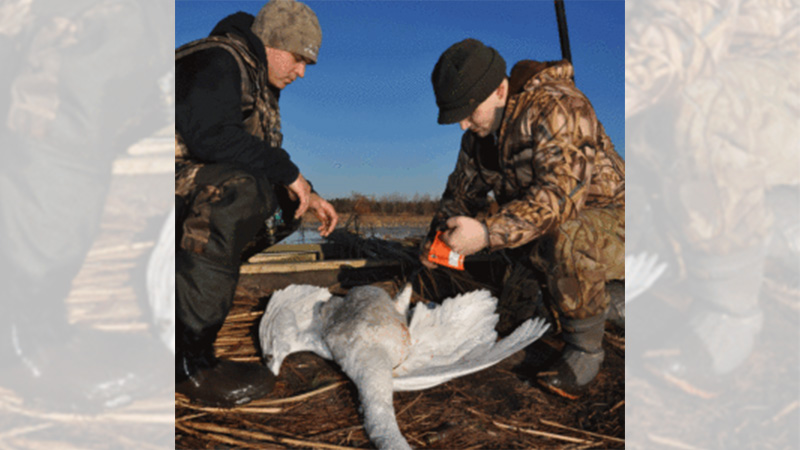


Most hunters chase tundra swans in ag fields, but hunting over impoundments can be very effective — and is more traditional. And Gull Rock Game Land provides everything you need.
The tundra swan is the largest waterfowl species hunted in North Carolina. In bygone years, traditional hunts included decoying them on the water or sneaking up on them in a boat, but modern agriculture changed all that.
Now, swans are primarily hunted in fields of winter wheat or soybean stubble.
Nathan Garrett, who guides swan hunters, has taken hunting the big birds to a different level, as well as to a different playing field. He won the title of World Champion Swan Caller in the youth category in 2010 and became one of the youngest competitors to qualify and compete in the World Duck Calling Championships in Stuttgart, Ark., in 2011.
He understands the motivation of hunters who apply for the annual permits issued by the N.C. Wildlife Resources Commission.
“Most people want to go swan hunting just one time so they can get a bird to mount,” Garrett said. “But some others will apply for a permit every year and hunt whenever they get one because they like hunting swans so well.”
Garrett falls into the addicted category of swan hunters. He began hunting at age 4 with his father, the late Nick Garrett, who owned Wild Fowler Lodge before his passing.
“When I was 8, I saw a flock of swans fly over Jones Bay,” Garrett said. “Several years ago, I got into swan hunting big-time, and I’ve been doing it ever since. I tried competition calling as a learning experience. I wanted to refine my calling and get as good as I could get.
“Very few people call swans using any type of mechanical call. They use their voices because it’s so hard to use any kind of whistle or reed call to make all the necessary sounds and make them realistic.
“I can’t call swans as well as I could when I was younger because my voice has changed. I have trouble making the higher, breaking sounds.”
Garrett used a yard cart to wheel guns and gear along a dike between two flooded waterfowl impoundments.
“There are a lot of impoundments like this one in Hyde County,” he said. “I really enjoy hunting swans over water, because it’s more traditional. I call around to the various people I know who own impoundments to find out where the swans are resting and feeding. Most people don’t like to have too many swans in their impoundments because they eat up all of the food intended for ducks, (so) it’s fairly easy to get permission to hunt swans because it chases them away, if only for a day or two.”
Entering an area, Garrett startled hundreds of swans to flight. He waded out with less than a dozen floating goose decoys that had been painted to look like swans.
“If you hunt a field, you need at least two-dozen decoys,” he said, “but in an impoundment, you can get by with a half-dozen. I set them in a straight line or in a circle right in front of the blind. The important thing is to put your decoys where the swans want to land, and they will usually come right in.
“Sometimes, they circle around and give you a great show, and you can hear their wings buzzing. It’s really amazing. You will never forget the sights and the sounds of a decoying flock above the water or the big splash after you make a good shot.”
While setting the decoys, Garrett collected floating stalks and reeds. He brought them back to the bank and placed them in bundles on top of a pit blind.
“I like hunting from a pit blind much better than hunting from a ditch in a field,” he said. “A blind is comfortable and roomy, and you don’t have mud sticking to everything and getting inside your shotgun.”
Garrett pumped about a foot of water from the bottom of the blind, where several buckets made for comfortable seating of various heights. However, there was little time to enjoy the comfortable blind, because the swans began returning almost immediately.
“Wait until you can see their eyes to make sure they’re in range,” Garrett said. “Aim for the bill and try to hit the swan in the head. Juveniles are gray, and adults are white, but sometimes it can be hard to tell because the adults get a blond color from them sitting on the water of an impoundment.”
Garrett made sounds that involved the swans in conversation. He made a hail or greeting call consisting of a series of loud hoots and woos that excited the birds, and they made the same sounds in return. As they flew closer to the decoys, he switched to a murmuring call he called a contented or resting call by vibrating his lips rapidly in a manner he described as “like a machine gun” while making a moaning sound.
“The juvenile swans make a ‘wheep-wheep’ sound, and the adults do more hooting and hollering,” he said. “They make a lot of different sounds, and most hunters try to mimic them whenever they are trying to decoy them. It’s hard to make a sound that isn’t swan-like.”
The three hunters in the blind took their swans in short order, shooting one from each of three different flocks. After that, swans kept streaming in and landing at the outskirts of the impoundment.
“They are getting more wary by the year,” he said. “They will still decoy to white plastic trash bags if they are set in the right place, but they don’t tolerate human presence very well, so you still have to do a good job of hiding from them.”
Garrett liked the fact that the swans were all shot in the head and neck area because it made retrieving them easy. He has seen some retrieving dogs fetch swans, which is a big plus during a water hunt.
“A wounded swan can swim or run while flapping its wings a lot faster than you can follow,” he said. “I caught a swan once that attacked me. It beat me with its wings against my legs and left bruises from my knees down, and I’m sure if a wing had hit me in the face it would have broken my nose. I don’t carry a shotgun when I’m guiding because the client must kill the swan himself. I advise them to chase the swan and get within range, then shoot the swan in the head or neck. If I have to catch it for them, I jump on it and sit on it to keep its wings down until I can break its neck.”
Dale Davis, a biologist with the N.C. Wildlife Commission, said hunters who don’t have access to private impoundments have a good chance at filling their swan tags at Gull Rock Game Land in Hyde County.
“During most winters, we have a good population of swans at Gull Rock,” he said. “The birds aren’t bothered very much by the two-day-per week hunting schedule. Gull Rock doesn’t require a permit for waterfowl hunting, and it can be hunted on Tuesdays, Saturdays and holidays and opening and closing days during the waterfowl seasons.”
The fact that the swans are not hunted hard keeps them returning to the impoundment to roost, Davis said, but hunters entering an impoundment in the early morning hours can sometimes startle the swans away.
“Your best chance is probably a pass-shooting opportunity in the early morning,” he said, “but the swans will often return during the morning before the impoundment shooting hours end. If you have some decoys out for swans and they do return, there’s an excellent chance you will get your swan. Most of the time, hunters in the impoundment have already filled their swan tags or don’t have one, so there isn’t any competition from other swan set-ups, and you could have the impoundment all to yourself if you are strictly hunting for swans.”

Be the first to comment