

Unknown plus overlooked equals great fall fishing for stripers and catfish on Roanoke Rapids Lake.
“Good morning, how was the concert?” were the first words out of guide Don Enderle’s mouth as he poked fun at one of his fishing parties. “Everyone looks pretty good; you must have behaved and not partied too much.
“We couldn’t have asked for better weather this morning; it’s just about perfect. The fish might just be waiting on us to feed them, and we should have a nice day.”
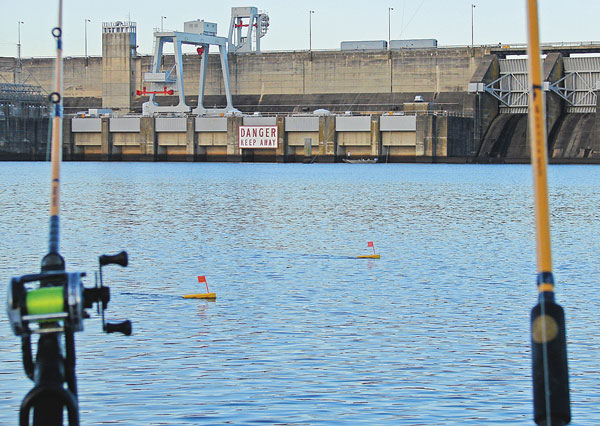
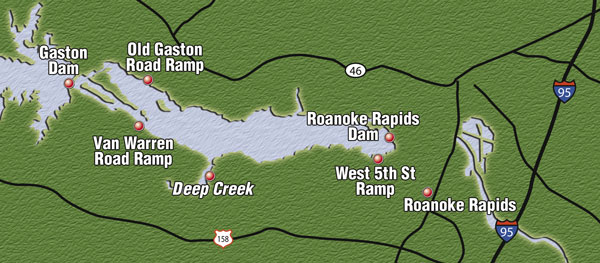
Idling away from the ramp, Enderle goosed the throttle on the idling Honda outboard and headed for Gaston Dam — like lots of other fishermen. But when the MayCraft center console came off plane, Enderle and his party were looking up at the dam from downstream; they were fishing in Roanoke Rapids Lake, a smaller, older reservoir that’s often overlooked by fishermen in favor of bigger and better known Lake Gaston of Kerr (Buggs Island) Lake.
There are plenty of reasons not to overlook Roanoke Rapids Lake, especially late in the fall when the striper fishing is excellent, and you have a chance to run into a nice largemouth bass, channel catfish — or even a walleye.
“There are a number of reasons why the fishing gets good in November,” said Enderle. “The water cools off, and that does different things to the baitfish we have here, but it really does make the fish more aggressive.
“They pack on some meat all during the (late fall and) winter. They feed up all the way to spring.
“You get to play the water thing twice a year at Roanoke Rapids Lake. Being the farthest downstream, the water temperature tends to be closest to the groundwater. In the summer, it’s cooler because it’s coming off the bottom (of Gaston). In the winter, it’s warmer because it’s coming off the bottom (of Gaston).
“November can be different,” he said. “Some years, you’re running around in shorts and a T-shirt, and some years, you’re digging stuff out of your drawers to keep warm.”
A couple of minutes after arriving, Enderle, who operates Tri Lakes Guide Service on Roanoke Rapids, Gaston and Kerr, eased a Minn-Kota trolling motor into the water and explained that he would be slow-trolling live baits he’d caught in a cast net before his fishing party had arrived, and that even at its slowest idle, the big outboard moved the boat too fast.
With the speed reduced enough that the boat left just a small ripple in its wake, Enderle began to deploy baits. And baits. And more baits. Soon, the number and placement of rods and lines left the back of the boat looking like a spider web in the initial stages of construction.
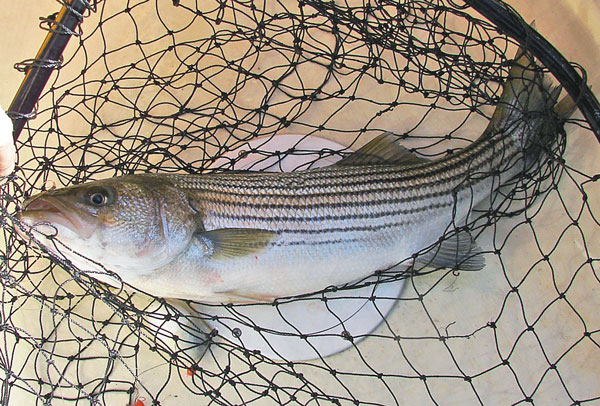
Enderle’s spread of 10 baits at different depths and distances behind the boat — thanks in part to the use of side planers — proved to be effective. The first strike, a barely legal striped bass that was released, came before all the lines were set, and fish continued to bite all day.
“We’ve got a unique combination of factors that will determine where the fish will be feeding,” said Enderle (252-813-8501). “Our weather has just begun to cool, so the fish should be near the surface. We’ll start off by positioning everything there and move it around if we don’t start catching fish soon. With the water level down, that makes it a little shallower and easier to cover too.”
Surprisingly, every time a striper or channel catfish got too hungry for its own good, Enderle was able to help his fishermen work the fish back to the boat through the maze of lines with almost no tangles. After a while, one of the soft tipped rods bent way back and the clicker on its reel began to sing.
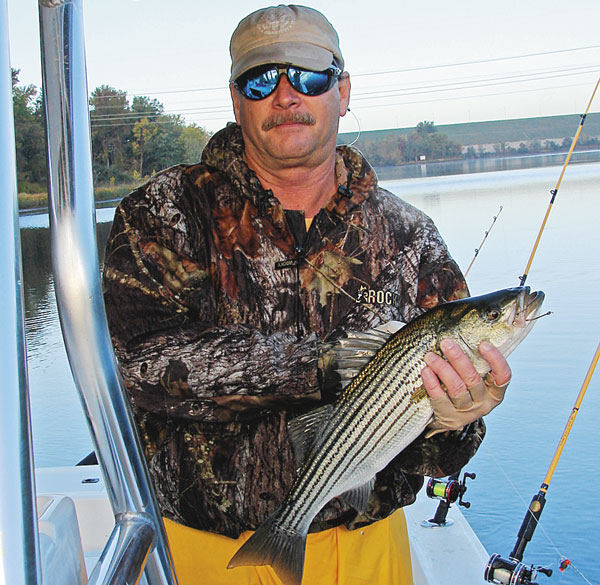
“That’s what we’re here for,” Enderle said, a little more excitement in his voice. “That’s not a huge one, but that striper is a little bigger than what we’ve caught so far. I’ve caught some in here that ran into the 20s. That one won’t make that, but it’s definitely bigger than what we’ve caught so far.”
And it was. This striper weighed around six pounds — no monster for sure, but certainly a worthwhile catch.
While checking and changing baits, Enderle pointed out one sporting two holes that had been drug just a little down the bait’s side. He said the predator was a walleye — the only fish in the lake with dental work capable of punching holes in a baitfish.
A little while later, with largemouth bass, stripers and channel cats making up the day’s catch, Enderle said he needed a big walleye for supper or a really big fish from one of the other species to cap off the trip.
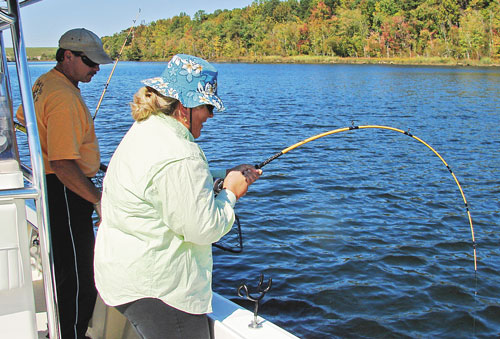
It didn’t take long before one of the planer lines on the port side shook like it had brushed a stump, then stopped and suddenly disappeared. Enderle grabbed the rod, made sure the hookset was a good one, and handed it — with the clicker on its reel buzzing — to Donna Mooneyham of Oak Island. He put pressure on her, announcing that it might well be the fish of the day.
A few minutes later, a nice channel catfish came into view, but it saw a boat filled with hungry-eyed fishermen and decided to put some distance between itself and them. But it was soon tired, and Mooneyham brought it to the side of the boat, where Enderle scooped it up with the net.
With congratulations being exchanged, Enderle realized the fish might be close to a state record. He unhooked it and made a few phone calls, having someone check the N.C. Wildlife Resources Commission website. Mooneyham’s fish weighed 21 pounds, and when Enderle found out the state record was 23 pounds, he let Mooneyham pose for a few photos before easing it over the side and letting it swim away.
“It would have been nice to have a state record,” Mooneyham said, “but I’m having fun fishing, and that was why I came on this trip, so it’s okay. Maybe it will happen another time. I’m sure going to keep fishing.”
Several stripers and catfish later, the trip was at its end, and the run back to the ramp was filled with good-natured banter. A fall day that had begun with everyone wearing jackets had warmed to shirt-sleeve weather — almost as hot as the fishing had been on a lake that many anglers have forgotten, if they’ve known about it at all.

Be the first to comment