Watch for moving water and get fresh baits on the bottom for big Badin blue catfish.
Peering through the first of rays of sunlight across the glassy surface of Badin Lake, it’s a little difficult to fully comprehend how many huge blue catfish are swimming around in the lake, one of a handful of Piedmont reservoirs on the Yadkin River. Chris Hammill of Hammill Outdoor Adventures had plans to make introductions to several of them.
“My buddy that left us bait; (he) fished last night, and said they didn’t generate at Tuckertown, so there wasn’t any flow and he didn’t catch anything,” Hammill said. “One of the big keys to catching fish here is moving water, and it has to come through the dam for that. Since they didn’t generate last night, they probably will today, and we’ll be up here pretty close to the dam to take advantage as soon as the water begins moving.
“We may get a couple of bites without the water moving, but they are usually weak and pretty non-committed, and the hook-up percentage is low,” Hammill said. “There isn’t a power generation schedule I can find, but they should generate sometime today. When they start and the water starts moving, the fish will turn on. Let’s head on up and get set up on the spot I want.”
While it has managed to avoid the crowds of some of the other piedmont lakes, Badin Lake has been quietly building a reputation for producing a variety of fish and some rather large ones, especially blue catfish — including an 89-pounder caught in 2006 that is the state record. Hammill said he’s seen bigger fish, even had clients hooked up to a couple, but so far they hve escaped capture.
After running up the lake for a few minutes, Hammill slowed his boat and began watching the fish finder closely; the bottom began arching up and turned into a flat. He eased an anchor over the bow and pulled the line through a guide and back to the console. Once he was sure the anchor had set, he began backing away from it out into deeper water and trailing the line out through the guide.
When the fish finder showed the bottom beginning to fall away quickly, he eased a slightly smaller anchor over the stern. When it set, he took in the line from the bow anchor until the boat was positioned near the top of the slope, tied off both and said it was time to fish.
“The water is just beginning to warm, and the blues are moving onto this flat to feed,” Hammill said. “They are about to begin spawning and are feeding the best of any time in the year. I’ll get some baits spread around this edge and up on the flat, and we’ll see what depth they like today. I just hope they get some water moving soon.”
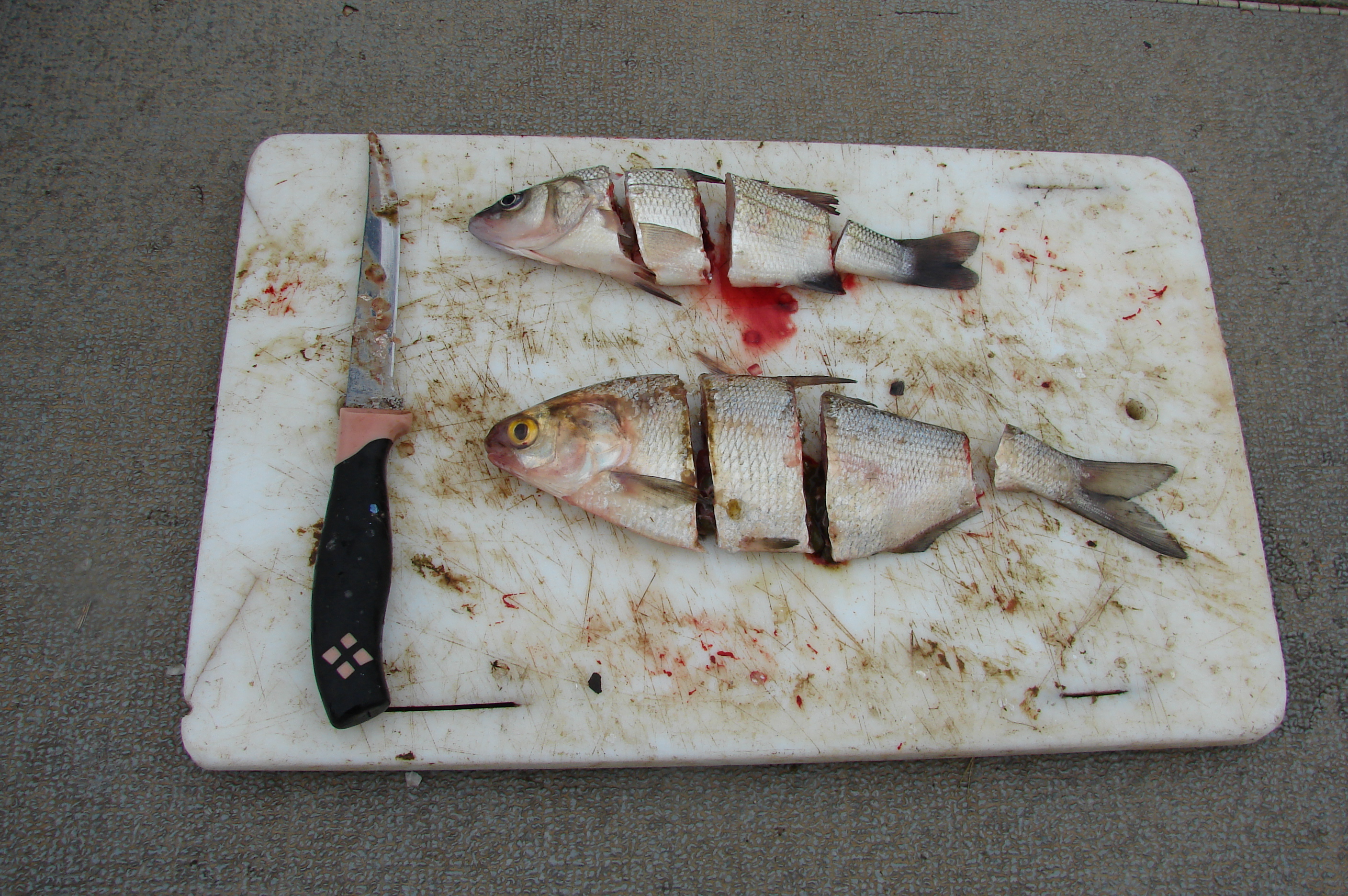
Hammill had plenty of outfits rigged with his special adaptation of a heavy duty Carolina rig. He cut chunks of white perch and gizzard shad for bait and fan-cast them in a circle around the boat, hoping a hungry fish or two that hadn’t feed overnight while the water was still might be around, but really hoping for the water to start moving. Suddenly, one of the rods on the shallow part of the flat bobbed a little, and Hammill sprang to attention.
“That was a bite, but he wasn’t serious and was just checking it out,” Hammill said. “Hopefully, it tasted good and he’ll come back.”
After several minutes, another rod jerked down and came back up. A few seconds later, Hammill pointed out that the line was moving off slowly, parallel to the boat, and not pulling the rod down. After a few feet, the line stopped.
“He’s either stopped to eat or dropped the bait,” said Hammill, who eased the rod out of its holder, tightened the line and prepared to set the hook. A shake came up the line, and he leaned back to set the hook. Reeling down to remove any slack, he set the hook again. The rod pulsed hard a couple of times and then the line went limp.
“That’s one of the problems of fishing without current,” Hammill said. “They will not pick up the bait and move off; (they) just grab it and sit down to eat. That fish was probably facing the boat, and that’s why the hook didn’t set. I get better hooksets with these Kahle hooks than with circle hooks, but neither of them sets well if the fish is pointed your way or moving toward you.”
Hammill was making a quick trip down the lake to catch fresh bait when Yadkin Inc., a division of Alcoa that operates several hydroelectric plants on the river, started generating at the Tuckertown Dam, and the water started moving in Badin Lake.
In a little cove, he baited small rigs on light spinning outfits with small pieces of fish, and shortly, he had about 25 nice perch. He headed back to the same area upstream from the Old Whitney landing and reset the anchors.
“They are finally moving some water,” Hammill said. “I hate to sound overconfident, but this should turn on the fish, and we should catch some. Get ready.”
Within 10 minutes, the first rod bowed deeply, and its reel started giving up line. Hammill set the hook, played the fish for a few minutes until it tired and turned it towards the boat, working it through the other lines before deftly scooping it up in his huge landing net.
“Oh yeah, they usually want to come out and play once the water starts moving,” Hammill said. “I don’t know exactly how it affects them, but it sure gets them going.”
Hammill pulled out a set of scales and weighed the big blue, net and all. After deducting the weight of the net, he proclaimed it a 41-pounder, big enough to earn a citation through the N.C. Wildlife Resources Commission’s N.C. Angler Recognition Program, which has a minimum of 30 pounds for 41 inches for a release citation.
“The regulations allow keeping one each over 32 inches, but I like to release all of the big ones. We’ll keep a small one to eat if anyone likes. They taste pretty good,” he said.
The next strike came almost immediately after Hammill had gotten a new bait back in the water. This fish headed straight away from the boat but tired quickly and came in easily. In the boat, Hammill estimated it at close to 15 pounds, a good size to keep and eat.
Hammill was rinsing his hands when the next rod went down and the reel began crying as line was ripped from it by a fish headed down the lake. This fight lasted about 10 minutes before the tired fish was led through the lines to the boat.
“I thought this was going to be a pig,” Hammill said. “It grabbed that bait and took off like it was huge. I have caught a lot of 60-pounders and a few in the 70s here, and they all ran like that. This fish will only go about 45 to 50, but it sure represented itself well.”
For the next hour, the strikes came about every 15 to 20 minutes. Only one fish appeared to be smaller than 30 pounds, and the only one he weighed was another 45-pound fish.
When the current quit moving and it appeared that a storm was approaching, Hammill suggested heading for the ramp, having had plenty of action. Twenty minutes later, with the boat on the trailer, the bottom fell out. On what he considered an “off day,” Hammill’s party had caught three blue catfish in the 40s, several smaller ones and a bunch of white perch that were fun to catch in a different way. The state record had survived another day, but fishing was fun and gave an excellent sample of catching the Badin blues.
DESTINATION INFORMATION
HOW TO GET THERE — Badin Lake covers about 5,350 acres on the Yadkin River, southwest of Denton and northeast of Albemarle. Access on the east side is largely via NC 109; on the west it’s US 52. NC 49 joins those two highways, crossing just a few miles north of the lake. The lake is served by a handful of public boat ramps: at the town of Badin and at Old Whitney on the west side of the lake and at Gar Creek, Lakemont Road, Circle Drive, Lake Forest Drive and in the Uwharrie National Forest on the east side. See www.ncwildlife.org for exact locations.
WHEN TO GO — Blue catfish are a year-round target on Badin, but they typically bite better as the water warms heading into spring. The peak is typically from February into May as catfish become active and move into the shallows to bulk up for spawning. There are also flathead catfish and channel catfish in Badin Lake. Channel catfish may bite at any time and flatheads prefer the warmer months.
REGULATIONS — Catfish regulations are pretty simple. No size minimums or creel limits are in place, but fishermen can keep only one blue catfish 32 inches or longer per day. White perch is a favorite cut bait for fishermen targeting blue catfish; there are no limits.
TACKLE/RIGS — Stout tackle is required to battle catfish that can be, in a word, huge medium to medium-heavy, 7- to 8-foot conventional rods and reels with a smooth drag capable of handling 30-pound test line. They must have enough backbone to lift a big fish off the bottom. Fresh cut baits of white perch and gizzard shad are the ticket. A modified, heavy-duty Carolina rig is the ticket; tie an 18- to 24-inch leader of 50-pound monofilament and thread on a cork six inches above the bait to keep it just off the bottom. Eagle Claw Super Kahle hooks in 7/0 to 9/0 are preferred.
GUIDES/FISHING INFO — Chris Hammill, Hammill Outdoor Adventures, Concord, 704-239-7921, www.hammillsfishing.webs.com; Maynard Edwards, Yadkin Lakes Guide Service, Lexington, 336-249-6782; Hoots Outdoors, Albemarle, 704-982-9817; Sports Country, Denton, 336-859-3933.
ACCOMMODATIONS — Stanly County Chamber of Commerce, 704-982-8116, www.stanlychamber.org; The Badin Inn and Golf Club, Badin, 704-422-3683, www.badininn.com; Pineview Inn, New London, 704-463-7862. Camping is available in the Uwharrie National Forest, 877-444-6777, www.recreation.gov.
MAPS — DeLorme North Carolina Atlas and Gazeteer, 207-846-7000, www.delorme.com; Kingfisher Maps, 800-326-0257, www.kfmaps.com.