

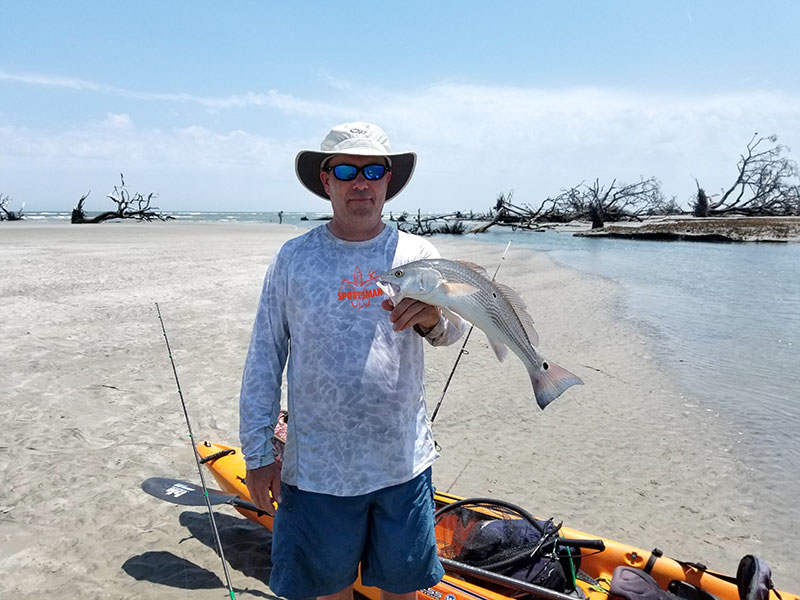
Getting stranded in a saltwater creek at low tide sounds dreadful, but it’s anything but when you do it for the right reasons.
And the right reasons, when it comes to kayak fishing, involve catching fish and enjoying beautiful scenery in a relaxing setting.
Many days this time of year, kayak anglers strand themselves on purpose, checking the tide charts the day before to be sure they arrive in time to get stranded.
Getting stranded is not something you can do every day, especially in the fall as days are growing shorter. The tide has to be at a certain cycle to get you into a creek early enough that you can get stranded, while allowing enough time for the tide to return, giving you a way out of that creek and back to the landing before the sun goes down.
Get in
I like to hit the water as the tide is coming in, which makes it slightly tougher to paddle away from the landing. But once I make it to the mouth of the creek I plan to get stranded in, the tide carries me in. I don’t even need to paddle except to keep my kayak straight.
At this point, I’ll fish past the place I want to get stranded and do some exploring. And once the tide turns, I’ll ride it back to my stranding point.
As the banks of the creek become more and more exposed due to the falling tide, I pull my kayak up, hop out, then set up a couple of bottom rigs, placing my rods in the rod holders of my kayak.
I carry a Helinox camping chair, which weighs less than a pound and packs up super compact. I unfold the chair, get a snack from my cooler, then kick back and watch my rods as water rushes out of the creek.
Bonus fish
It’s not uncommon to catch some bonus fish as the tide moves out, and when dead low tide hits, any fish left in the creek is stranded, so they are easy pickings if they’ll just get a little bit hungry.
At dead low, many creeks have a series of deep holes separated by oyster mounds or mud flats. This is a great time to wade fish, trying different lures and different baits in each hole. It’s also a great time to catch bait, either with a cast net or with a minnow trap.
And if the fish aren’t biting and you’ve got a buddy with you, dead low tide is a great time to kick back, relax, and observe the spartina grass in its last stages of green, with much of it already beginning to show brown thanks to autumn.
Then, the real magic happens when the water returns for the incoming tide.
As the tide floods in, it brings redfish, speckled trout and flounder, eager to reach the baitfish and crabs that have been hiding in the creek for the past several hours.
The gamefish are hungry and ready to eat. And there you are, already set up with fresh bait. The first hour or so is usually the best, with some of the hottest action you’ll ever experience.
Get out
A few hours in, the water is high enough to start nudging your kayak, and now it’s time to pack up and paddle out of the creek.
Heading back to the landing, don’t forget to enjoy the scenery. Winter will be here soon, and all that is green will soon be brown, and the water you just waded in will be too cold for that.
Check next weekend’s tide chart. See if you can squeeze in one more fall day to get yourself stranded.
Be the first to comment