

Find the daily patterns
It’s April, spring has sprung, and the crappies are biting. No matter where you live in North or South Carolina, a lake near you is producing excellent crappie fishing.
But as many anglers discover, success is dependent on finding crappies because more than any other time of year, they’re on the move, and on their spawning migration.
The good news is their movement patterns during the pre-and post-spawn are something anglers can plan for, and by being mobile in their search, they make that crappie-catching connection.
Prime time
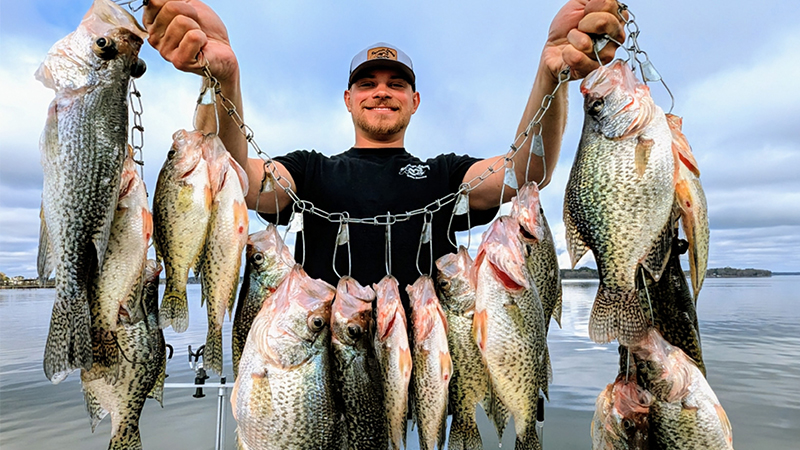
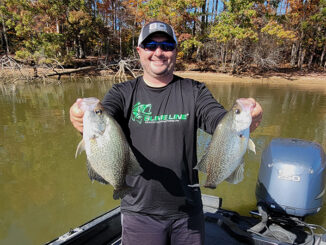
Capt. Jake Futia is a full-time fishing guide on lakes Wylie and Wateree on the Catawba River chain, specializing in crappie, catfish and striper. During the winter and through the spring, Futia said it’s prime time for crappie fishing, both for quantity and quality.
“The action can be absolutely non-stop, and it’s THE time of year when we consistently catch the most slab crappies,” he said. “My technique works on most any lake. But I refine the process to meet specific conditions. It involves following the fish from their deepwater winter patterns into the backs of creeks and coves where they spawn and back out.”
Futia said a snapshot of the process is that crappie typically winter in deeper water, and/or around heavy cover. Once the water temperature begins to warm, they start moving out of the deep haunts towards shallower water.
“On Lake Wylie, that typically means movement out of the main river channel to the flats along the river’s ledge,” he said. “When they make that transition, they’ll migrate toward creek mouths in large schools. Once gathered at creek mouths, they begin to work their way up the creek.”
Futia (704-989-1871; or check his website, captainjakesguideservice.com) said two key elements are important to remember. First, not all crappies move into pre-spawn mode in the creeks at the same time; they arrive in waves. Second, it’s not a straight-line movement up the creek. That’s where it gets interesting during April.
On the move
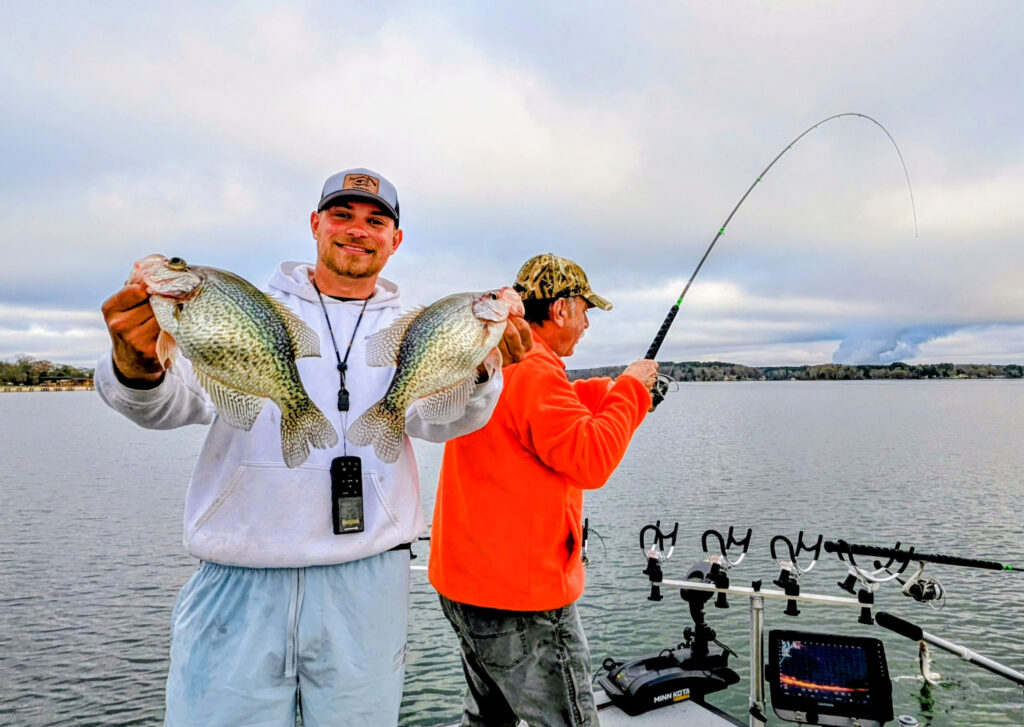
“As they migrate up the creek, they begin to diversify where they’ll be in the water column,” Futia said. “For much of the winter and early pre-spawn, I catch many fish near the bottom, although we’ll also target ‘roaming fish’ suspended, located using Forward Facing Sonar. But during the pre-spawn up the creeks, the fish may be anywhere in the water column, even suspended shallow over deeper water.”
Using traditional electronics and logging a little seat time in a search, he’ll find the specific area and depth where crappies are congregating on that day and focus his effort on those locations.
“This search is necessary because crappies constantly move, and they shift back and forth,” he said. “A cold front, or some external factor, may briefly push crappies back toward deeper water toward the mouth of the creek. Successful crappie fishermen play the daily ‘find the fish’ game.”
When spawning, crappies flood the shallows, and Futia said casting jigs, or minnows under bobbers, to shallow water along shorelines and in the back of coves will produce. Although spawning fish offer a relatively narrow window of opportunity, it’s productive and fun. Once they spawn, they begin the reverse movement back down the creek, now in post-spawn mode.
“For consistent action, the key to remember in mid-and-late April is that more crappies continue in the migration, and it’s not uncommon at some point to find fish in pre-spawn, spawn, and post-spawn mode,” he said.
Both directions
It’s a pattern where anglers can target crappies as they’re literally coming and going during their spawning migration.
“Moving crappies like to eat, and the bite is often excellent once you locate them,” he said. “Depth is always crucial for crappies, so whether fishing minnows or longline trolling, it’s essential to keep the lure at the depth crappies are holding on that day.”
Futia is a diehard ‘minnow-man’ because they’re the ‘real thing,’ he said. He uses a two-hook rig, with a 3/8- to ½-ounce bell sinker on the bottom. The bottom hook is about a foot up the line, and the second hook is placed about 12-18 inches above that on a 10-pound test line. This rig enables him to work two depths effectively.
“This rig is effective throughout the winter, pre-spawn, spawn, and post-spawn,” he said. “I like a No. 6 wire hook because it’s small and enables the minnow to work naturally.”
Futia said his rigs are key as well. He prefers 12-foot Catch The Fever Precision Troll medium-heavy rods for fishing minnows or jigs.
Find and catch
“They’re ideal for year-round fishing, and having all my rigs with the same length and action helps anglers catch fish consistently,” he said. “On April trips, I often switch from minnows to jigs, or vice versa daily, and this same rig performs great for both.”
When the water temperature reaches the mid-60’s, longline trolling works great.
“When I mark a lot of fish in the 10- to 15-foot depth range, trolling is an excellent option,” he said. “I still work different depths, and using 1/16- and 1/8-ounce jigs, with various colors of plastic trailers, I can pull them at different depths. I also vary the length of line on each rig behind the boat, while trying different speeds, because both change the depth the lures run.”
The result of this experimentation for Futia is that he observes which rigs catch fish. As the fish-catching pattern forms, he strategically adds more rigs, baits, or lures to that productive pattern.
“It’s a process, but it’s productive on these moving targets,” he said. “Fishing every day gives me a head start, because I know what’s been happening and that provides a starting point. But anyone can get on the water, and with due diligence, find and catch crappies.”
And being on your favorite lake in April, while catching slab crappies, is as good as it gets for Carolina anglers. ■
Be the first to comment