

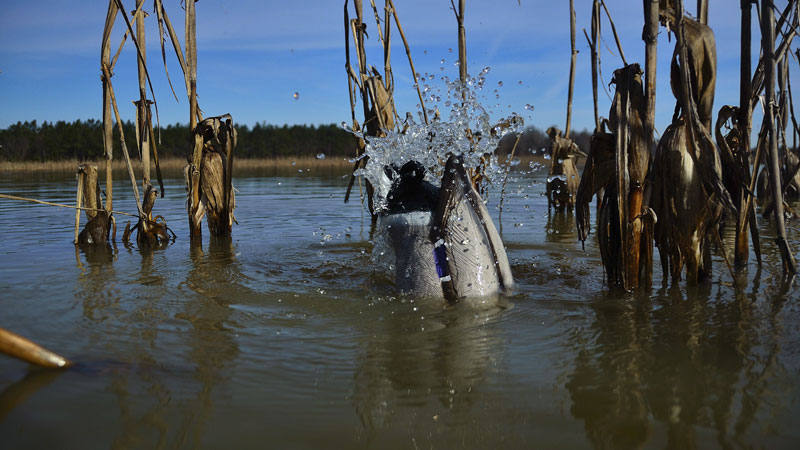
Hunters can fill up all kinds of space with the implements involved in waterfowl hunting, but what’s really important? Not nearly as much as you’d think.
Every serious hobby can generate enough gear to fill up a shed, garage or a spare bedroom — every type of tool to make success more achievable.
Duck season draws hunters from all walks of life, and they are far from immune to this syndrome. What is considered necessary equipment to one and maybe a gimmick to others?

Some items are required to take down a limit of ducks, and some items can surely make the task more streamlined. And then you have some items that are more beneficial to the companies selling them rather than being good to the consumer trying to bring a flock of greenheads into shotgun range.

Duck hunters need the basics to take down a limit of ducks:
A capable weapon, necessary licenses and permits and non-toxic loads are the absolute minimum. In some situations, it’s all that is needed to get some birds in the bag. Unfortunately, these unique situations aren’t too available for most people and on most properties. Ducks are semi-aquatic species that feed, rest and loaf in an inundated environment. And with ultra-keen senses and the eyes of an eagle, ducks often require hunters to have some level of specialized equipment to get the job done.
Many hunters who love the sport often hire a guide or outfitter to take them to their blinds or in their specialized duck boats. For a little money, these hunters can be put into the right situations with all the right equipment, and if the birds cooperate and the shooters are good, they can head back home with a limit of birds and even more precious memories to treasure. But other hunters choose to find the right places on their own and buy their own equipment to get the job done.
Bradford Howell of Surfside Beach, S.C., isn’t a hunting guide nor an outfitter, but he sure could be. For more than a decade, he has chased these winged migrants over 10 states and in all four major flyways across North America.
After putting in a ton of hours each year, sometimes hunting 50 days out of a 60-day season, Howell takes a dynamic approach to perfecting his duck-hunting tactics.
“I put a lot of time into scouting, and I am a firm believer in matching the hatch,” Howell said. “If you scout it, replicate it the best that you can with good decoys.”
Ducks can be lured into a place that looks similar to places they visited the day before, and ducks sure like company, because it lets them know the spot looks like a safe place to drop their feet and eat.
“If you see 20 mallards in a hole the day you scout it, replicate it the best as possible in any situation,” he said.
Decoys are a duck hunters’ best friend and a must-have for hunters attempting to lure birds into a specific spot, but not all decoys are created equal. Howell said motion decoys are critical in any decoy spread and are the most-important factor when he arranges his decoys.
“Make sure to have water movement, a flutter on the water, or spinning wings of some sort. You need something to catch their eye when they are coming in from afar,” Howell said.
Thirty years ago, hunters relied on the wind to blow decoys around, but the wind doesn’t always cooperate at the right time, and a jerk string or a battery-powered device may just do the trick.
Motion decoys come in wide variety of flavors, from traditional spinning-wing decoys and shakers to full-fledged water thrashers. Regardless, something is needed to incorporate into the decoy spread to grab the duck’s attention from afar and lure them into shooting range.
Another must-have piece of equipment Howell recommends is a good duck call or a good lanyard fillled with duck calls.
“Unfortunately, there isn’t a perfect formula for calling in ducks. Each day has its own technique. I listen to the ducks, and some days you have to scream at them, and other days you have to sweet-talk them,” Howell said.
Hugh McLaurin of Big Lake Outdoor Products in Elloree, S.C., knows just about everything about calling duck and making duck calls. For 15 years, McLaurin has made and sold duck calls all over the United States.
“Calls can certainly be overused and abused,” McLaurin said. “The call is the greatest conservation tool ever invented. They have scared more ducks and kept them from getting shot than any item in the hunter’s tool bag. But when used correctly, they can bring them right to you.”
In most situations, a good duck call is necessary, because the ducks don’t always see the decoys, or sometimes they need a little encouragement to know that it’s okay to come down and join the crowd in the festivities.

“Ducks in flight are looking for food, fellowship and safety — a good place to congregate, just like people. Ducks aren’t too much different than people in that respect,” said McLaurin, who uses a wide array of calls and vocalizations to pull ducks into range. He will use the hail call, soft feeding chuckles, the comeback call and others that mimic ducks in their natural environment. And he will use calls that sound like mallards, pintails, gadwalls, wood ducks, teal and others. But for McLaurin, a solid mallard call is hard to avoid having in his tool bag.
“About every duck will respond to a mallard call. Mallards are almost always associated with other ducks, which is why the mallard call can be so productive to have on your lanyard,” McLaurin said.
Knowing how to use calls can make a big difference. As easily as they bring ducks in, they can scare them away. Primarily, McLaurin calls to ducks when they are flying away from him, but he will give soft, feeding ticks when the ducks are coming in.
“The decoys are the No. 1 attractor, but I will encourage them with some soft calling as they approach. But other times I have to call very aggressively to get them to commit,” said McLaurin, who brings a full lanyard of calls to the duck blind, his favorite being his T-Rex Double Reed. It utilizes a dimpled, stainless-steel reed and is extremely versatile, which can be real benefit when calling to ducks in full camo and reaching for a call.
“The stainless reed makes it so raspy, and it is easy to blow for anybody if you are calling loud with a hail call to soft feeding ticks. It’s just the perfect call,” McLaurin said.
Hunting is one of those hobbies that appeals to a wide range of companies that can successfully sell products to its target audience. And out of every type of hunting opportunity available, duck hunters are subject to every gimmick imaginable. But some of these tools of the trade are far from gimmicks and truly flatten the curve.

Don’t you move!
Ducks are some of God’s creatures that received excellent vision, a factor that keeps the species sustainable. Keen vision has enabled many ducks to live another day, and duck hunters have to prevent these little feathered migrants from seeing them to have any measure of success.
Ducks and all wild populations of game utilize their senses to avoid predation and any dangers on and above the ground. Since ducks have such great vision, hunters must up their game to make sure they stay invisible to their prey.
The first method to stay hidden is to blend into the surroundings with a full covering of camouflage. Camouflage is one of the largest components of the hunting industry, with every type of pattern available, yet something that is equally important as camouflage and possibly more important comes in a different set of color palates.
“Camouflage is important for duck hunting, but the best thing you can do is sit still,” veteran hunter Bradford Howell said. “If you can be still, you can be in a solid or pattern color and still get ducks to come in.”
Ducks pick up on movement, and hunters need to avoid being seen if wearing full camouflage or in a solid olive drab.

Be the first to comment