

One of my pet peeves is with fishermen who release fish, but handle them so poorly the fish are often injured and may not survive. When this happens, those fish weren’t actually released; they were simply thrown back over the side.
Hopefully, this got your attention but didn’t raise the hair on the back of your neck to the point you are defensive and won’t listen.
In our current time of increased fishing activity and more stringent regulations, there are many times a fish must be released. They could be too small, too large, an ineligible species or a fish caught during a closed season. Fishermen may choose to release fish for other reasons, too. The bottom line is, more fish will require being released, and fishermen need to release them in a way to best insure their survival.
I don’t believe fishermen handle fish poorly because they don’t care. I believe it is simply from not knowing the physiology of the fish and that there are good and bad ways to handle them to help ensure their survival after being released.
Prime time for a fish being injured is when handling and releasing big fish. They are heavy and often slimy, and there aren’t any handles. The one spot fishermen see to grab them is in the mouth. This can be by hand on species that aren’t toothy and with fish grips or lip gaffs on the species with sharp choppers. Grabbing these fish by the jaw or in the mouth is not bad in itself, and it’s actually a pretty good way to handle them if they aren’t being removed from the water.
However, big fish are often injured when they’re being removed from the water. Think about those photos you’ve seen of tarpon or red drum hanging from a lip grip or lip gaff. This is not good for the fish at all! All the pressure and all the fish’s weight is lifted by the lower jaw.
Fish have tendons and ligaments that run from their jaws and connect through the gills to their bodies. Lifting big fish so they are bearing their entire weight on their mouth or jaw often strains these tendons and ligaments, and sometimes, they even break or detach.
A fish with broken or detached tendons and ligaments in its mouth, jaws and/or gills has usually been given a death sentence. They have problems using their gills to filter oxygen from the water, catching and chewing food and even swimming. Sometimes, the fish survives long enough for the damage to heal — and sometime it doesn’t.
Another thing that happens when big fish are lifted out of the water is they are dragged across the transom or gunwale and the slime coating on their bodies is scraped off. This slime coating is a protection, and without it, fish is subject to infections and parasites it would have normally resisted.
Dragging big fish across the transom or gunwale also injures them. It could be as simple as bruising flank or stomach muscles or as complex as tearing filaments, tendons and ligaments that hold internal organs in place. Fish are built to be freely suspended in water, with even pressure all around. When lifted from the water, the internal organs tend to shift to the lowest spot in the body cavity, and this creates strains and ruptures. The resulting injuries could be minor, but also could bruise or otherwise damage the internal organs to the point of ceasing to function.
The best way to handle fish to insure their survival after release is to not remove them from the water. If the hook is in a location to be easily removed, then remove the hook, revive the fish and send it on its way. If the hook is not in a position to be easily removed, cut the leader as close as possible to the fish’s mouth and don’t risk damaging it to remove the hook. Fish survive surprisingly well with imbedded hooks, and many times the strong stomach acid breaks down the hook and allows it to be expelled or passed.
When a fish must be handled before being released, the proper way it is to support it from underneath. George Beckwith of Down East Guide Service (www.pamlicoguide.com), a marine biologist by trade who has done red drum survival studies for the N.C. Division of Marine Fisheries, always cradles larger red drum that are removed from the water. He said their stomach area needs to be supported, and the larger the fish, the more important it is.
Beckwith said another thing to avoid is holding big fish by their gill covers — as was once popular for pictures of big drum. This damages the gill covers and the muscles and tendons that work the gills. Beckwith’s studies have shown that properly handled red drum have a very high survival rate after release, but poor handling adversely affects them.
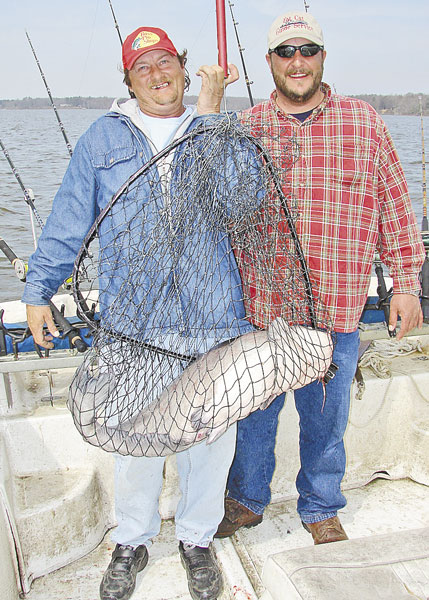
Virginians Joe Hecht (www.fatcatguide.com) and Chris Eberwein (www.catfishingva.com) lead their customers to a lot of very large catfish on the James River near Richmond. They release all catfish heavier than 20 pounds and prefer to keep only those less than 10 pounds to eat. While catfish have a rugged reputation, Hecht and Eberwein know the large fish they are releasing are the prime brood stock and take special care not to injure them.
To get measurements and weight so their customers can receive citations, they must remove the fish from the water. They use large nets to support the fish and remove the handle to weigh the fish in the nets. Once the fish has been weighed and released, they weigh the net and subtract its weight to get the actual weight of the fish. This idea will work for any fish that will be released and is very simple to do. I have used it for puppy drum and cobia, and it works very well to support the fish, plus, it reduces them flapping about and makes handling them so much easier.
Eberwein and Hecht also use circle hook rigs to avoid deep-hooking the fish and having to struggle to remove a hook.
One final tip for reviving fish before releasing them. Many folks like to swish fish back and forth in the water. This may be easy for the fishermen, but fish don’t have a reverse gear, and their gills don’t work when going backwards. Turn the fish into the current, cradle it under the belly and move its tail from side to side to get it going. If there is no current, moving forward with the trolling motor will have the same effect.
I salute fishermen who release fish they do not plan to eat. Handling fish properly can make the difference between a successful release and merely throwing them back. Hopefully, this gives a little insight into ways you can help insure released fish survive to keep the species going and thrill other fishermen at a later date.

Be the first to comment