

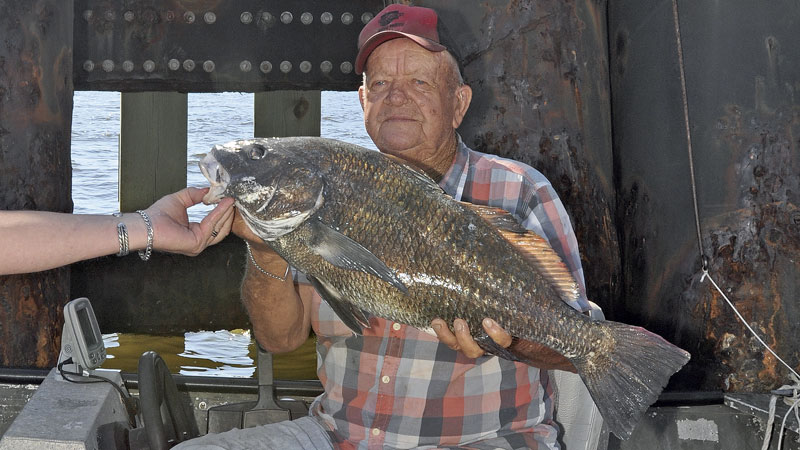
Black drum shouldn’t be considered second-rate
Capt. Jot Owens (910-233-4139) was dropping baits for sheepshead near the pilings of a bridge at Wrightsville Beach, NC when he felt a strike. Having grown up fishing the area and taken anglers fishing as a guide for 25 years, he knew his fish.
“It’s fighting so hard, it’s bound to be a black drum,” he said. “You are always going to catch some when you are fishing for other species at structure. We are fishing for sheepshead, and black drum like the same baits and stay in the same places. Anywhere you find oyster shells, black drum are going to be there.”
The black drum is the unsung drum. After all, there is no dedicated tournament circuit for them as there is for the red drum. They do not hit topwater lures and only occasionally take a fly. But what they do not have in the sportiest-of-fish department, they make up for in other ways.
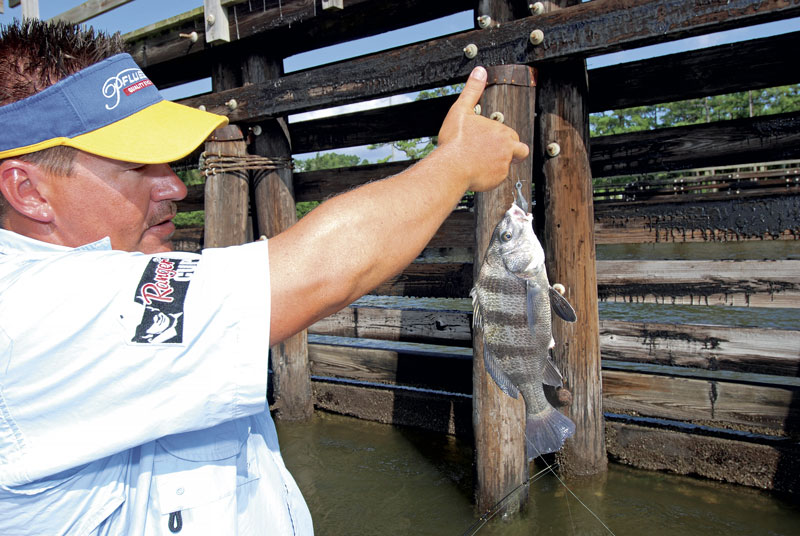
“An 18-inch black drum is a good-sized fish around the bridges,” he said. “They are great to eat, but without a lot of meat on them. It’s like catching a gigantic croaker because they are almost all head and ribcage. While they are underrated, I would rate a black drum an 8 or 9 on a scale of 1 to 10 in the taste and texture department. As far as fighting ability, I would rate it just below a red drum at a 7. As far as quantity, I have to give black drum a 5 or 6.”
Owens said that black drum are not as abundant at Wrightsville Beach as they were in the past. He blames fewer occurrences of dark water.
“It’s not that you aren’t going to catch them,” he said. “It’s just that if you want to target them consistently, you should move to water stained with tannic colors consistently like the Cape Fear River. The area from Carolina Beach to Bald Head to Wilmington is where you are going to find them in abundance.”
Happy accidents
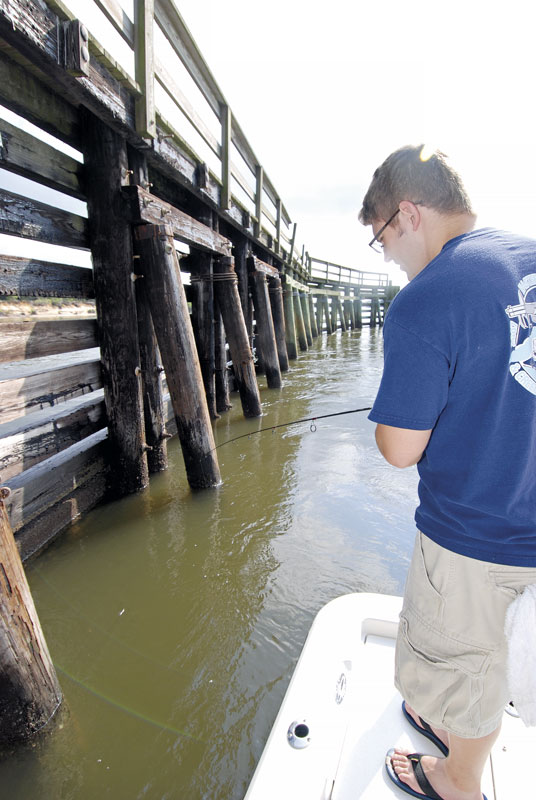
He locates them quite often when he is speckled trout fishing. Black drum attack live shrimp and fresh cut shrimp fished above and beside oyster beds, along rock outcrops, at seawalls, mooring docks, pilings, navigation markers and other structure. They hit baits fished on float rigs or Carolina rigs.
If several black drum are boated, most anglers are only too happy to forgo trying to catch speckled trout for a while, until they have loaded up the live well with enough black drum to take home to eat, or until they are tired catching and releasing them and want to move on to find more trout.
“I stay away from the best-known places like Snow’s Cut Bridge, the ADM Dock, the Dow Ethyl Plant and the Quarantine Station, because they get fished to death,” he said. “Instead, I look for the smaller, out-of-the-way structure, especially structure that is not manmade. They might be around a pier, though, if it is along the same type of structure in a high current flow area. On low tide, you can see the rocks and ledges almost anywhere you can point. Any place where there is something that breaks a strong current is a good spot to fish. They travel along in the current and concentrate at the ledges created by hard structure. If there are oysters, black drum are going to be concentrated in that area. In Snow’s cut, for instance, you can fish that type of structure from the bank. Bank anglers catch plenty of black drum around the rocks.”
Owens’ go-to baits are fresh cut shrimp, live shrimp and fiddler crabs. These are the same baits he uses for sheepshead and speckled trout. Black drum will sometimes strike soft plastics and live or cut fish. But they are much more likely to strike fresh crustaceans.
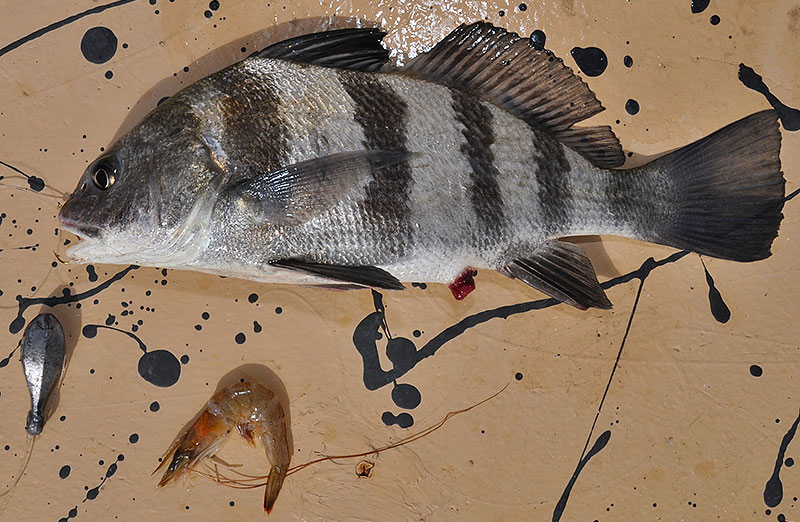
He fishes from a 22-foot Ranger bay boat, which can cover a lot of water, including rough water when necessary. Fishing the river on a windy day along with the long run from Wrightsville Beach can make for a rough-and-tumble trip. He fishes with a 7-foot Fenwick HMG Inshore medium spinning rod with a 2500 Penn Slammer IV reel with a minimum of 15-pound test braid. He lands fish with a rubber mesh net because it prevents tackle tangles and makes it easier on fish that are released.
“When I am fishing black drum structure, I try to position the boat up current and anchor or set the Power Pole down,” he said. “I don’t use the Spot Lock feature on the Minn Kota trolling motor because the fish are becoming leery of that humming motor in shallow water. But it doesn’t seem to bother them if the water depth is at least 6 feet. So I use it when the fish are in deeper water.”
Check the piers
In South Carolina, anglers will find black drum in the same types of places. The Little River Inlet jetties are similar to the Masonboro Inlet jetties in their ability to hold black drum. And the backwater structure areas of the coast offer similar habitat to the Cape Fear. However, anglers who have no access to boats, or anglers in general, overlook how productive the black drum fishing can be at the ocean piers in both states.
Scott Sheldon, who has worked at Apache Pier (843-497-6486) a half-decade, said any angler who catches a keeper black drum carries a smile along with his fish when walking the planks to the scales.
“I like fishing for them and so does every other bottom fisherman at the pier,” Shedon said. “Most of the time, a fisherman is fishing with shrimp on a 2-hook bottom rig or a flounder rig when they catch a black drum.
Hurricane Ian damaged several piers, including massive destruction at Cherry Grove Pier, in Sept. 2022. However, there is still plenty of room to fish for black drum at Apache Pier and other piers.
Sheldon said near the entertainment center, which is right over the surf zone is a top destination. “The best spot at Entertainment Center is right in front of the breakers,” he said. “You have to move in and out with the tide and keep your bait just offshore of the breakers.
“Another great spot is at the restrooms about three-fourths of the way out along the pier. They like structure, especially the bigger fish. You might catch some smaller fish by casting out and away from the pier. But the biggest ones are caught right under the pier, in the same places where the red drum like to bite. That means you are fishing straight down beneath the pier around the pilings.”
Get the net
The really good runs of the smaller black drum begin in April and May, then taper off by the end of June. However, anglers might catch black drum during any month. The choppier conditions are usually the best for catching black drum. However, they will hit whether the water is dirty or clear and in almost any water temperature.
The best baits are shrimp, barnacles, and fiddler crabs. The best rig to use is a 7-foot spinning rod with 20- to 30-pound test mono or 30- to 50-pound test braid. Heavy lines are necessary to haul large fish away from the sharp shells of barnacles and oysters that cover the pilings.
“The sheepshead experts who fish at the bathrooms also catch a lot of black drum,” he said. “They scrape barnacles off pilings and tie them on their hooks. Black drum like them just as well as the sheepshead do. I have seen them catch black drum that weigh 12 to 15 pounds that are so big that they need a drop net to lift them from the water.
“You can lift a 7- or 8-pounder on 20- or 30-pound test monofilament line. But you have to use a drop net with fish that are heavier than that, or they will break off and get away. We have a drop net for anglers to use at the entertainment center and another one at the bathrooms. But really dedicated black drum anglers bring their own drop nets in case they have to rush to use one of ours and it happens to be missing. Someone else may be using it and sometimes, the nets just disappear. Not having a drop net in those few seconds when it’s needed is a discouraging way to lose such a nice fish as a big black drum.”
Terminal Tackle Determines Success
Black drum are landed on many different types of terminal tackle. Their habit of doggedly digging for the deep means line constantly contacts shell-covered structure. So using 30- to 50-pound leaders with heavy monofilament and braided lines is a given.
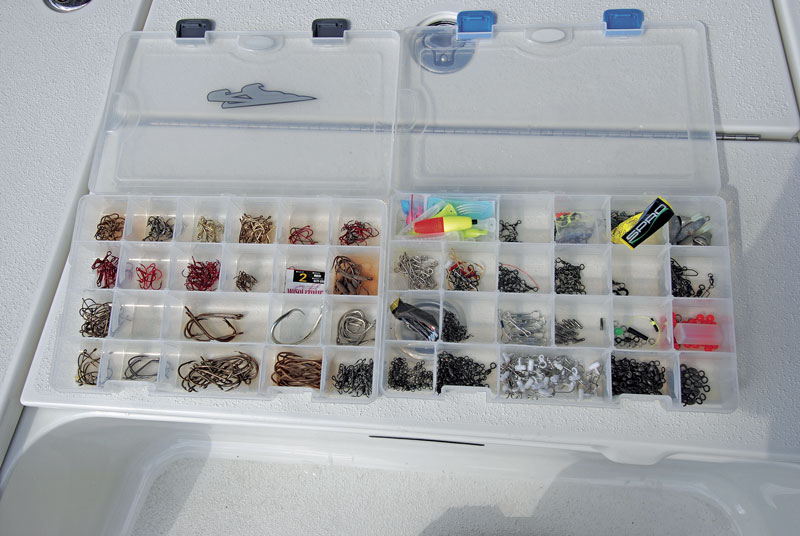
Anglers should check their lines, leaders, knots and terminal tackle every time the rig is snagged on the structure or after every fish is landed to be sure of no nicks or other damage that will eventually result in a lost fish. Black drum can reach impressive weights and put up a hard fight.
Float rigs and Carolina rigs (flounder rigs) and 2-hook bottom rigs (chicken rigs or spot and croaker rigs) should have heavy hooks and leaders, with No. 2 or 2/0 through 5 and 5/0 Kahle, wide bend or wide gap hooks much better choices than small treble hooks or light wire hooks. The anticipated size of the fish dictates the hook size. Many anglers also use jigs, with or without floats. All jigs should also have strong hooks.
One jig that has taken the black drum and sheepshead world by storm is First Flight Lures NC Treat jig. Owens said the ¾-ounce size NC Treat is his favorite jig for catching sheepshead and black drum because the hook pivots on the jig head, allowing the bait to rest naturally on the bottom.

Be the first to comment