

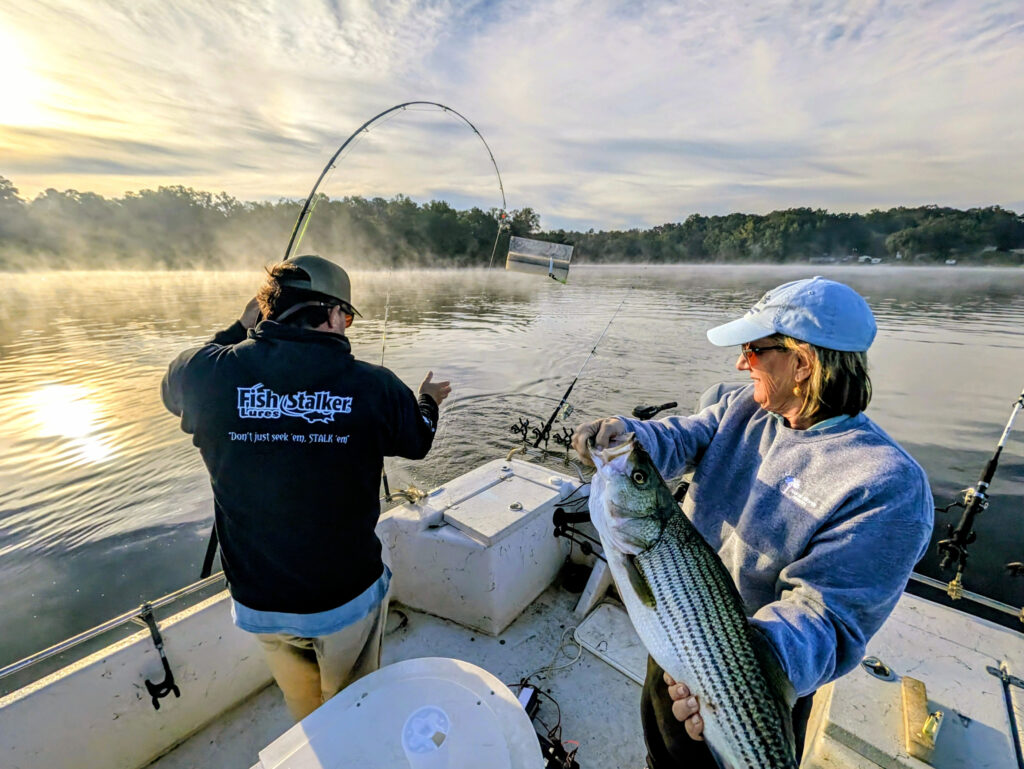
Capt. Daniel Skipper shows the way
Cool fall mornings just before dawn are my favorite time to chase stripers. Pair that with a lake that has been stocked with striped bass for 80 years and your odds of success are high. You’ll greet dawn feeling like you’re in the piscatorial Garden of Eden.
I know this because I recently had the chance to striper fish this specific lake: Lake Greenwood, on the outskirts of beautiful, historic Greenwood, SC.
The South Carolina Outdoor Press (SCOPE) held its annual Conference in Greenwood in October, and outdoor communicators took the opportunity to explore this fishery.
With striper guide Capt. Daniel Skipper at the helm, we experienced aggressive bites, screaming drags, and adults squealing like joyous kids. All before the magical moments of sunrise.
We felt like happy kids, too. Hookups were fast-paced. We enjoyed these powerful fish at their fall best, forcing us to bow our backs, straining to hold our footing, while gripping horseshoe-shaped rods bent three eyes deep in the water.
The scenario was entirely appropriate because Skipper’s (864-430-0488) business is named Three Eyes Deep Guide Service.
Just the start
Skipper said our October trip was at the start of the prime fall season because as water temperatures drop into the 70s and 60s the action continues to improve. The best is yet to come as November and December are exciting, fast-paced fishing months for stripers.
“The stripers and forage are reacting to the falling water temperatures after a long, hot, dry summer,” Skipper said. “The shad are wandering in tightly-packed pods, and the stripers are hunting and foraging on the shad. The fishing is good now, and we’re catching quality fish along with the quantity we saw this morning. But these fishing patterns will improve, and by Thanksgiving, we’ll be reaching a seasonal peak that carries through December.”
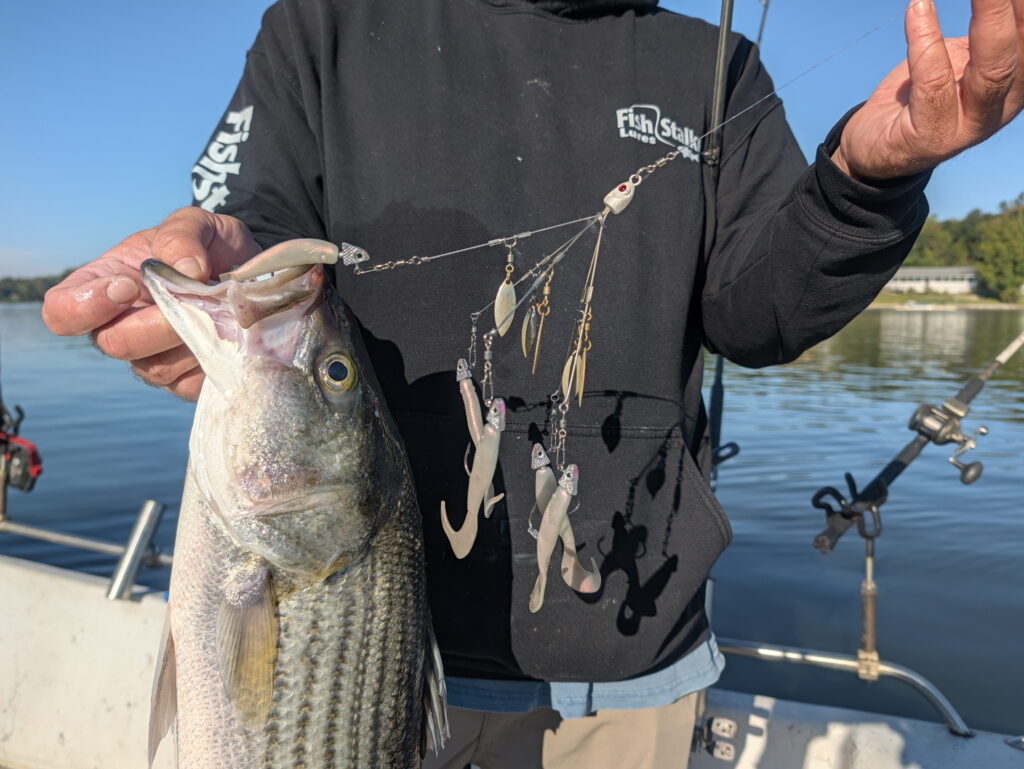
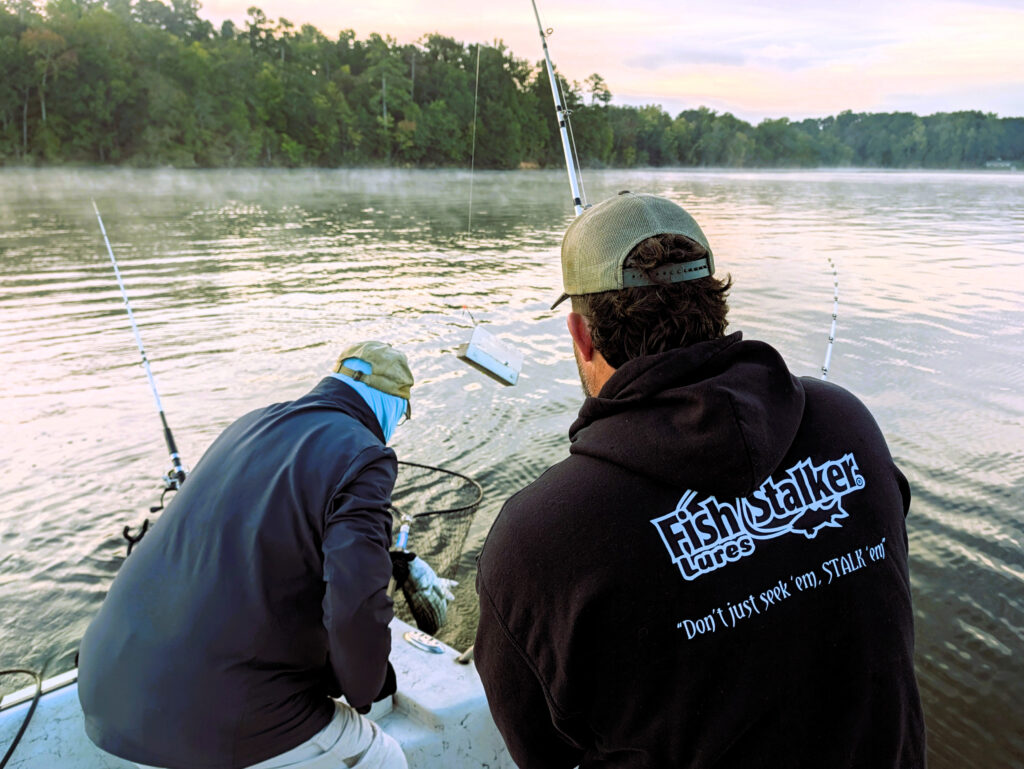
We used the proven tactic of freelines out the back of the boat, along with two planer boards off each side, all baited with frisky blueback herring. The herring are available locally at the tackle shop at the Hwy. 72 Bridge. Later, as the water cools, Skipper begins pulling umbrella rigs to work areas quickly and effectively as scattered schools of forage and fish consolidate into larger packs.
Year-round fishery
Skipper said fishing is generally good for stripers most of the year, and anglers can make good catches almost anytime, especially with live bait. In late fall, topwater schooling and “surface swirling” make artificial lures effective, with bucktails often the best choice.
Spring fishing heats up in March and April as water temperatures rise and stripers attempt to spawn, forming predictable patterns for experienced anglers.
Skipper said that after spawning, stripers return downstream, congregating in large schools along channel ledges and humps in the main lake. In this pattern, fishing success depends on using electronics to locate big schools of forage and fish.
“During May and June, the fishing can be off the charts sensational,” he said. “It’s a situation where we may hook and land multiple limits of fish within a two- or three-hour window early in the morning. And that’s fast-paced fishing. The trips may be shorter, but the action is sometimes non-stop, fun-filled chaos until limits are in the box.”
Mid-winter and mid-summer are traditionally slower, although the fishing can still be good. These extremes of water temperature, low and high, are less conducive to fast-paced fishing because of stressful environmental conditions. As Skipper said, these extremes also affect anglers.
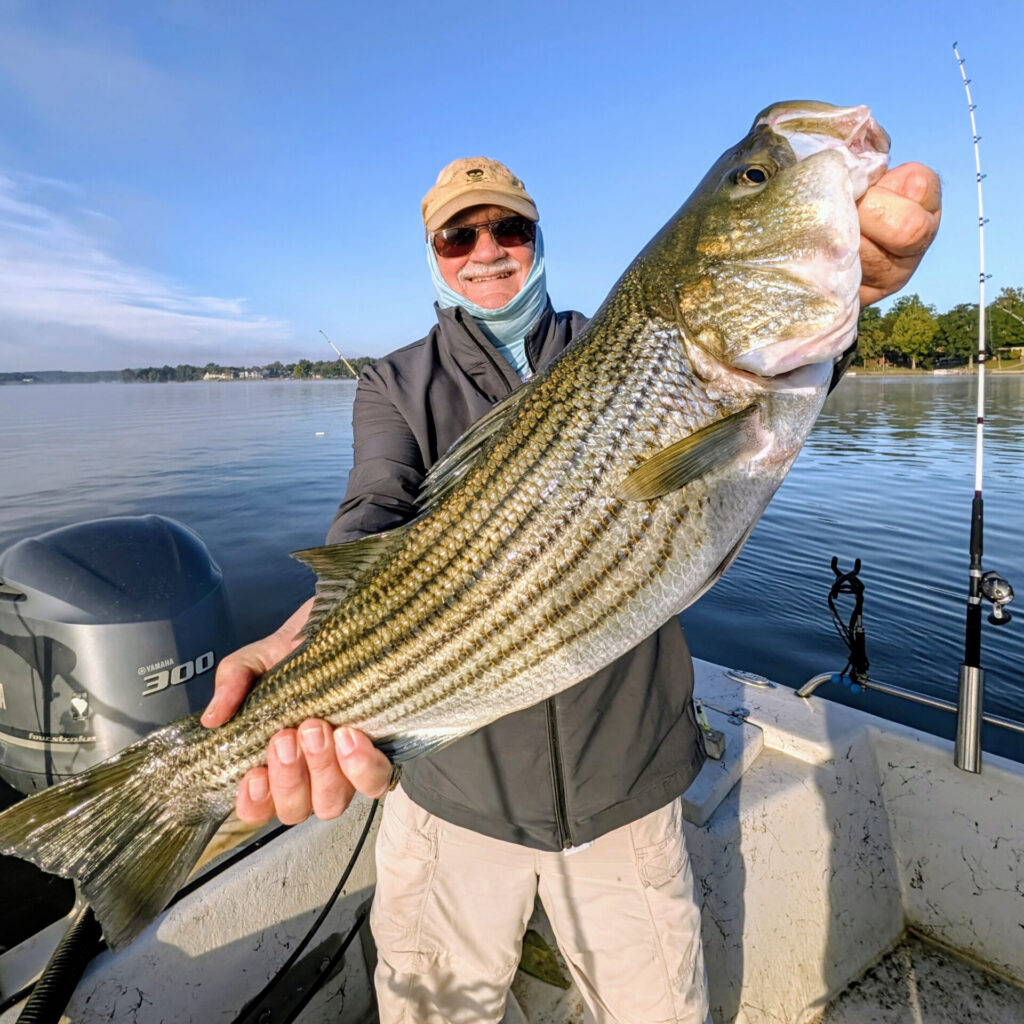
Many anglers may have heard that stripers are available in Lake Greenwood, but few know how sensational the fishing can be. While our fishing was excellent, it was not peak time. We caught plenty of stripers in the 25- to 30-inch class, along with multiple smaller, frisky fish. And of course, we had the obligatory “big one that got away” hooked for a couple of minutes.
Quality and quantity
Lake Greenwood has a 10-striper limit per person with no size limits year-round. Skipper wouldn’t have been surprised if someone caught significantly larger stripers that day, because he’d boated one that pulled the scales to more than 20 pounds just a few days earlier.
“We have quality stripers in Lake Greenwood, and just as importantly, we have strong age classes of diverse sizes,” he said. “The potential for trophies is real and so are the opportunities for fast-paced action.”
This healthy fishery has deep roots, and Amy Chastain, Region 1 Fisheries Assistant Coordinator/Biologist for the SCDNR, said detailed records confirm consistent stocking in Lake Greenwood for decades.
“The first record of stocking striped bass was from 1955,” Chastain said. “Stocking in the early years consisted of fry, fingerlings, and adults, and the source fish came from the Santee-Cooper system.”
Chastain said Lake Greenwood’s striper population is strictly a put-grow-take system, and while no natural reproduction occurs, they do attempt to spawn, but successful freshwater striper spawning conditions are rigid and don’t exist here.
She said the stocking goal for Lake Greenwood is 12.5 striped bass/acre annually (142,500 fingerlings on average), and as hatchery production allows, surplus fingerlings are added, occasionally bumping the average to 14.5/acre.
In addition to stripers, the crappie, catfish, and black bass all provide excellent fishing. And as Skipper explained, when pulling live bait, all of these species are in play. Our SC outdoor writers/media group conducts an internal “bragging rights” fishing contest, and Skipper’s boat provided the winning striper, catfish, and black bass.
Lake Greenwood is a keeper in my fishing world. ■

Be the first to comment