

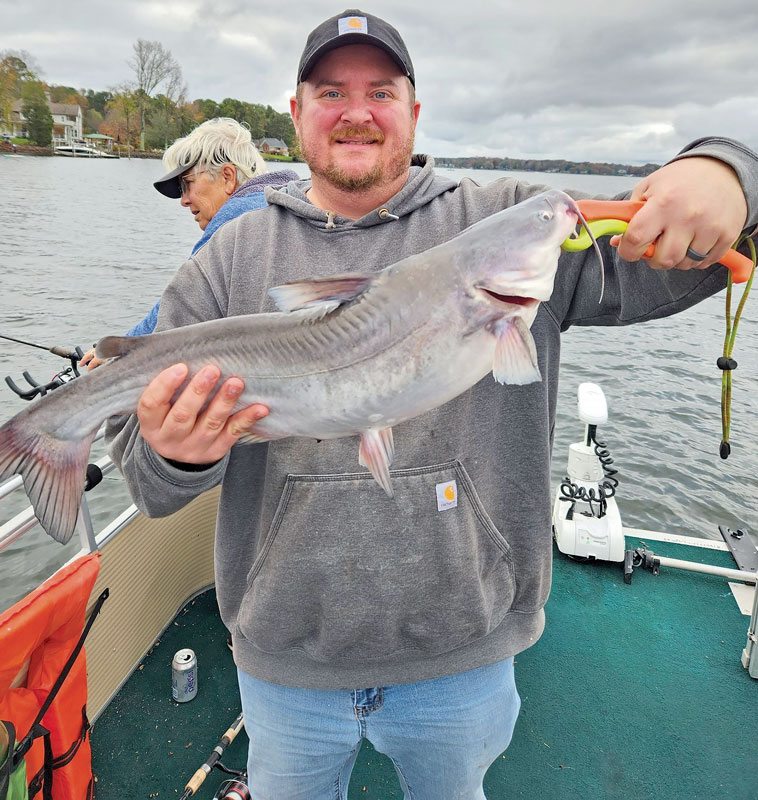
Winter’s chill doesn’t stop catfish from biting
The Yadkin River Chain of Lakes are known for their good fishing, and Capt. Butch Foster and his wife (and First-Mate) Barbara are some of the best at building that reputation. The Fosters operate Captain Butch and Barbara’s Fishing Adventures, and they specialize in catching catfish, crappie and stripers on the lakes of the Yadkin River System. This is a division of Yeah Right Fishing Charters (www.yeahrightcharters.com, 336-309-5900). On this trip, they were tested to the limit. Warm temperatures had taken a nosedive to below freezing and chilled the water by 9 degrees in two days. Brr!
A late-season cold front bulldozed its way into North Carolina’s Piedmont two nights earlier and brought the deep freeze with it. Capt. Butch suggested meeting for breakfast to give the sun an opportunity to break the deep chill before heading out. A brisk wind intensified the cold, and he may have been trying to warm the fishermen as much as the fish.
Capt. Butch said Tuckertown Reservoir was generating that morning, and he would begin the day there, since moving water is a key to catching catfish. The Yadkin River Chain lakes are all man-made impounded lakes, created to produce hydroelectric power to run aluminum plants.
Cold weather, small crowds
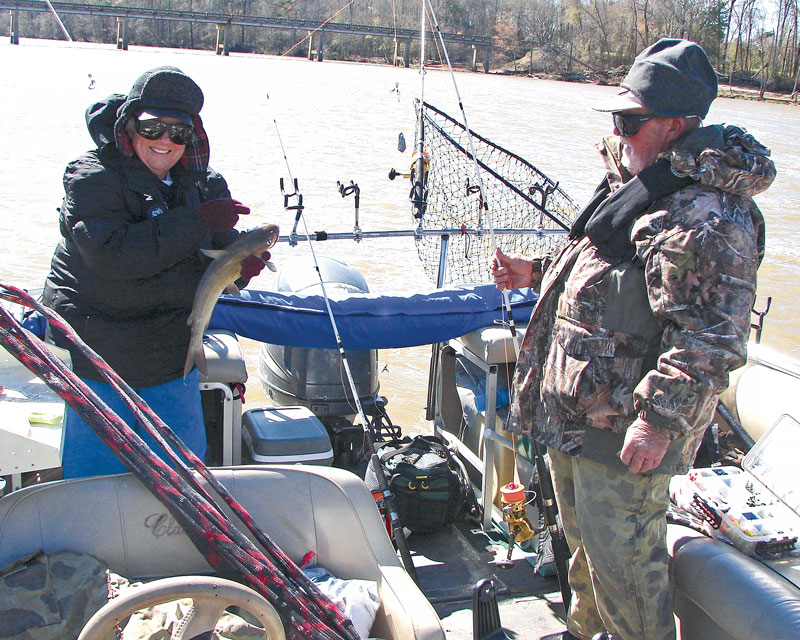
Tuckertown was in generation stage, but Capt. Butch’s rig was the only boat at what is typically a fairly busy ramp. With no crowd, launch went quickly and smoothly and he was soon motoring into the tailwaters of the dam. Capt. Butch deftly maneuvered his boat into a position where he had caught fish a few days earlier and slipped over the bow anchor. The current was pretty swift and the anchor didn’t grab well on the first try, but locked up solid on the second attempt. He added a second anchor from the stern to hold the boat steady.
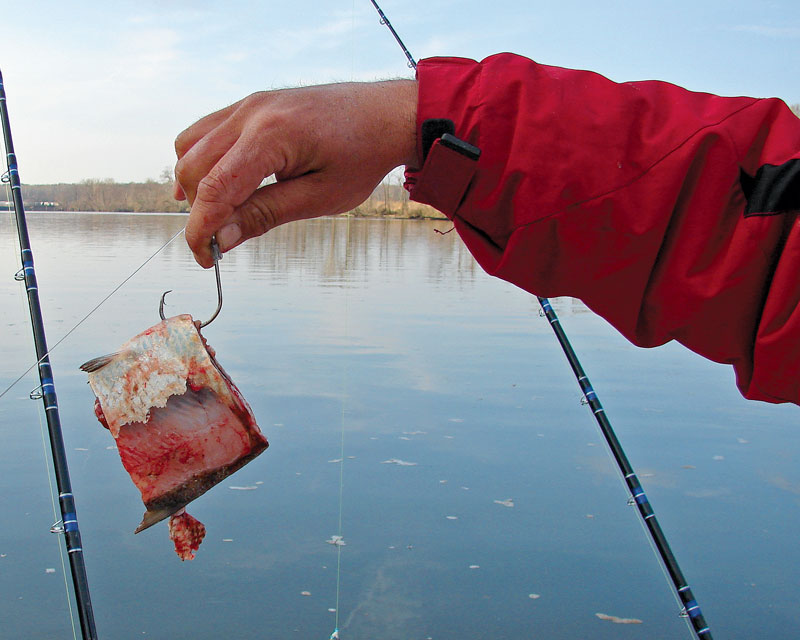
This was a 24-foot pontoon boat that Capt. Butch had set up for fishing. It has livewells, storage, a potty enclosure, a top and even a heater – which was very welcome this morning. Once the anchor lines had been adjusted and the boat settled in, Barbara placed fishing outfits along the rails and broke out chunks of bream, crappie, perch and gizzard shad for bait. She and Capt. Butch baited the hooks and cast the rigs to different points beside and downstream of the boat.
“Catfish are carnivorous, but almost omnivores,” Capt. Butch explained. “They eat every species of fish found in these lakes and will eat others, plus pieces of chicken and prepared catfish baits. They are scavengers and scour the bottom eating things they find. Flathead cats will sometimes eat chunks of bait, but are usually partial to live baits. Hopefully we’ll find out something likes these pretty quickly.”
It took about 20 minutes for the first rod to go down. Unfortunately, it bounced back up pretty quickly as the fish either didn’t have it well or let go. They waited a few minutes hoping the fish would come back, but it didn’t.
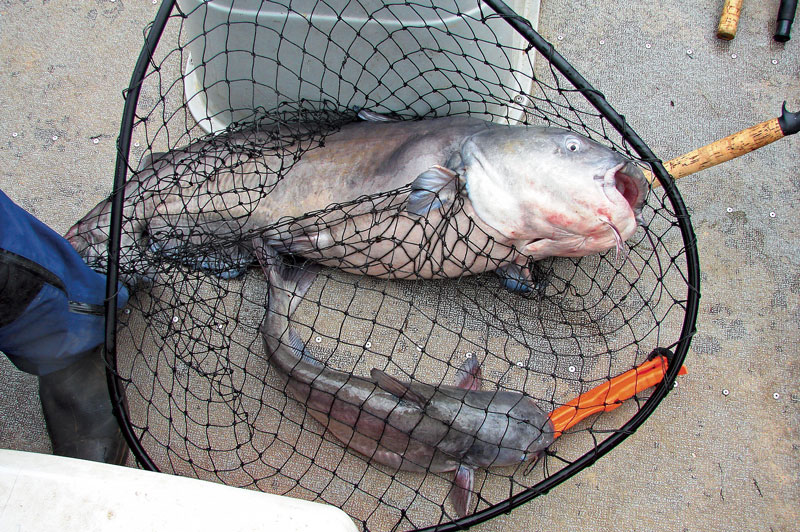
Before Barbara could rebait that rig and cast it back out, another rod bent down. This one was pulsing hard as the circle hook had done its job and hooked solid. Barbara fought the fish to the boat, which was a little more difficult in the briskly flowing water, and when it was close, Capt. Butch swept it up in the landing net. A minute later, he dropped it into the cooler.
“Well, they’re biting a bit,” Capt. Butch said with a smile. “I was hopeful, but concerned about fishing in these conditions. This is a good sign and even warms me up a little.”
Fresh bait is key
Capt. Butch cast out the already baited outfit, then rebaited and cast out the outfit that just scored and poured a cup of coffee before another rod went down. This fish missed on the first strike, but returned in a minute and hooked solid that time. Shortly after, it joined the others in the cooler.
The action continued slow, but fairly steady, with some fish getting hooked and others getting a free meal. Even with the lethargic strikes, the bite was better than expected and catfish were being added to the cooler.
During a mid-morning lull, Capt. Butch explained that this was only one of several ways and locations they target catfish. He said he had definitely been concerned that the sudden intense cold front and rapidly dropping water temps would put the fish off their bite. Apparently, heading to the dam’s tailwaters was the right decision and the catfish were feeding, just slowly.
Capt. Butch said fishing the tailrace allows setting baits in likely locations around the boat so the foraging fish can find them. He said he had also been concerned the sudden cooling water would make the fish lethargic and more inquisitive, instead of biting aggressively. Some half-hearted bites occurred, but many fish committed and were hooked.
He said many days when the weather cooperates, they move to other parts of the lake and the other lakes. Structure is the key, and they sometimes anchor and fish, or sometimes slow-troll with live baits. Flathead catfish typically prefer live baits, and when trolling, the catch may also include stripers and other fish.
Rigging up
Capt. Butch’s typical trolling spread includes baits on downriggers, planers, trolling sinkers, planer boards and the surface. The idea is to cover a wide swath in the water and position baits at different depths in the water column. Capt. Butch also said planer boards could also be used to fine tune the outer edges of an anchored bait spread, as long as current is present.
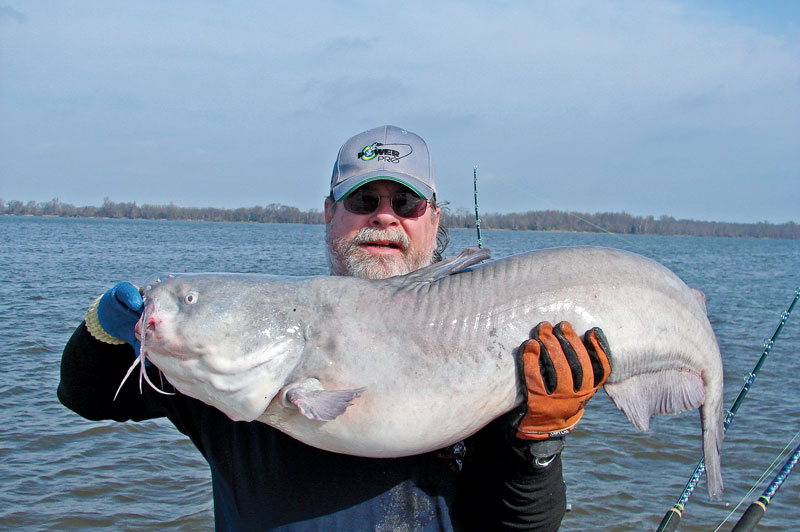
Capt. Butch used three primary rigs for fishing the rocky bottom of the tailrace. He called one a modified Santee Rig and it uses a sliding 11/2- to 3-ounce no-roll weight on the line to the reel, with a 3-foot leader back to a float and either a 5/0 or 9/0 Catt Maxx circle hook. The float holds the bait just off the bottom and makes it easier for the catfish to find it. Another is a Sliding Sinker Rig, which is a fishfinder style rig that uses a sinker slide to attach a coin sinker above a barrel swivel, with a couple of feet of leader back to a circle hook.
His big fish rig is similar and is made to hold a bait closely in place. It uses a lighter line to the sinker, to avoid losing the whole rig if the sinker becomes hung. There is a 3-way swivel between the main line and the leader, with the sinker attached to the third eye.
Even in the extreme conditions of this trip, Captain Butch and Barbara Foster managed to locate and catch catfish. The trip produced catfish fillets for dinner, plus more for the freezer, even though the fishermen convinced them to call it a day early. Aspiring fishermen would do well to pay attention, and booking a charter with them is excellent OJT.
The Yadkin River forms numerous lakes
The Yadkin River begins near the Blue Ridge Parkway in Watauga County, NC and flows through W. Kerr Scott Reservoir, High Rock Lake, Tuckertown Reservoir, Badin Lake, Falls Reservoir and Lake Tillery on its way to becoming the Pee Dee River near Rockingham, NC. It then flows through Blewitt Falls Lake just north of the NC/SC state line. All are man-made lakes, created by damming the river, and all but W. Kerr Scott Reservoir are used to produce hydroelectric power.
The lakes in the Yadkin Lakes Chain generate hydroelectric power for the Yadkin Project and have a combined generating capacity of approximately 215 megawatts. Hydroelectric projects have a long history in NC and, while several other projects have been deemed eligible, the Narrows Dam and powerhouse at Badin Lake is the only NC hydroelectric project listed on the National Register of Historic Places.
High Rock, Tuckertown, Badin, and Falls Lakes and their hydroelectric production were originally managed by Alcoa under contract with the US Government, with oversight by the Federal Energy Regulatory Commission (FERC). The contract with FERC expired in April 2008 and was reviewed after the NC Division of Water Quality revoked their water-quality certificate, which is required to operate power-generating dams along the river. On September 22, 2016, Alcoa received a license to operate until March 31, 2055. The license requires a minimum water level and maintaining a swimming beach for High Rock Lake. The terms of the license also apply to Cube Hydro Carolinas, which purchased the hydroelectric power operations.
Be the first to comment