

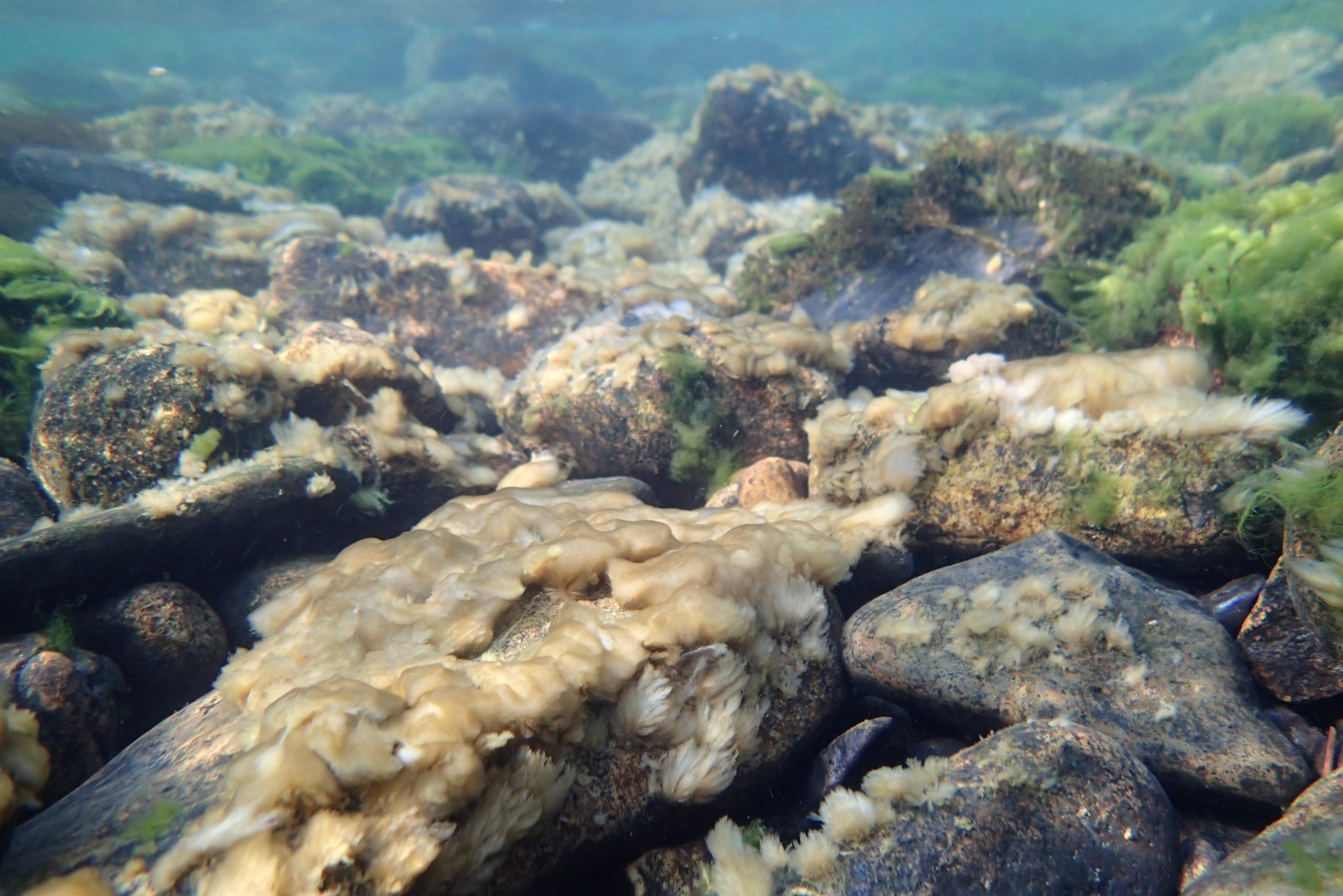
Didymo, or rock snot, sounds funny, but it’s serious business
Something nasty this way comes — to paraphrase novelist Ray Bradbury — an alga called “rock snot” that creates carpet-like mats on stream bottoms, smothering aquatic organisms that trout and other fish depend on for sustenance.
Unlike other algae that thrive in water with high phosphorus levels, didymosyphania geminata, aka didymo, thrives in pristine, freshwater streams that have consistently low temperatures, a low nutrient base and little or no phosphorus. It is so invasive that it can be spread in a single drop of water.
Didymo was discovered in late 2015 in the Tuckasegee River near Whittier in Jackson County and the Holston River in Tennessee by researchers from Tennessee Tech University who were conducting routine surveys of regional streams. Although the organism is widespread in Europe and in the northern United States, it was the first time it has been documented in the Southeast. It has been considered an invasive species only since the 1990s.
Rock snot blooms form on rocky stream beds in thick mats, creating stalks that attach to rocks, plants and submerged debris. The stalks are pale yellow, tan or brown and look like strands of toilet paper trailing in the water. Although didymo looks slimy and a bit like raw sewage, it has no odor, feels like wet wool, and does not disintegrate easily when rubbed between the fingers. Unlike other algae, it contains no chlorophyll. Mats can be as thick as 8 inches and can completely cover a stream bottom. Once established, it can’t be eradicated.
It spreads by attaching to just about anything that it comes in contact with, including watercraft, wading boots, waders, clothing, hooks, flies and other fishing gear. Felt-soled boots are notorious for spreading the organism.
The confirmation of didymo in the Tuckasegee River marks the third time in the past two years that an aquatic nuisance species has been discovered in western North Carolina streams. In December 2014, gill lice were found for the first time in North Carolina on brook trout in the Cullasaja River in Macon County. Another type of gill lice that affects rainbow trout was found in August 2015 in trout from the West Fork of the Pigeon River in Haywood County and the Boone Fork of the Watauga River in Watauga County. In July 2015, whirling disease, a parasite affecting trout, was confirmed for the first time in the state in rainbow trout from the Watauga River near Foscoe in Watauga County.
Gill lice are tiny crustaceans that attach themselves to a trout’s gills, inhibiting the fish’s ability to breathe. Whirling disease is a parasite that causes neurological damage to a fish, causing it to whirl in a corkscrew pattern.
Doug Besler, mountain fisheries supervisor for the N.C. Wildlife Resources Commission, said that while whirling disease can be fatal for some trout, “gill lice may not directly lead to substantial mortalities in trout populations; however, their presence is a stressor that is cumulative over time.
“Each new stressor” he said, “whether it’s drought, high water temperatures or even another aquatic nuisance species, is additive in terms of stress placed on each infected trout, and those stresses can add up to declines in abundance if enough individuals are affected.”
Jacob Rash, the Commission’s cold-water research coordinator, said, “Aquatic nuisance species are organisms that cause ecological and/or economic harm if established. It is important that we all work to help prevent the introduction and spread of these nuisance organisms by being good stewards of our state’s aquatic resources.”
The following procedures are recommended to prevent the spread of nuisance species:
After a fishing trip, remove any visible residue such as mud, plants and other material from boots and waders. Avoid wearing felt-soled boots on any stream that is known to have rock snot. Some northern states have banned felt-soled boots.
Avoid moving to a different stream if there is any danger of nuisance species being in the first stream.
Clean all gear thoroughly, including rod, reels, line, lures, flies, net and anything else that has had contact with water.
Use hot water (at least 140 degrees) and dish-washing detergent to clean gear — two cups of detergent to 2.5 gallons of water. Some gear can be sanitized by cleaning with a mixture of household bleach and water (one cup of bleach to 2.5 gallons of water). If gear is not cleaned, let it dry for at least 48 hours before using again. A less-desirable but effective method of treating gear is to place it in the freezer.
Watercraft also should be thoroughly cleaned and sanitized if it has been used on an infected stream. The craft can be washed using a half-gallon of household bleach in 5 gallons of water. If rinsed just with hot water, let the craft dry for at least five days.
With no known means of eliminating nuisance species, it’s up to trout fishers to help prevent the spread of these threats to our trout streams.

Be the first to comment