

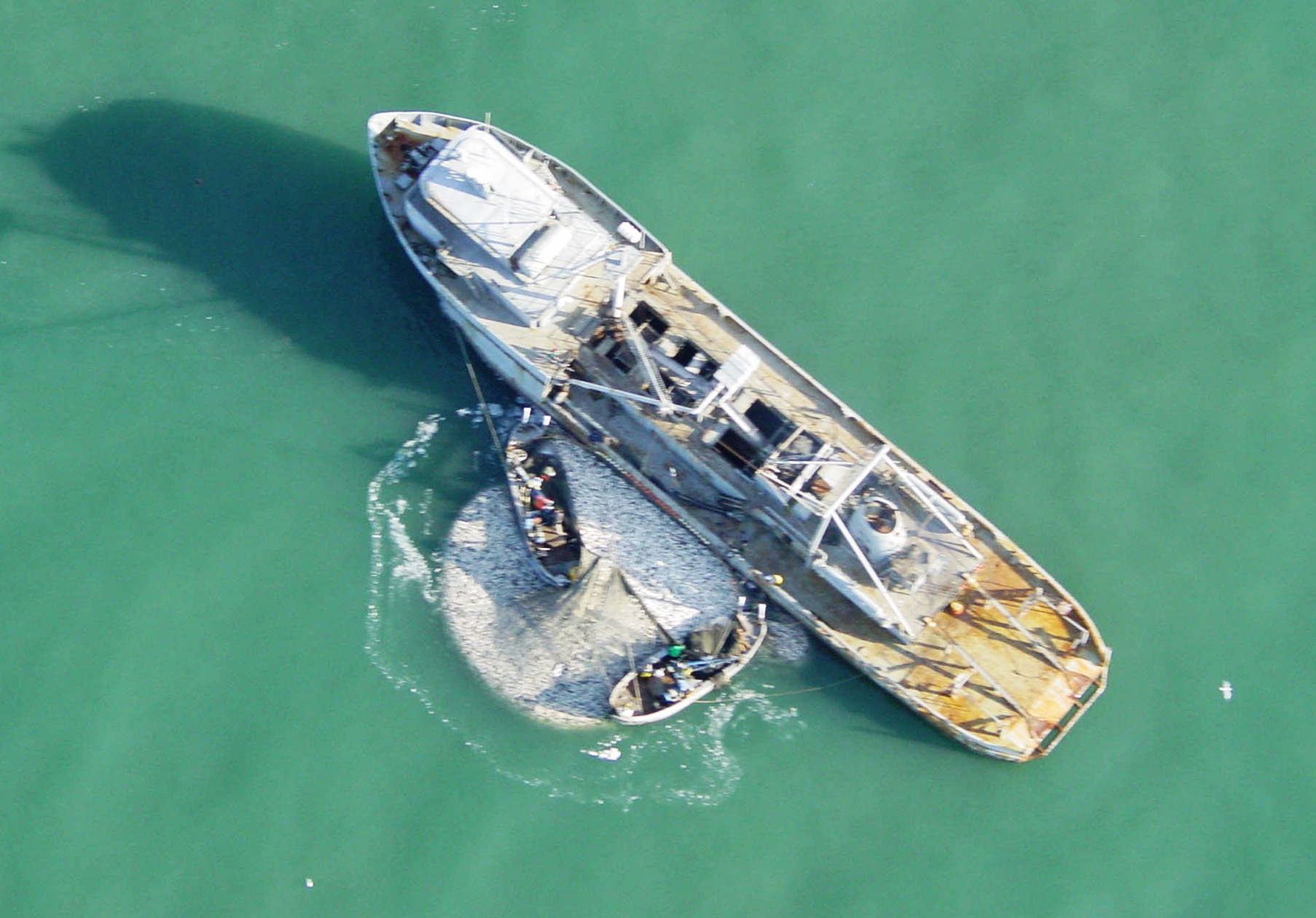
The N.C. Marine Fisheries Commission voted at its May 11 meeting in Atlantic Beach to end the controversial practice of purse-seining for menhaden in North Carolina waters. Menhaden may still be harvested by other means.
Purse seining is the practice of using a pair of “purse” boats to run a net around a school of fish, then connecting the net and “pursing” the bottom closed so no fish can escape. Once the net is pursed, a large hose is lowered into it and the fish are vacuumed into the hold of a mother ship. This technique was used only in North Carolina waters to capture menhaden for the reduction fishery, where the menhaden were cooked and reduced to fish meal and fish oil.
No reduction plants have operated in North Carolina since Beaufort Fisheries closed in 2005. The menhaden boats operating in North Carolina waters are owned and operated by Omega Protein Corporation, based at the company’s plant in Reedville, Va.
The vote to eliminate purse-seining of menhaden was 5-4, with commissioners Anna Beckwith, Rob Bizzell, Chris Elkins, Joe Shute and Darrell Taylor voting in favor. The dissenting votes came from commissioners Mikey Daniels, Allyn Powell, Joe Smith and Bradley Styron. Powell holds the scientist seat on the Commission, while Daniels, Smith and Styron are fish-house owners and commercial fishermen.
“I had no idea this was coming,” said Dr. Louis Daniel, director of the N.C. Division of Marine Fisheries. “I was giving my report on menhaden from the meetings of the Marine Fisheries Legislative Committee and the most-recent meeting of the Atlantic States Marine Fisheries Commission, and someone asked a question. After that question, Commissioner Joe Shute made the motion to stop purse-seining, and it passed on a vote of 5-4. I was stunned. I had told the Commission the (legislature’s) Marine Fisheries Committee was going to recommend to the General Assembly to ban this, but I didn’t expect them to move this quickly.
“The Commissioners directed me to end purse-seining by proclamation, and that will happen soon,” Daniel said. “There are some complicating factors, and we’ll have the lawyers look it over. Once everyone is satisfied, I’ll issue the proclamation.”
Purse-seining has been marked by controversy for years, in part because it traps and kills any fish feeding on targeted schools of menhaden or simply unfortunate enough to be in the same area. Species have ranged from bluefin tuna to king mackerel, stripers and red drum. Critics of purse-seining were particularly enraged in 2009 off Cape Lookout when several boats from Omega Protein encircled a school of large red drum that was feeding on a school of menhaden. The red drum were suffocated when the net was pursed, and when the menhaden were vacuumed into the mother ship, the net was dumped and the reds floated to the surface and washed up dead on Cape Lookout beaches.
Opponents of purse-seining were thrilled by the Commission’s vote.
“We are glad to see the (Commission) take action to help North Carolina fish and fishermen,” said Bill Mandulak, fisheries chairman for the Coastal Conservation Association of North Carolina. “Menhaden are currently at the lowest level of abundance ever recorded. This measure will certainly help North Carolina’s fish stocks and eliminate the wasteful by-catch problems associated with this practice.”
“This is an outstanding action,” said Rube McMullan of Ocean Isle Fishing Center and leader of the citizen movement in Brunswick County that had purse-seining banned from that county’s beaches several years ago. “Bravo for the Marine Fisheries Commission. I salute them for their forward thinking and action on this issue. This should help our menhaden numbers rebound to the levels of years ago, and there will be forage fish for large predators like the bluefin tuna in the winter.”
“The (Commission) should be recognized for taking positive action to help all North Carolina fish stocks,” said Greg Hurt, president of CCA-NC. “We applaud their vote for conservation today.”

Be the first to comment