



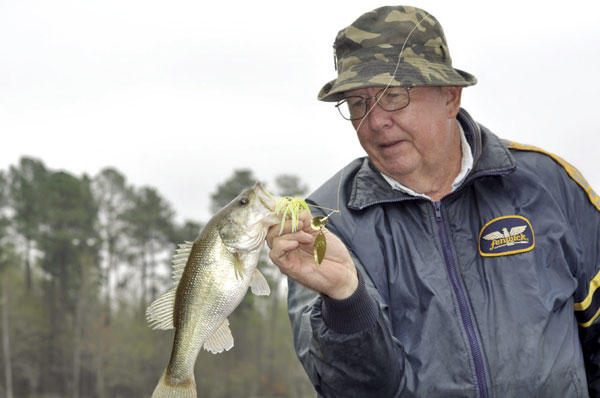
Falls of Neuse Lake offers bass fisherman several option this month.
By June, the largemouth bass spawn has finished at most North Carolina reservoirs — but not entirely at Falls of the Neuse Lake.
Stretching for almost 26 miles and covering 12,410 acres in Granville, Durham and Wake counties, Falls is actually three lakes in June, at least as far as bass fishing is concerned. The spawn occurs at different times along its entire length during the sixth month, probably because of the lake’s changing physical characteristics.
The lower section is mostly narrow and riverine, featuring a series of sharp “S” curves and steep, rocky banks. The middle portion spreads out like a normal lake, with four large feeder creeks. The section upstream of the I-85 bridge is a shallow, stump-filled flat, with the Eno River channel snaking downstream from Lake Michie and flowing through its middle.
The spawn finishes first in the lower, deeper end of the lake, and bass there will be in the postspawn period, suspended off rocky bluffs or on deep channel humps. At mid-lake, bass will be postspawn or nearing postspawn, moving into and out of shallow water. In the shallow flats above I-85, the spawn will often still be in full swing.
So fishermen have choices how and where to target bass on Falls this month.
“June is a transition month at Falls,” said guide Kennon Brown of Roxboro. “Ninety percent of the bass will be postspawn, but in the upper section, they often still will be on the beds.”
No matter where anglers fish, the bottom line is that they’ll have the opportunity to catch lunkers.
“I know everybody talks about Harris Lake as the best bass lake in the state and, for its size (4,100 acres), it might be,” Brown said. “But you can’t compare Falls to Harris; that’s like comparing apples to oranges. Falls is three times bigger than Harris, but I would bet you there are as many bass per acre in Falls, maybe more, than in Harris. Jordan’s also got some good bass, but it’s got more predatory fish, like stripers and hybrids, and there’s none of those in Falls, so Falls bass have a better chance to survive and grow. And it’s slap full of baitfish.
“I think Falls is the best bass lake in the state if you compare lakes of similar size. No place I know can beat it.”
Brown was there at the beginning. Now 64, the Vietnam veteran lived his first 56 years in a Durham neighborhood off NC 98, a couple of long casts from the lake.
“When they were building the lake in the early 1980s, I drove a Jeep all over the lake bed,” said Brown, who operates Hawg Hunter Guide Service (919-358-3207). “I know pretty much every piece of structure on the bottom.”
Brown began fishing Falls Lake when it was opened to the public in 1983 and has watched it develop as a lunker factory.
“The lake got better and better, then leveled off,” he said. “Since then, it’s held its own.”
To win a bass tournament on Falls Lake during the late 1980s and 1990s usually required a 5-fish, 30-pound stringer. Today, the average winning catch weighs 25 pounds.
By his count, Brown has caught 27 bass that weighed 10 pounds or more, and 17 came out of Falls, including a 13-pound, 12-ounce hawg he landed in June 2001, weighed on hand-held digital scales and released back into the lake.
“I caught that fish in four feet of water in Ledge Creek,” he said. “It hit a black-and-blue jig.”
The official lake record bass from Falls also weighed 13-12 and was caught Aug. 13, 1997, by Raleigh’s Scott Williford, who was throwing a Poe’s Series 400 crankbait in Horse Creek. Williford weighed that lunker on digital scales at Eddins Grocery in Wake Forest. If the big sow had been caught in the spring when it was full of eggs, it likely would have approached or topped 15 pounds.
One factor that has kept Falls a prime largemouth factory is size limits established by the N.C. Wildlife Resources Commission. In 1986, three years after the lake was impounded, the Commission set a 12-to-16-inch slot limit (no fish in that slot could be kept). That regulation remained in effect until 2010, when the Commission adopted a 5-fish daily creel limit and 14-inch size minimum in order to have fishermen remove more bass because electroshocking samples had showed that small bass were starting to make up too large a percentage of the fishery at Falls.
Brown’s favorite launch area is Ledge Rock, a free, public ramp that provides access to Ledge Creek. He likes the creek because its upper reaches are filled with willow bushes, it’s got standing timber, rocky banks, several coves and a piece of structure in its center on the creek channel that’s one of his secret holes.
“It doesn’t matter if the water’s hot in June,” he said. “Bass will still be up in the shallow water in the morning. If fish are active and chasing shad, they’re gonna bite.”
Brown has a secret Ledge Creek hole at what he calls a “blow-out” bridge. It’s part of a flooded road bed that includes bridge supports in 10 to 12 feet of water in the middle of the creek channel.
“When they demolished the bridge, they left the bridge pilings,” he said. “It’s a place only a few people know about. I’ve caught a bunch of good bass in June off those pilings using a jig-and-pig. Some of my clients have scored on big bass there, too.”
Brown likes to fish deep with a 3/8th-ounce black-and-blue jig with a blue sapphire Zoom Super Chunk trailer or Carolina-rig with 10- or 11-inch black worms or lizards.
“I like to split the tails of the trailer to give them added vibration on the fall,” he said.
The northwest bank of Ledge Creek features acres of timber, laydowns and blowdowns that are flooded when the lake level is normal or high. Fallen trees and logs often extend into deeper water, and bass will lie at the outer edges of those trees. Pulling a spinnerbait into the deep branches will often elicit savage strikes.
“That’s spinnerbait and jig-and-pig territory,” Brown said. “I’ll throw a 3/8th-ounce white-and-chartreuse spinnerbait, but you need one that has some blue glimmer (paint) on its head. Especially after a rain, that blue-glimmer head is a dynamite color. If you put a blue glimmer skirt on it, it’s even better. In the early morning, it’s also a good place to throw a buzzbait.”
Brown has another Ledge Creek spot where a bone-colored Rat-L-Trap, Sonic or Spot or a jig-and-pig is likely to nab a trophy bass in June.
“I don’t take many people to this place,” he said. “It’s a rocky point that’s got some car-sized boulders on either side as it drops off into deep water at the Neuse River channel. It’s got good current in the channel that pulls baitfish through those rocks. If you bounce a lipless crankbait or jig-and-pig off those rocks, you may get a big bite. There aren’t a lot of fish there, but if you stick one, it’s likely it’ll go eight pounds or more.”
Ledge Creek also offers easy access to the main body of the lake and a pair of excellent creeks, Big Lick and Little Lick, on the lake’s southwestern shore.
“They’re both good places to catch big bass because they’ve got willows in the backs of them and stump and grass fields at their entrances,” Brown said.
The back of Little Lick Creek, which Brown calls “Marina Creek” — because it houses Rollingview Marina — is an excellent spot for big bass.
“I like to get off rocky points below Rollingview or work the stump fields along the edge of the creek channel in June,” he said. “It has a lot of stump fields that parallel the channel. I like to throw a Carolina-rigged lizard or big plastic worm up on those flats and drag it off into the channel. You’re fishing water that’s mostly four to eight feet deep.”
In the lower end of the lake, in the river section downstream from the N.C. 50 bridge, best bets will be early morning fishing along rock walls with medium- and shallow-diving crankbaits or small topwater lures.
The shad spawn occurs during June, and bass often will herd schools of baitfish into rock corners and slash through them. Topwater lures such as Zara Spooks, Pop-Rs or Devil Horses will catch bass busting shad from dawn until about 9 a.m. After the sun rises, anglers use soft-plastics on Carolina rigs or deep-diving crankbaits to fish deeper water, especially humps along the “S” curves.
Fishing jig-and-pigs at blowdowns and laydowns also can be effective, especially the ends of trees submerged in deeper water.
“Or you can go into the upper lake where the spawn is likely nearly its end and fish the flats,” Brown said.
A thorough knowledge of the Eno River channel will help in navigating through these flats during the latter portion of the spawn.
“I like to put in at Hickory Hill (a public access just south of the I-85 bridge) and go under at the (I-85) culvert and fish those flats,” Brown said. “But it’s tricky getting in there. You need to know that part of the lake pretty well.”
Brown said anglers who arrive early can have a ball staying in the channel and throwing topwater lures such as buzzbaits at stump flats.
“The color I use will depend on the color of the water,” he said. “If it’s stained, I’ll go with a gold blade and chartreuse skirt. If it’s clear, I’ll use white with a nickel blade.”
As the day progresses, he’ll cast a jig-and-pig at stumps up on the flats near the Eno channel, then bump that lure down the side of the channel. A spinnerbait is also a good choice, especially early in the morning.
“I’ll also use an 11-inch Carolina-rigged plastic worm or one rigged Texas-style,” he said.
If he’s fishing the flats and bumping a worm down the side of the channel, he’ll use the Carolina-rigged worm. If he’s farther north in the river section toward Fairntosh where the Eno has downed trees, he’ll throw a Texas-rigged worm.
Brown said he anticipates that Falls of Neuse can remain a lunker lake for years to come if anglers will practice catch-and-release of big bass and stick to the 5-fish limit, even with the Commission’s 14-inch size minimum.
“Every fishermen needs to practice good management,” he said. “You can’t take every bass you catch out of the lake. If fishermen are good stewards, we’ll have good fishing for a long time.”

Be the first to comment