

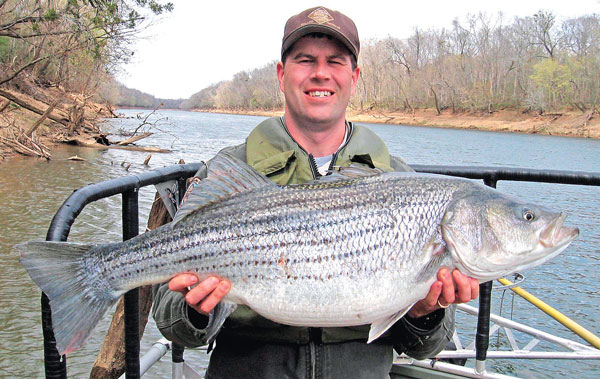


Catching striped bass with the long rod isn’t difficult, and it adds a sense of accomplishment during North Carolina’s No. 1 spring spawning run.
Guide Chuck Laughridge eased his aluminum boat along a rock-strewn shoreline at Weldon’s public boat ramp last April to pick up a late-arriving angler around 9 a.m.
He’d already been on the rushing waters of the Roanoke River for a couple of hours with fishing partner Seth Thompson of Dunn.
“They’re biting,” said the burly Laughridge, a co-owner of the N.C. Waterman website (www.ncwaterman.com). “We’ve already caught about a dozen. C’mon and get in.”
Whether it’s March and April, it’s not difficult to figure out what species of fish draws Laughridge and thousands of other anglers to Weldon: striped bass or, as the locals call them “rockfish” — or simply, “rocks.”
My introduction to the spring striped bass migration at Weldon was more than 20 years in the rear-view mirror, but I’d not forgotten the experience. I fished with a local guide who had two clients, a father and son, in a small aluminum jonboat that had barely enough room for all of us. The day’s goal was for the youngster to catch as many stripers as he could — period.
The guide tied a rope to a tree about a half-mile downstream of the Weldon launch ramp, baited his hooks with frozen shad and put four lines out on the bottom. We could have been fishing for bluegills, crappie or catfish, which was fine, considering the skill level of the guide’s paying customers.
We caught several rockfish in the 2- to 4-pound class, which thrilled the boy, but the fishing style and action was about as much fun as watching paint dry.
Meanwhile, out on the river, dozens of boats drifted past us, some with anglers zinging fly lines across the river, others using bait-casters or spinning reels to bounce lead and cut shad along the bottom. Occasional hookups with stripers produced whoops and yells.
Laughridge, who grew up in Rocky Mount and has fished the Roanoke’s spring striped bass run for more than 40 years, now uses only the long rod to entice stripers, and he’s as adept with a fly rod as anyone who’s ever worked the river in springtime.
“I like to cast a 2/0 Clouser (fly) in hot yellow or chartreuse and white,” said Laughridge, who lives at Harkers Island but spends five days a week every April and May on the Roanoke with a 9-foot fly rod in hand.
“I like to use a 7- or 8-weight rod,” he said. “I’ve been fishing with the fly rod exclusively for the last 25 years.”
The N.C. Wildlife Commission once split the season for keeping stripers on the Roanoke, with the early season (March 1 to April 15) from the mouth of the river west to the US 258 bridge, then everything downstream from Roanoke Rapids Dam to the US 258 bridge open March 15 to April 30. That changed in 2008, with the entire river open for harvest at the same time. The daily creel limit is two fish, with an 18-inch size minimum, no fish between 22 and 27 inches allowed in the creel and only one larger than 27 inches.
Laughridge, along with several of his fishing friends, are responsible for some of the striped bass regulations in place on the Roanoke today.
Since 2009, anglers also have been required to use single, barbless hooks (barbs may be pinched down on regular hooks) on the river from April 1 to June 30. This includes hooks on artificial lures, such as crankbaits, bucktails or topwaters, which must have treble hooks removed and replaced with single, barbless hooks.
The Commission also recommends that fishermen using live or dead baits use non-offset circle hooks to prevent gut-hooking stripers and the resulting delayed mortality.
Laughridge decided several years ago the best way for him and his friends to preserve Roanoke River stripers was to start using fly rods and encourage their use. He’s got several ideas to make the fishery even better, even though these days, it’s one of the most active on the east coast.
“After you catch your one keeper with live bait, it should be against the law to use live bait that day,” Laughridge said. “That one regulation would probably reduce (striper mortality) by 10 to 12 percent. People would learn more than one method of fishing for stripers up here, too.”
Laughridge would be a good example to follow. He catches more stripers with a fly rod than anglers using live or cut baits or other types of artificial lures. Bucktails and Rebels with a single, barbless hook are also popular for stripers among fishermen who visit the Roanoke, but Laughridge said his long rod beats them all when handled properly. Using a fly rod also is much safer to when it comes to causing minimal damage to stripers before release; hooks almost always wind up in the fish’s jaw and not in its gullet.
“You need to cast your line slightly up current and work it across the current, if you’re anchored,” he said. “If you’re drifting with the current, just bounce the (lure) off the bottom.”
Water temperature is the real key to catching stripers on the Roanoke.
“The stripers start to show up at Weldon when the water temperature gets into the high 50s, but that also depends on the water flow (out of Roanoke Rapids Dam),” Laughridge said. “That usually happens about mid-March.”
Baitfish availability is also a key.
“We have mostly gizzard and threadfin shad in the river,” he said, “but of course, the hickory shad are in the river (at Weldon) a month before the stripers get up there, and I expect they eat them, too.”
The rockfish begin to spawn when the water temperature reaches 65 to 70 degrees.
“When the sun comes out, it heats up the water, and 68 degrees is the optimum temperature for spawning,” Laughridge said. “That usually occurs around the middle of April and extends into early May.”
Targeting stripers with a fly rod is easy, if one knows the best way to work Clouser and Deceiver flies across the bottom.
“The best way to fish with a fly rod for stripers is to make three quick strips of the sinking line after your fly has hit the bottom while you’re drifting down the river,” said guide George Beckwith of Down East Guide service.
“That bounces the lure up off the bottom,” he said. “I like to pause after the three strips, then repeat the sequence. It seems like you have to ‘pop’ your fly at least three times off the bottom to get consistent bites. The fish usually hit the fly on the fall.
“Another key is to keep your line taught at all times, because that’s how you’ll feel striper bites. You don’t want any slack in your line.”
Most striped bass bites during the spring are vicious, but they can be subtle if the water temperature drops out of the 60s, and the river can produce some hefty specimens. In recent years, after protections were put in place, fishermen have caught significant numbers of 40-pounders and a few 50-pounders.
The Commission regularly electroshocks the river as well. Its biologists and technicians often boat huge fish — Jeremy McCargo netted a 52-pounder last year — in order to pull scales off to test for age and health. Most of the larger and older female stripers have come from the Atlantic Ocean.
When anglers observe striper “fights” —males, or “buck” stripers, surround big females and whack their sides to stimulate egg releases — Laughridge said that’s when topwater lures may work as well.
“When we see a fight, we throw topwater poppers at ’em,” he said. “Stripers are opportunistic feeders, and even though they may not be in the fight, they’ll often come (to the surface) to investigate. It’s kind of like a biker at the church picnic; if he can’t sing in the choir, he might as well eat the food.”

Be the first to comment