

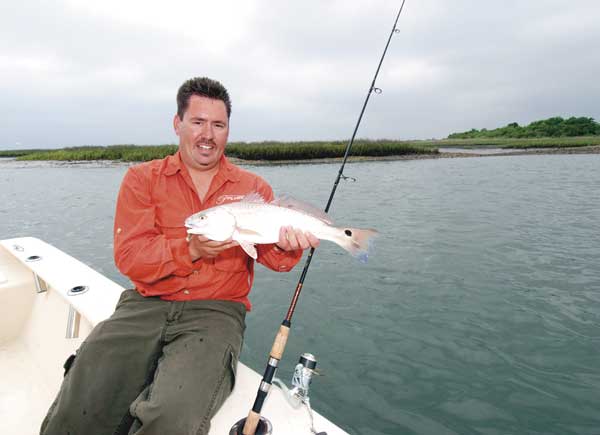
When the weather’s too rough to take a small boat outside, anglers can find plenty of red drum inside Wrightsville Beach’s city limits.
Capt. Jot Owens surveyed the water and sky as clouds moving from the northwest skidded overhead.
He was trying to find some schooling fish, Spanish mackerel or bluefish, just offshore of Masonboro Inlet at AR 370. But after a couple of fruitless hours of searching, the wind shifted to the northeast, and he ducked back inside the protection of the inlet’s rock jetties.
“There was only a small window of opportunity that let us get out on the ocean,” Owens said. “The weather report was right on the money because the wind went on around to the northeast, and it got rough just like it said. On days like this, it’s a good thing there are plenty of red drum at Wrightsville Beach.”
Owens operates a 23-foot Jones Brothers Bateau, powered by a 115-hp Yamaha outboard, under the name of Fortune Hunter Too Fishing Charters.
The 28-year-old has had his captain’s license for seven years and earns his living by putting his clients on fish just about any day, regardless of the conditions.
Being out in the elements means he knows where they hide. When a big nor’easter blows everyone else off the water, Owens switches to Plan B, or in this case Plan R — for redfish.
“I’d say 30 to 40 percent of my clients actually ask to catch red drum,” Owens said. “But there are so many redfish, after they catch a bunch and release them, they’re ready to catch something to eat, like flounder or trout.
“It’s a amazing how many redfish there are and catching them doesn’t take the sense of feel it takes to hook a flounder.”
Owens said he takes a few fly fishermen on excursions, but most of his clients use spinning tackle. He prefers using superbraid lines instead of mono lines for redfish.
“The low stretch of superbraid makes it easier to feel the strike and set the hook,” he said. “It’s also not as prone to tangle as monofilament, and when you have inexperienced clients, that can mean a more enjoyable day.”
Owens uses Pfleuger Medalist 6035 spinning reels with medium-action Shakespeare or Pfleuger medium- action rods. He spools the reels with 20-pound-test Ugly Braid line and ties on a monofilament leader, using an Albright knot.
“The leader is less visible and gives you something to grab when you are landing the fish,” he said. “I don’t like to use a swivel because it’s a piece of metal in the water the fish can detect. It doesn’t take long to tie the Albright, and it also slides through the rod tip. A swivel can damage the tip’s top.”
Owens defines his fishing area as the shallow waters from New Topsail Inlet to Whiskey Creek. He said red drum could be anywhere in the inside waters of the feeder creeks, ICW, or privately- or publicly-maintained navigation channels.
“I catch them in places where other boaters and anglers are passing right on by,” he said. “They hang out at docks along the ICW and at the oyster beds along the sides of the channel.
“Anywhere there’s a sandy spot with an oyster bed, there are going to be red drum nearby. I fish as far north as southern Topsail and Rich Inlet. Back Channel and Figure 8 Island have some good drum fishing. I also catch them in Mott’s Channel, the Lollipop, the mouth of Bradley Creek, in Shinn Creek and near Masonboro Boatyard.”
The best way to find places to fish is to scout a potential area during a dead-low, lunar tide. Owens has found sunken boats, barges, oyster beds, rock piles, old docks and all sorts of other structure by looking at low tide.
“You return to fish the structure as the tide rises,” he said. “There may not be redfish at a piece of structure every time you try. But if you keep fishing them, you’re going to find a few reliable spots.”
The best way to keep them reliable is to release caught fish.
Owens said many of his favorite structure areas hold small schools that are easily fished out by anglers who retain their slot-limit catches every time they hit the water.
“They stay in spots day after day,” he said. “You can over-fish an area.
“If the water is clear enough you can see the school, it’s easier to judge how many fish you can catch. Most spots I fish hold three to 10 fish.
“If you want consistent fishing for them, you have to release them. Then you can catch the same fish all season. If you keep them, you fish that school down to nothing in nothing flat.”
Some places he fishes hold large schools. But this occurs mostly in the surf zones. When the fish are in the surf, he watches for porpoises that eat red drum. Sometimes the red drum form such big schools he simply looks for a purple mass in the water.
“I also fish natural structure,” he said. “The edges of oyster rocks and deep-water water grass bed are good spots. Even if there’s a sandy edge, a marsh grass area can still be good. I like to find a grass edge with a sandy edge then a slough with a steep drop-off where mullets patrol the bank at high tide. Wherever there are mullet there are going to be redfish, even if there’s no other structure besides the sand along the edge of a grass bed.”
Owens uses jigs and soft plastics in the surf and when the fish are deep. His favorite lure at present is the Saltwater Assassin Slurp. He fishes it with a 3/8-ounce Sea Striker jig head. He uses light-colored jig heads with dark-colored soft baits because he thinks the fish easily can see the contrast.
“I like the moulting color soft bait,” he said. “I fish the 4-inch paddle-tail model. The Berkley Gulp is good too. But I like the Slurp better because it has the action of a normal soft plastic a Gulp doesn’t have.”
Owens took a sniff of a Slurp package and announced it smelled just like a menhaden. Such scented baits are the new kid on the block when it comes to fishing soft plastics. Their effectiveness has taken the inshore fishing world by storm over the past couple of seasons.
Hooking it on a jig, he made a cast. Before the boat moved 15 feet under electric power, Owen set the hook into a feisty red drum after it picked up the Slurp soft lure.
“The scented baits make an amateur catch fish like an expert,” he said. “Still, it’s not the same as catching a largemouth bass. If you jerk too hard when setting the hook, you’re going to pull out the hook.
“When you fish a soft plastic, sometimes all you’ll feel is a tap or a wiggle. You need to set the hook right then. But all you have to do is tighten the line and lift the rod. That’s enough to hook the fish. Don’t pump the line or you pull it the hook right out of his mouth. If the fish darts toward you, the line gets slack in it as you pump the rod and the fish tosses the lure.”
Over the sandy bottoms and oyster beds, as well as beneath docks, Owens finds a crankbait fills the bill for redfish. He uses shallow running models for the best results.
“You want to use a floating crankbait you can jerk a little bit and it goes under,” he said. “If the fish are getting shy, they’ll hit the lure right when it goes under the water. But it gets harder to fish the top waters in wind and that’s when I go to a live bait.”
To fish live mullet or menhaden, Owens fishes a float rig with a 40-pound leader with a split shot and an L042 1/0 Eagle Claw wide bend hook.
He fishes it over the same bottom structure where he uses topwater rigs and crankbaits and the float keeps the bait from hanging on the shells. He also fishes a Carolina rig with 14 to 18 inches of 40-pound mono leader and the same hook in areas where hangs are not likely to occur.
“With the Carolina rig you use only the weight you need to hold the bait in one place,” Owens said. “You want the bait to stay in one spot so the drum can to come to you and it usually takes a ½-ounce to 1-ounce egg sinker to do that in the shallow waters where I fish.
“With live baits, I let the fish start swimming away and take until rod is pointing at the fish. Then I lift the rod, keep line tight and start reeling.”
Owens uses a trolling motor to stalk the shallows. He uses a manually-operated style and stands on the bow to operate it. This allows him a clear view of what’s ahead so he doesn’t ground the propeller into the bottom and take a chance of disturbing the fish.
“A trolling motor really makes a difference,” he said. “It’s quieter than a pole and is easier to use in the wind.
“I use it to find fish and to get bait. You can really sneak up on a school of menhaden or mullet with a trolling motor where an outboard will scare them.”
Owens also likes to fish topwater lures in the shallow waters over the oyster beds. He spots the fish or the structure he wants to fish and begins casting a small topwater lure like the MirrOlure Tog Dog Jr.
“The redfish have to really be fired up to hit the bigger topwater lures,” he said. “But they really eat up the smaller models.
“The best colors are orange-and-gold, chartreuse and blue-and-white. I like lures with rattles.
“When you fish a topwater lure, you’ve got to have patience. Sometimes they strike and miss. If they’re aggressive, you can usually hook them on the first or second strike. But you have to be careful not to overwork an area.
“If a fish swirls at a topwater lure a few times, come back and try again. Don’t continuously hit him. You can even come back the next day and get him if you don’t make him shy of the lure.”
Owens fishes the topwater lures the same way as bass fishermen. He uses the walk-the-dog method, stopping a second if the fish misses the hook-up then keeps it coming.
“I’ve had a fish hooked and get off three times then come back and get it again on the same cast,” he said. “They usually hook up on the first or second explosion. That’s the most exciting way of catching them. I’d rather catch one on a topwater lure than 10 on a jig or cut bait.”
Owen tags lots of the larger fish he catches, participating in a tagging project of the N.C. Division of Marine Fisheries.
“We’re getting more and more tagged fish in the southern area of the state,” said DMF red drum biologist Lee Paramore. “Tagging gives us important information for formulating the red drum fishery management plans. We’re finding out that fish tagged in North Carolina usually stay within the state’s waters. Over 90 percent of red drum tagged in North Carolina are recaptured in North Carolina.”
It shows fishermen who release fish are helping themselves to catch them again. Even more definitive information from tagging studies proves this fact.
“Red drum are very reliable fish,” Paramore said. “Tagged fish move around, but they show up at the same time in the same place year after year.
‘Our tagging studies also show that juvenile fish back in the marshes have a high catch rate, so releasing those fish is important. “I tagged 67 redfish over 27 inches long last season. That’s the third-highest number in the state.
“I’m helping out fishermen and the fish. Redfish are such a big part of my business and I want to help keep it that way.”

Be the first to comment