

With fishermen having to be more frugal with their money and not getting to go as often, they have more time to examine their boats, equipment and terminal tackle. The whole purpose is to maximize the output for their limited time on the water and put more fish in the boat.
In scrutinizing past equipment malfunctions and fish lost to equipment failures, they hope to raise their ratio of boated fish to the number of strikes they get.
One of the pieces of equipment they are observing closely is the wire used for leaders, and I have received a good number of questions asking my thoughts and opinions.
Two basic types of wire and materials are available: single-strand and multiple-stranded constructions — made of stainless steel or titanium. While the properties and promotional points of titanium wire seem to be very good, I have experimented with it and have never quite gotten comfortable.
My extended experience is with stainless-steel wire, and I use both the single-strand and multiple-stranded varieties. Single-strand is my choice for tournament fishing, and multiple strand wire is for everything else, including fun fishing, pre-fishing for tournaments, charters, cobia fishing and any non-tournament inshore/nearshore fishing that requires a wire leader.
The differences in the wires come from their construction. Single-strand wire is just that — a single piece of wire. Multiple-strand wire uses several strands, usually seven, of smaller wire that are wrapped together to achieve greater strength. I compare multiple-strand and single-strand wire on four characteristics or traits: diameter, abrasion or tooth resistance, resistance to kinking and breaking and ease (or difficulty) of use.
Multiple-strand wire will be larger in diameter in the same strength and metal. It is close on the lighter-weight wires, but the difference increases as the poundage rating increases. Before long, an enterprising engineer may find a way to overcome this, but now, it is a fact of metallurgy.
Single-strand wire also comes out on top when comparing abrasion and tooth resistance. Single-strand wire carries all its strength in one piece, and it will need to chafe a long time before it affects the strength. However, the construction of stranded wire uses several smaller wires that are wrapped together, making it possible to fray or cut it one strand at a time until it is weak enough to break. Stranded wire also cuts more easily with scissors and doesn’t require a wire cutter. Sharp teeth will cut it too.
Unfortunately, I have had stranded wire cut or broken both ways. This is difficult enough to take when a big fish cuts it cleanly on the strike. However, when you lose a fish to gradual weakening from wearing through several strands during a fight, it is doggone near impossible to put it behind you. Unfortunately, I can attest to this personally.
Stranded wire moves to the top when comparing resistance to kinking and breaking. Two popular ways to attach hooks to stranded wire involve using knots, not the detailed haywire and barrel twists used with single-strand wire. Some fishermen snell hooks onto multiple-strand wire, while others use Figure-8 knots. Stranded wire can be wrapped around itself, a hook, the fish — whatever — and it still resists kinking and breaking.
Conversely, a single-strand wire that wraps on itself will kink, and any strain will break it. It’s another metallurgy fact that single-strand wire breaks well below its rated strength once it becomes kinked. Struggling king mackerel often kink single-strand wire, especially when they begin rolling and darting near the boat.
Stranded wire wins the ease of use comparison hands down. As mentioned earlier, multiple-strand wire can be tied in several knots, while single-strand wire must be twisted properly to hold. It takes about 30 seconds to tie a 2-hook rig using stranded wire if the wire is cut and the hooks are out. It takes two to three minutes to make the same rig using single-strand wire. In addition, stranded wire can be cut with good scissors, but single-strand wire requires wire snips or cutters.
Looking at these comparisons, each wire wins two categories. So which is better? The answer is: neither. The decision is based on personal preference, and in different situations, I use both.
I prefer single-strand wire for tournament fishing and multiple-strand wire for fun-fishing. When tournament fishing, I consider the smaller diameter for a rated strength and superior bite- and abrasion-resistance of single-strand wire the most important factors. The goal in tournament king fishing is to catch a single, large fish, and this first involves the rig being inconspicuous enough not to spook the older, wiser fish. Once a large fish is hooked, the fight is generally longer, and there is more chance of the wire being chafed or bitten through during the fight. Even if the rigs take longer to make, if they help get a larger, older, wiser fish to bite and hold together to get it in, they are well worth the extra time and effort.
For fun fishing, pre-fishing tournaments, charters and other fishing, I use stranded wire. The ease of working with stranded wire is probably its most-important attribute. With practice, rigs using Figure-8 knots and can be tied in roughly 30 seconds. The rigs are easy to handle and are almost as reliable and productive as my tournament rigs.
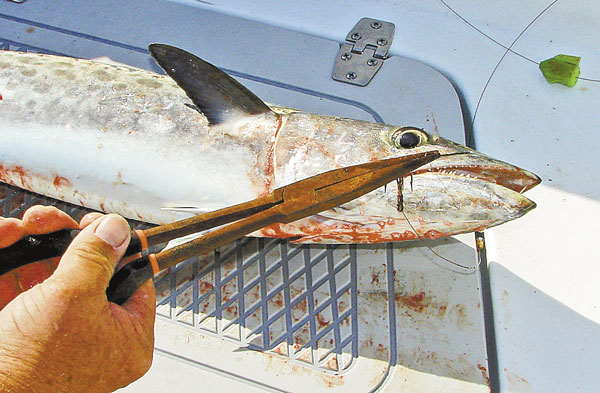
The more-aggressive, teenager-size kings are rarely leader shy, and they are the ones preferred for eating. A big king that gnaws through the leader while fun fishing isn’t upsetting, as it would be released anyway. Big kings caught while fun fishing that will be released don’t require handling and removing some of its protective slime or the chance of injury. Just reach down as close to its mouth as possible and cut the stranded-wire leader with a good pair of scissors.
Then come back and catch it during a tournament using a rig made of single-strand wire.

Be the first to comment