


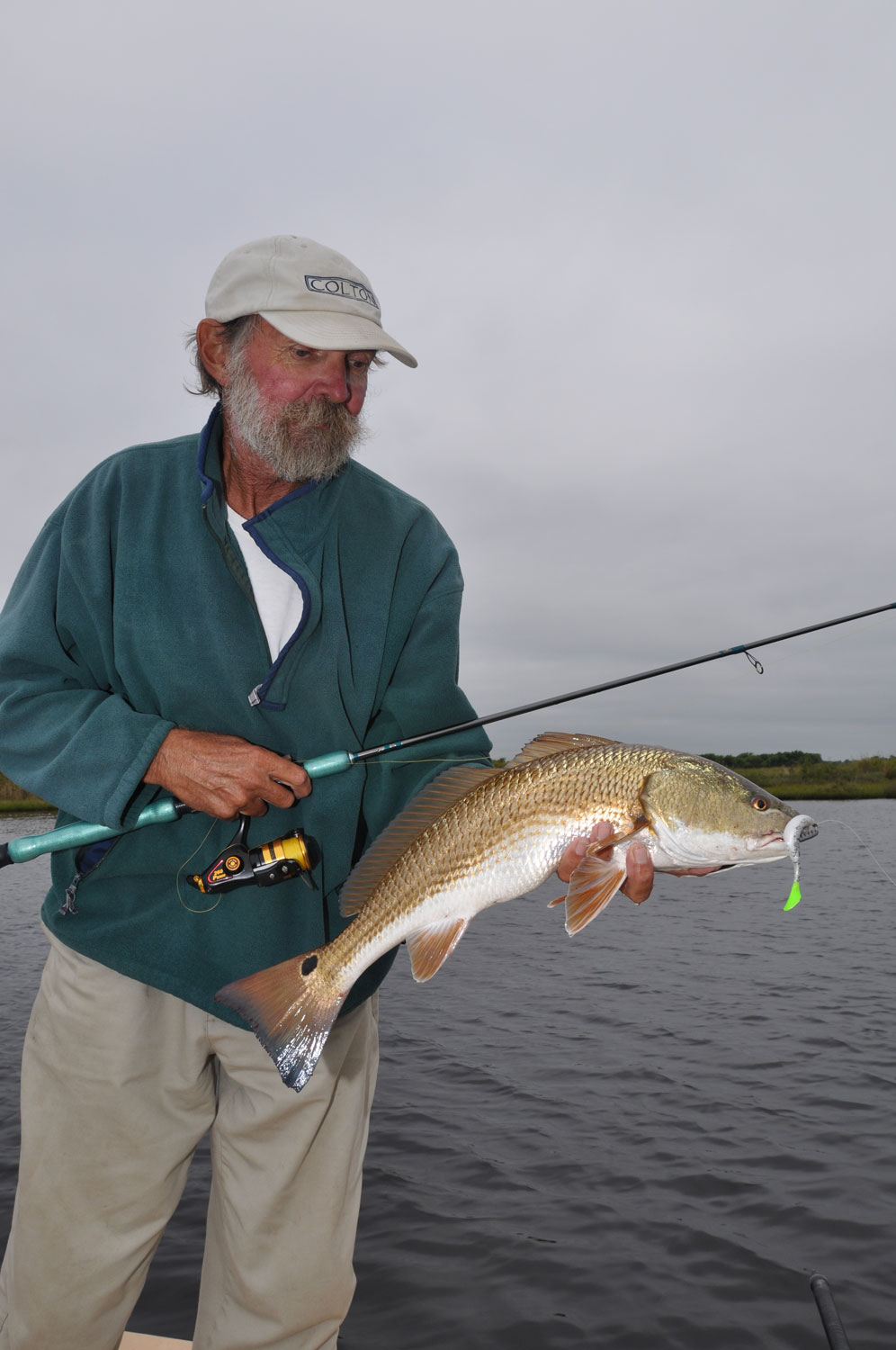


Skinny water in marshes behind North Topsail Beach holds plenty of red drum for patient, quiet anglers. So break out the poles and ease into range.
Capt. Lee Parsons does most of his fishing along North Carolina’s coast from a large, center-console boat, but when he pulled up to the Turkey Creek boating access area near Holly Ridge in Onslow County, he backed a 21-foot, flat-bottomed skiff down the ramp.
“You can’t launch anything that takes much water here,” he said, “but this skiff draws only 6 inches of water, which makes it ideal for poking around with a pole.”
And the places that the 58-year-old Parsons had planned for a day’s fishing with Cody Davis, an enthusiastic teenage fisherman working on a senior school project titled “Coastal Recreational Fishing Fundamentals” were out-of-the-way places.
“Capt. Lee is the best fisherman I know,” Davis said. “I learn something new on every fishing trip with him. Today, I hope to learn how to pole a boat in the shallows for red drum. Everyone today uses an outboard engine to get to their fishing spots, and a trolling motor and Power Pole to get around in the shallows.
“Poling is almost a lost art.”
Parsons had selected an ideal area for the trip, nothing that the backwaters around North Topsail Beach don’t have an excessive tidal range, and with a decent amount of rain having fallen, the water level would probably stay high enough for access.
“We only have about a foot of tide here to begin with,” Parsons said. “The rain will keep it high, and I want to fish in a foot or less of water. That’s when using a pole has a purpose. There’s no other way to get in on the kind of action we will get to see today.”
The boat ride across the Atlantic Intracoastal Waterway was short and pleasant, and once Parsons had shut down the outboard and trimmed it up and out of the water, he surveyed a cove ringed by a grassy shoreline. Behind the grass, beach houses formed the skyline. An old fence and a duck blind indicated that Parsons planned to fish practically right in someone’s backyard.
“If they only knew how good the fishing was, they would be out here, too.” he said. “I’m fishing in old rice plantations, and there are ditches, pilings, oysters, edges, drops, flats, sandbars and mud flats. When it comes to the bottom, I want to fish a light, sweet bottom — not a dark, sour bottom. Fish like the sweet bottoms the best. I can tell the type of bottom when I hit it with the pole.”
Parsons used polarized sunglasses with amber lenses to cut the glare.
“You have to be able to see down into the water,” he said. “You won’t often see the fish, but you are trying to spot the muds they make when they get spooked or find the baitfish they are eating. You are also looking for structure or any little clue that fish are in the area that will help you make accurate casts.
“The main things you want to find are oysters, stingrays and flounder. If these three things are there, the red drum will be there.”
While some anglers call them redfish, Parsons and Davis were adamant about calling them red drum.
“It’s their correct name, so that’s what I want to use,” Davis said. “Lots of other fish are red in color, but red drum shine like a copper pennies in the dark-colored waters of North Topsail.”
Parsons and Davis were using custom, 6-foot-10-inch spinning rods mated with Penn 260 Slammer reels spooled with 20-pound, yellow braided line and 6-foot leaders of 20-pound mono that get shorter over time because Parsons reties after every two or three fish or if the leader becomes frayed.
He uses a surgeon’s knot to join the leader and line, and said the line will usually break at the knot, so he reties it often.
“I like using the yellow line,” Davis said. “It helps you see where the lure is working and … any little twitch that might mean a strike.”
Parsons had fished the area often and knew places red drum would likely be, but that didn’t mean they would be actively feeding.
“You want to present your lure to the fish in such a way that he cannot refuse to strike it,” he said. “You vary the retrieve until you find what they prefer, and that depends upon the temperature, water clarity and the mood of the fish. Using the correct rhythm and speed of the retrieve is extremely important. Slow and twitchy — those are the keys.”
Parsons described the retrieve that had been working, a cast followed by a count of five seconds to allow the lure to fall. Then, the lure was given two or three twitches before being allowed to fall again. Davis was fast into a red drum within the first few retrieves, and after that, the action was steady, but Parsons had to keep reminding him how to fish the lure.
“With a soft-plastic lure, you have to give the lure life because it doesn’t have any action of its own,” he said. “Red drum are very specific in their feeding habits. You stop paying attention to what you are doing and revert to old habits, then you think they’ve stopped biting. That’s the time to rest a minute and think about your cast and your retrieve. Go back to doing it right, and you will be hooking up again.”
Parsons pointed out shell beds and deep holes he had discovered with his pole on previous trips. From his higher elevation — standing on the skiff’s center console — he could see into the water better than the angler could from the bow.
Davis felt a strike and set the hook. This time, a keeper-sized flounder came aboard, and he unhooked the fish and put it in the livewell to take home.
“I don’t keep any red drum,” he said. “I’d rather let them keep swimming and reproducing. If you keep a lot of red drum out of a small area, your fishing will take a nosedive — but I might take home a flounder.”
Once the sun was high, Parsons tied on a topwater lure. He cast it to the grassy shoreline where something, likely a red drum, had disturbed a school of mullet.
“Sometimes a topwater lure is better than a soft plastic,” he said. “In certain types of cover or out in the open water, it can attract a strike from a long way off, and you can watch the fish coming out of the deeper pockets in the grass to attack it.
“A bright day can really turn them on — or it can turn them off. You never know until you give it a try, and catching a red drum on a topwater lure can really top off the day because it’s so exciting to see them strike.
“The trick is to cast the topwater lure so it lands right at the edge of the grass. If you have to tug it free, let it rest a minute before you begin the retrieve. If a fish is around, the splash and the vibrations from pulling it out of the grass will tell the fish it is there.”
At the end of the trip, one red drum had hit a topwater lure and six others were landed after hitting a soft-plastic bait. Four flounders up to 3 pounds were a big bonus.
“Look back at where we started fishing today,” Parsons said. “We’ve moved slowly along, picking the cover apart like surgeons. We’ve moved 100, maybe 200 yards to catch 11 fish and miss four more strikes. Everyone thinks that poling a boat is hard work, but I haven’t even been breathing hard or worked up a sweat.”
For his part, Davis said he was sold on the technique.
“I’ve seen that poling is a very effective way of fishing and why it is traditional,” he said. “It doesn’t use any battery power or fossil fuel, and that’s a big plus when you want to reduce the cost of a fishing trip or want to go green and reduce your environmental impact.
“It’s also more fun than running around all over the place, passing by lots of fish just to get to what you think is a better fishing spot.”
DESTINATION INFORMATION
HOW TO GET THERE: The Turkey Creek Boating Access Area is popular for fishermen who want to reach the marshes behind North Topsail Beach. From the junction of US 17 and NC 210, around 13 miles south of Jacksonville, take NC 210 east 5.6 miles and turn right on SR 1518 (Old Folkston Rd.), then go 1.7 miles and turn left on SR 1529 (Turkey Point Road), then 1.6 miles and right on SR 1530 (also Turkey Point Road) to the ramp at the end of the road.
WHEN TO GO: Red drum are in the North Topsail marshes year-round and may be caught at any time, depending upon the water temperature. One of the best bites is in early spring, when the fish become very active as the water warms up but before the big, tight winter schools split up and disperse over a wide area.
BEST LURES/TECHNIQUES: Capt. Lee Parsons targets red drum with a 6-foot-10, Riley Custom spinning rod, a Penn Slammer 260 reel spooled with 20-pound, yellow braided line and six feet of 20-pound monofilament leader. As far as soft plastics, he prefers a Bass Assassin Saltwater Assassin, salt-and-pepper with a chartreuse tail, on a Daiichi Copperhead hook with spring retainer, pre-weighted or with a D.O.A belly weight pinched onto the shank. As far as topwater baits, a MirrOlure Top Dog Jr. in red head/white body or any other dark head/light body color.
FISHING INFO/GUIDES: Capt. Lee Parsons, Gottafly Guide Service, 910-540-2464. Also, see Guides & Charters in Classifieds.
ACCOMMODATIONS: St. Regis Resort, N. Topsail Beach, 800-497-5463; Greater Topsail Area Chamber of Commerce and Tourism, Surf City, 910-329-4446 or www.topsailchamber.org.
MAPS: Capt. Segull’s Nautical Charts, 888-473-4855, www.captainsegullcharts.com; Sealake Fishing Guides, 800-411-0185, www.thegoodspots.com.

Be the first to comment