

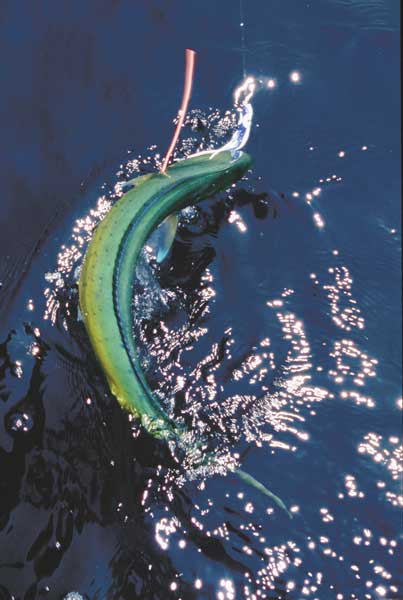
Small-boat anglers have fun with dolphin off the Crystal Coast while gathering much-needed information.
When most fishermen daydream of dragging in dolphin, they typically conjure:
• Towering offshore hulls with Carolina-style flared bows deploying spider webs of lines from out-riggers stretching outward above their gunwales;
• captains staring at the ocean’s surface from lofty flying bridges;
• dolphin chasing dredges and daisy-chain teasers among the lures and baits trailing in the wake as part of extensive trolling spreads.
While dragging eight to 12 baits and lures in the water behind a boat costing $20,000 per foot of length is certainly a classic and productive way of catching dolphin, anglers in small boats shouldn’t feel intimidated at the scope and cost of pursuing these rainbow-hued fish.
All anglers really have to do is watch the weather and sneak offshore during calm days to catch their share of dolphin.
Willis Heffren was preparing to retire from Grady White Boats in Greenville during the summer of 2006. He and the company’s newest employee, Justin Wallace, Grady White’s assistant to the director of sales and marketing, were heading offshore in a Grady White 225 Tournament model boat for a day of dolphin fishing. They were following a lead boat, Anthony Ng’s 30-foot Bimini model Grady White center-console boat, as they crested the rolling waves of Beaufort Inlet.
Ng keeps his boat docked at Atlantic Beach and fishes whenever he gets the chance. While many anglers are aware of his expertise at catching groupers, during this trip he and the other anglers were heading offshore, teaming up to help a multiple-year dolphin-tagging study conducted by Dr. Don Hammond.
Jimmy Hardin, also of Grady White Boats, was along for the trip and was in Ng’s boat with Joe Albea and Hammond. Albea was filming a potential episode for a television show he produces.
“There seems to be a mystique surrounding catching dolphin,” Heffren said. “But like any other gamefish, they’re hungry and bite what’s in front of them if they’re in a feeding mood.
“You don’t need a lot of fancy tackle and lures to catch them. All you have to do is get out to where they are feeding and start fishing.”
Heffren showed Wallace how to navigate in Ng’s boat wake over the sea miles. It was a bit choppy, with cresting 3-foot seas.
While the anglers endured some sea spray misting balanced on their sea legs against the chop, the little Grady White dual-console boat with the walk-through windshield handled the conditions without a fuss. Most think of this particular style of boat as a family outing boat, with its forward seats and open bow. But on calm days, even family runabouts can serve double duty to reach dolphin grounds.
After an hour or so of riding, the pair of boats slowed down to trolling speed as they approached a weather buoy. Over the VHF radio, Ng described the buoy as a UNC NCCOOS (N.C. Coastal Ocean Observing System) buoy (located at coordinates 34.34.34N/76. 42.00W).
“We’re out around 24 miles offshore of Beaufort Inlet,” Ng said. “In July this is typically a good place to catch plenty of dolphin.”
Dolphin form schools around floating objects, including a floating weather buoy tethered to the bottom with a cable. But a floating line of Sargassum seaweed, which most fishermen term a “weed line,” was evident near the buoy.
“Weather conditions and current conditions cause the weed lines to form,” Heffren said. “Anytime you find a weed line in July, there are going to be dolphin around. They feed on the small sea life, fish, crabs and other crustaceans, that are associated with the weeds — so the dolphin hang around in the shade beneath them.”
While his boat may have seemed on the small side to many experienced dolphin anglers, Heffren’s gear was essentially the same. He used 30-pound-class Penn International reels set on roller-guide rods. He also trolled fast with small speed lures.
A dolphin is still a dolphin, no matter the size of boat onto which it’s brought. Lever-drag reels, such as the Penn International series, hold plenty of line.
While most dolphin weight less than 20 pounds, an occasional fish will top 40 pounds, perhaps much more. A beefy drag and 400 yards of line is important for boating any fish as fast as a dolphin once it reaches heavyweight status.
“A dolphin will strike anything shiny trolled at a fast speed,” Heffren said. “I like to use small skirted trolling lures in white, blue-and-white, silver and other light colors.”
Setting out only two rods for his diminutive trolling spread served Heffren and Wallace well. There were so many dolphin there was seldom a time when two rods remained in the water. In fact, there were so many fish, by the time Heffren finished tagging one fish with a dart tag and writing down the information on a data sheet, he had lost track of the location of Ng’s larger center console.
“It’s a slick day out here today,” he said. “But if you come this far in a small boat, it pays to head out with another boat, using the buddy system to stay safe.”
Another aspect of the trip was Hammond’s desire to implant a satellite tag into one of the fish. But the tag, which disengages itself from the fish at a predetermined date and time to relay information about the fish’s travels to a satellite, is extremely expensive. Therefore it would only be implanted into a large dolphin — if one were caught.
By using a VHF radio to communicate, the two boats were soon in eye contact with one another. Dolphin after dolphin leaped behind both boats, with the fish on Ng’s boat being captured by Albea’s camera while the anglers played them with light tackle.
Ng also trolled with Penn International 30-pound class reels. But he mixed them with standard king mackerel live-bait trolling gear. He also used spinning and bait-casting rigs to catch the fish using the decoy method.
“When you bring a fish to the boat, other dolphin will follow the hooked fish,” Ng said. “We troll until we hook one and leave it beside the boat. Then everyone can cast lures and hook up fish.”
Ng used a small rubber squid lure made by Tsunami to troll and to cast for dolphin. Hammond was having a field day, swinging dolphin aboard in rubber net, measuring them, writing down the date, time, location and weather conditions, then inserting dart tags and releasing them. He also kept a few for the table.
Called by many anglers, the gamefish, dolphin, also called mahi mahi or dolphin fish to distinguish them from the sea mammal (porpoises) with the same name, dolphin complete their life cycles under a live-fast, die-young scenario.
Incredibly fast growing and super prolific, dolphin are the food source of many of the sea’s greatest predators, including marlin and sharks. But little was known about the fish until Hammond began his tagging research project six years ago.
“A dolphin was the first bluewater fish I caught, and it was the prettiest fish I’d ever seen,” Hammond said. “It was the hardest-fighting fish, the most beautiful fish, the most acrobatic fish, the strongest fish and it was also great on the table.
“I’ve been in love with dolphin ever since.”
Hammond was a marine fisheries biologist with the South Carolina Division of Marine Fisheries until his retirement. He had concerns about dolphin stocks beginning in 1996 when commercial fishermen began taking huge numbers of dolphin from the ocean with long lines, which are ocean trot lines dangling baited hooks for miles.
“There was little known about the fish,” Hammond said. “One study was done in 1991 in Florida,
“They tagged only 57 dolphin. I don’t believe their timing was right because sportsmen were not yet concerned enough. The decline in the fish was not yet evident.”
Hammond decided to tag dolphin using a 6-inch-long, nylon dart tag inserted one-third of the way behind the head in the fish’s dorsal musculature. The barb interlocks into the bases of the spines. Used for many tagging studies anglers refer to these as “spaghetti” tags.
“You’ll pop the tag off before you pull it out,” Hammond said. “There’s no tag failure with this style of tag.”
During the first year of Hammond’s study, more than 350 sport fishermen implanted 379 yellow tags. Biologists implanted 83 orange tags.
Yellow tags offered a tagging study T-shirt for the return of information while orange tags offer a T-shirt and a $20 reward.
”While sport fishermen will turn in tag information in exchange for a T-shirt, I asked commercial fishermen what it would take for them to send in the information,” Hammond said. “Twenty dollars was the amount most of them agreed would be enough of an incentive.”
Since that first year, which was funded by grants, more than 6,000 dolphin have been tagged. Now called the “Dolphin Tagging Study,” it’s funded only through donations.
Sport fishermen volunteer to tag dolphin. But it’s never been easy to get them to participate. Commercial fishermen don’t tag dolphin because they sell their catches. A few charter guides participate in the program.
“The implementation of size limits or bag limits by the states usually gets anglers started,” he said. “Dolphin are fun to catch and tagging them gives you incentive to keep fishing once your limit is reached.”
While dart tags have provided important information, a satellite tag would provide much more. Once implanted, the satellite tag collects information until it releases from the fish at a predetermined time and date. It floats to the surface and relays information to a computer via a satellite link, assuming the fish isn’t eaten sooner than the tag releases.
”Everything eats dolphin,” Hammond said. “That’s why they grow so fast and reproduce so rapidly. I want to implant the satellite tags in fish weighing over 30 pounds because the adult fish have the best chance of surviving long enough to provide information.”
Out of 6,100 dart tags implanted into dolphin over the first 5 years, only 141 were returned. Therefore, the information provided by radio tags is invaluable. Only two radio tags had been implanted because of their cost, which is more than $1,000.
“Everything is currently done on a volunteer basis,” Hammond said. “There was some grant money in the beginning, but now it’s paid for with my own funds or donated funds.
“We could use a lot more taggers. We’ve already found out lots of things about dolphin migrations. The fish start out as juveniles along Florida or elsewhere along the Atlantic coast. They move northward, then east along the currents. But once they head east, we aren’t sure what happens.
“Based on the sea currents, I believe some of them return south, some wind up in the eastern Atlantic and some may even mix with the fish in the Gulf. We can only confirm that through tag returns.
“Any information we gather will give fishery managers better information for managing dolphin stocks. Too many other fish, as well as commercial fishermen and recreational fishermen, depend upon them to keep dolphin populations at risk. If any bluewater fishermen kept a log of every fish he caught, he would find that far and away, most of them are dolphin.”
Dolphin are landed in a net and placed on a wet towel. Another wet towel is put over the fish’s head to calm it. The tag is inserted, a length measurement is taken and the fish dropped over the side. A form is filled out with the date, location and whether it was caught along a weed line.
The entire process takes a minute or two.
The odds of having a dart tag returned are very low. However, a few days after this particular tagging trip, Hammond called to report one of the fish tagged aboard Heffren’s boat was caught at Diamond Shoals by a charter boat named Bigeye.
The fish had traveled 67 miles in five days.

Be the first to comment