

Here’s how to hunt the trophy of all small game
Before the door to his pickup truck opened, Bruce Trujillo’s dog, Poncho, was barking.
Looking out the windshield since the wheels left the pavement, he was ready to roll.
“He sees woods and knows it’s time to hunt for real,” Trujillo said. “I take him for a run somewhere and tree a squirrel most mornings when squirrel season isn’t open. It keeps us both in shape for hunting season when it arrives.”
Poncho is a Carolina Cur. Originally bred by James Parnell in Society Hill, S.C. Carolina Curs are recognized by the National Kennel Club and United States Squirrel Dog Registry. Six-year-old Poncho has treed more than 700 squirrels that Trujillo and his friends took home.
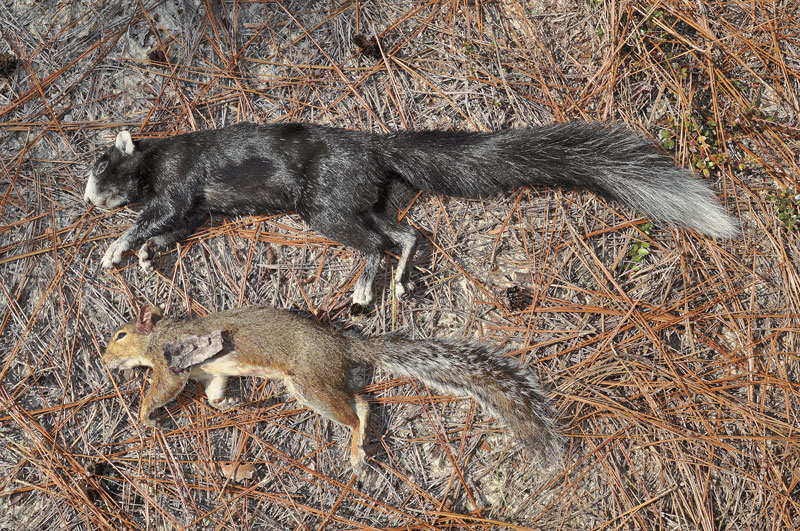
“I’ll take anyone to hunt gray squirrels,” Trujillo said. “But fox squirrels are a horse of a different color. I am more secretive about places I hunt them.”
Finding fox squirrels
The expression fits the game. The eastern subspecies that inhabits the Carolinas’ coastal plain and lower piedmont is Sciurus niger niger. They exhibit more color variations than any other game mammal.
Before Trujillo could roll up his leash to stow in his vest, his head swiveled toward the woods. Poncho was already trailing.
“He’s on squirrel scent,” he said. “The way he is trailing, it’s likely a fox squirrel.”
The trick to finding fox squirrels is locating the right habitat and reading the signs. Trujillo hunts private and public lands in several states. He lives in Castle Hayne, so he mostly hunts in North Carolina. Most of his fox squirrel hunts take place on NCWRC game lands.
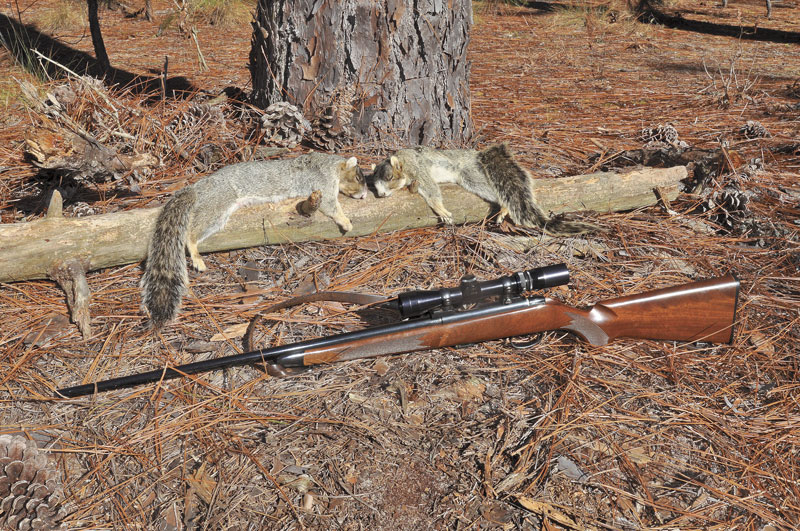
“I have ridden for hours, searching for ideal habitat,” he said. “An abundant fox squirrel population requires mature longleaf cones and turkey oak understory. It’s hard to find both because as soon as a longleaf has cones, it is big enough to harvest. And frequent controlled burns prevent turkey oaks from producing acorns.
“You can find fox squirrels anywhere. Once you hunt with a dog, you find that out. But you can also waste a lot of time in marginal fox squirrel habitat or gray squirrel habitat. A fox squirrel might be in a hardwood drain. But there will also be lots of gray squirrels. The dog winds up treeing so many gray squirrels you might not find a fox squirrel for days.”
Once he finds likely habitat, Trujillo drives roads, looking for fox squirrel tracks. Their footprints are bigger and more widely spaced than gray squirrel tracks.
“A fox squirrel will scamper along, jumping up on a tree trunk, then another and another, so he can watch for danger,” he said. “That can make a difficult trail for an inexperienced dog. It took Poncho a long time to figure out how to circle a tree and figure out which way the squirrel jumped.”
Trujillo also looks for feeding mounds (middens). Fox squirrels leave piles of discarded cone scales at the bottoms of feeding trees. They also build distinctive nests.
“A fox squirrel nest is huge, compared to a gray squirrel nest,” he said. “They also use manmade materials. You might see paper, cloth, plastic and brightly colored twine used for tying pine straw bales sticking out of their nests.”
Stick to the pines
Once he finds good habitat and signs, he checks the proximity to hardwood stands. He doesn’t turn the dog loose near them.
“If the dog gets on a gray squirrel, he’s going to the hardwoods, which is wasting time,” he said. “I keep him out in a savannah far from the edges so he is unlikely to run across a gray squirrel’s scent. With a young dog, it takes some doing. Once Poncho learned how to hunt fox squirrels, he got better and better, until he was good at trailing and treeing them. It’s nothing to watch and hear him race 400 to 800 yards in a straight line with his GPS tracking collar showing the route. If you didn’t have confidence, you would think he was running a deer.”
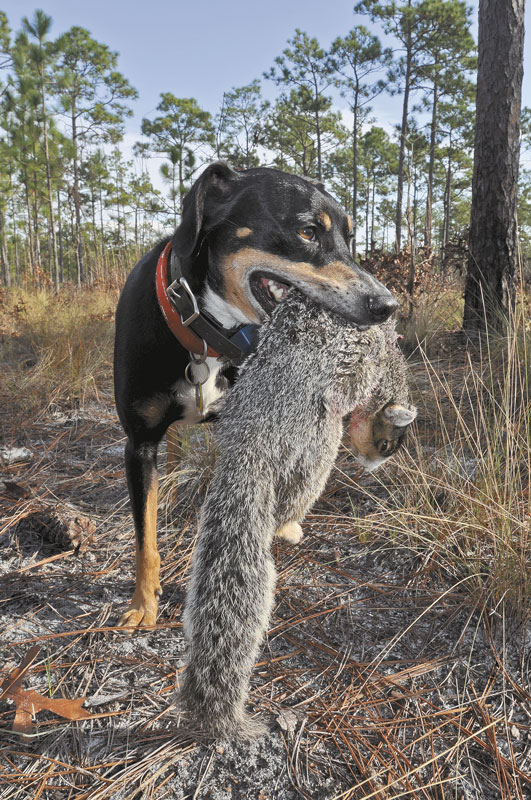
On this particular day, it took all morning to tree a fox squirrel. The squirrel was in a longleaf pine. Poncho had trailed it there for more than an hour. The squirrel had been feeding along, leaping a few feet up on a tree trunk, then moving again. Altogether, the squirrel tapped off of eight trees.
Eventually, Poncho stuck at one tree. Jumping on the trunk, what had been well-spaced trailing barks became frenzied barking. He moved around the tree, scenting the ground and nearby tree trunks, but kept returning to the tree with the squirrel.
Look closely
It took Trujillo 20 minutes to see it. Rather than hide in a fork like a gray squirrel, he was at the end of a limb. Wrapping his tail around his head, he peered through the fur. Trujillo used a binocular to find him.
“He looks like any other longleaf cone,” he said. “It’s amazing how hard they can be to see, as big as they are. Their tail usually gives them away.
“But, sometimes, even though you are certain he is up there because of the way the dog is barking, you still can’t spot him. He may be in a nearby tree, so you look up in them. He may be in a hollow, so you look until you find one. Sometimes you just have to figure his camouflage is so good or he is in a cluster of pine needles and cones so dense that you just can’t see him. Then, reluctantly, you tell the dog the squirrel is gone and urge him on so he will find another one.”
North Carolina manages fox squirrels with a bag limit of one per day and shortened season, but they can be taken on any state game land. South Carolina uses lands restrictions to control the harvest and they can be hunted on WMAs that are not state-owned. They can be hunted at Francis Marion and Sumter National forests and Manchester State Forest.
SCDNR Biologist Corey Drennan said he doesn’t want to see excessive pressure on fox squirrels at Sumter National Forest, but they are there.
“Hunters can find them mostly in McCormick and Edgefield counties,” he said. “The habitat is mostly a mix of hardwoods and loblolly pine. So you will also find lots of gray squirrels.”
Danny Carlson, a wildlife technician at Francis Marion NF, shared similar sentiments.
“We don’t want to see undue pressure on fox squirrels, but hunters can find them in the large, open pine savannahs where there have been prescribed burns. The hardwood component is along the edges in the creek runs and drains so they will tree gray squirrels, too.”
Manchester State Forest Director of Operations is Ken Kendall. He said fox squirrels are present there.
“We have a lot of loblolly pines and longleaf pines,” he said. “We also have some non-native slash pines that were planted, but have been removing them and replacing them with native pines. It is good fox squirrel habitat and we do see them.”
Kendall said not many squirrel hunters head for Manchester, but a few hunt there. He also wants hunters to be careful and not overharvest them.
“A fox squirrel is the trophy of small game,” Trujillo said. “I hunt them a few times each year and never take more than one or two from one spot. I want to make sure there are some in the same spot, next season.”
Two subspecies and their color variations
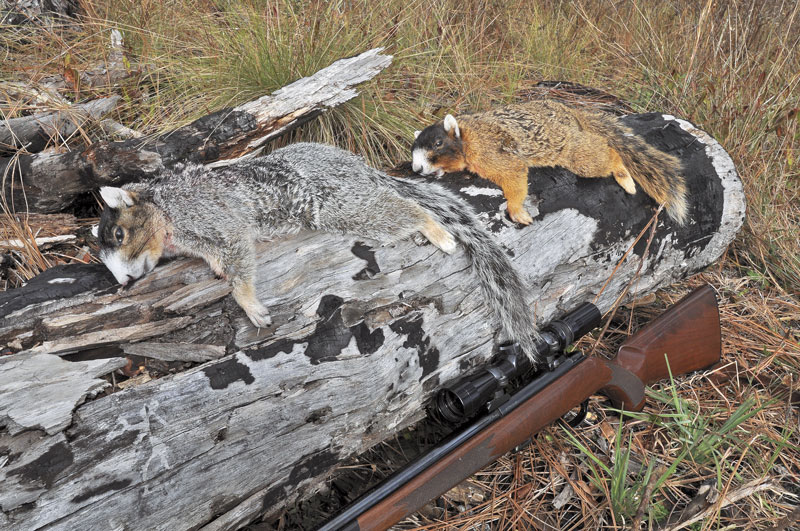
The subspecies inhabiting the Carolinas’ coastal plains and lower piedmont is the southern subspecies, Sciurus niger niger. They exhibit more color variations than any other game mammal. A second subspecies, the eastern fox squirrel, Sciurus niger vulpinus, repopulated North Carolina’s Appalachian Mountains from the north about a decade ago, prompting the state to create its Deer Hunter Observation Survey (DHOS).
The DHOS actually began as a fox squirrel survey. Hunters who saw the standard color, eastern fox squirrels with russet tails and undersides and gray bodies wanted to pursue them. Other hunters were also seeing greater numbers of the southern subspecies.
The 1000 hunters who logged everything they saw from a deer stand over four seasons proved fox squirrels were distributed more widely than previously thought, resulting in an open season for the entire state. Prior to that, only 27 counties had a season. DHOS data also resulted in a 1-month extension of the season, through January.
The reason southern fox squirrels have such wide color variations is their fire-dependent habitat. Fox squirrels have litters of individuals with different color patterns – gray with black head, black with white nose, ears and feet, even all-white or all-black with everything in between.
When startled, fox squirrels can freeze at the end of a limb, roll up their tails and look like longleaf cone, or they can disappear against a fire-charred pine trunk. The classic coloration, resembling a gray fox, allows them to blend perfectly into the leaves of turkey oaks where they have not been defoliated or eliminated by burning. Fox squirrels with camouflaging fur that allowed them to hide from predators passed these color variations to their descendants.


Be the first to comment