

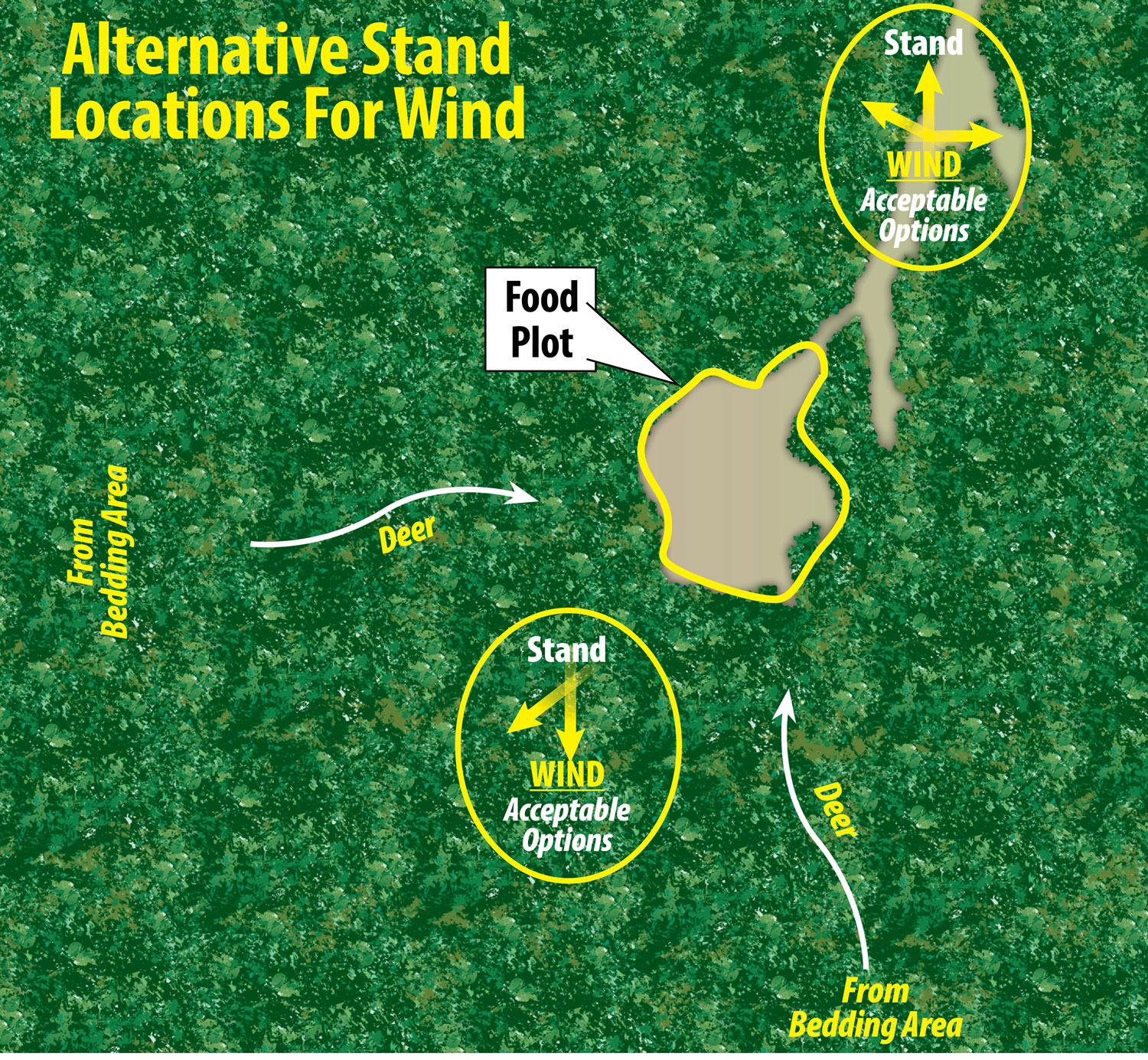
If deer couldn’t smell, they would have been hunted to extinction thousands of years ago. They rely on a keen sense of smell to find food, communicate with other deer and avoid dangerous situations. If hunters want to encounter a deer at a lethal range, they must learn to conceal their scent or eliminate the possibility that a deer can smell them. When setting up stands, hunters need to make sure the wind is in their favor, sending all odors away from the animals.
If it wasn’t for the unpredictable nature of the weather, deer would struggle avoiding deadly encounters with hunters and predators. While meteorologists use expensive software models and weather instruments to forecast the weather, conditions are always subject to change. However, the wind forecast is fairly reliable, and hunters can take advantage of that knowledge.
Hunters should set up their stands with respect to the dominant wind direction, but one problem that many hunters overlook is setting up all of their stands in the same position to that wind.
Ben Lecroy of Laurens County sets up his stands with the wind direction in mind, but he makes sure he has options on any day he’s hunting.
“Nothing is more frustrating than having the spot, and the first week of November comes, and we get a southeast wind that you do not have a stand set up for,” he said. “I will always have multiple stands for all wind directions.”
Having options is never bad. Not only will Lecroy have several different stand locations set up for different winds, he will have several tree stands set up around his primary location ready for different wind directions.
“Identifying stand locations for multiple wind directions is one of the most-overlooked tactics, and it is critical that you have a wind that is good for you but is also good for the deer as they are approaching and can go about their business until the shooters shows,” he said.
Deer are very social creatures. A spooked deer will alert every other whitetail within hearing, and an old, mature buck in the area will remember and learn to make a detour on that route.
“Beating the wind is key to ambushing a mature buck. There is a fine line between having a good wind and a bad wind. It can literally be a few feet that get you busted or puts him into bow range,” Lecroy said.

Be the first to comment