

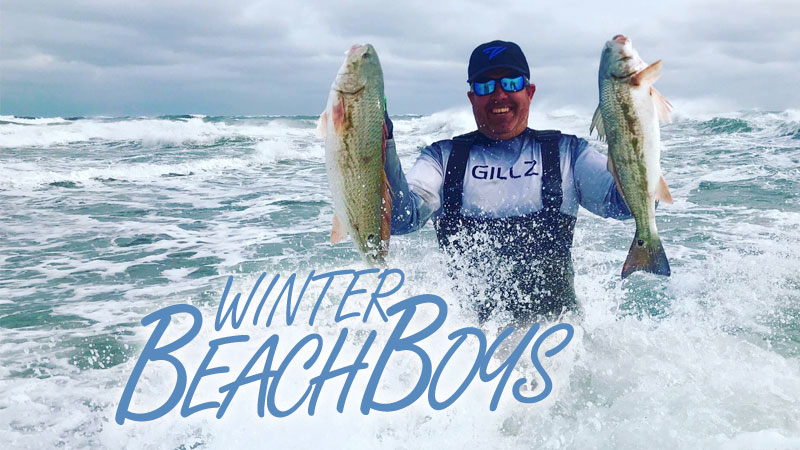
When most people think of surf-fishing in December, they think of long, stout surf rods, casting heavy weights and rigs from calf-deep water, then retreating to a big rod holder, a chair and a thermos of hot cocoa.
But that’s not what’s on Noah Lynk’s mind this month. He surf-fishes for redfish with light tackle, and he wades out as far and deep as he can possibly go.
Lynk, of Noah’s Ark Fishing Charters out of Harker’s Island, N.C., also does something else that doesn’t often enter most people’s minds when thinking of surf fishing. He uses his boat to get to his favorite surf-fishing spots, and he catches a lot of red drum this time of year, especially when fishing in the rough surf of Cape Lookout.
“It’s cold, and you’re going to get wet,” Lynk said. “This time of year, the surf is often very rough, and it’s often very windy. At times, you’ll have surf breaking over your head. You’ll get water in your waders. You might even go for a tumble in the surf. But there is nothing I can think of that’s better than fishing here this time of year. The fishing is that good. Every time I hook into a fish, I’m immediately reminded why I put myself up against these elements.”

Lynk’s plan of attack is pretty simple, as is his fishing strategy.
After beaching his boat, unloading the day’s supplies, then anchoring his boat to avoid it being stranded at low tide or taken away as the tide rises, he heads to the windward edge of the cape where the surf is the roughest, with waves cresting and crashing from opposite directions.
“It’s really simple fishing,” he said. “We just cast as far as we can, then reel in, letting the lure touch the bottom every now and then. Clarkspoons are great lures. They are heavy enough to cast a (long) distance, and their weight keeps them steady while retrieving them through the surf. These redfish are here in the shoals to look for food. So you don’t have to do anything special to get them to bite,” he said.
Instead of long, heavy surf rods and big reels, Lynk opts for 71/2- and 8-foot rods and 3000 series spinning reels. This may seem light to some surf anglers, but these aren’t bull redfish. These are mostly slot-sized fish, and in the cold, December surf, they put up a formidable fight, but a reel spooled with 12-pound braid is plenty stout enough to handle them.
Fishing this way, Lynk often breaks a cardinal rule by which many anglers swear. Adjusting your drag while fighting a fish is known as a big no-no, but he said you need to have that ability here to do just that.

“This is light tackle and fairly light line, and you need that to be able to cast the lures we’re using accurately,” he said. “You also need it to keep from horsing the fish in. You can use heavy surf rods, cast out big chunks of cut bait, then put the rod in a rod holder and just wait on a bite, but this is far more fun and challenging. You’re playing an active role when fishing this way, and there is nothing like it.
“But you have to know when to let the fish run and when to put pressure on it. Sometimes, you have to lighten your drag when you have a fish trying to run. If you can’t loosen your drag, you will get broken off at times. And if you aren’t willing to tighten your drag at times, you’ll simply get spooled,” he said.
And even though most of these fish are under 30 inches, Lynk said the occasional 40-inch-plus red drum shows up.
“You can’t be afraid to adjust your drag during the fight when that happens,” he said.
Lynk prefers a northeast wind, a rising tide, and fishing in the most turbulent water. But he said fish will bite just as good when those conditions aren’t present.
“A northeast wind is the most comfortable for anglers, and these fish will bite on any tide, usually,” he said. “As far as the turbulent water, that is where I always start. And it’s where the fish usually feed the most. The churning water stirs up the bottom and knocks sand fleas and baitfish around. The redfish know it and are constantly patrolling these areas. But sometimes, the bite can turn off there for whatever reason. Then we walk up the beach blind-casting into different spots until we find the schools.”
No matter what the temperature or wind direction is, Lynk said waders and quick-dry clothing are essential for this trip. Your shirt and whatever you’re wearing under your waders will get wet. And you will be miserable all day long if you’re wearing any cotton, he said.
Artificial intelligence
Guide Noah Lynk said that, on occasion, some of his clients want to fish with live bait. He said they catch some fish, but far fewer than those using heavy lures like Clarkspoons. Another of his favorites is a 11/2-ounce Shad Jig. He is also partial to the Halco C-Gar 120 and Halco Slidog 150, the former a topwater, the later a sinking, cigar-shaped lure. Both are solid, dense lures.

“With these lures, you can cast them far and retrieve them in heavy current without them getting blown around too much. And it’s easy to keep them touching the bottom,” Lynk said. “These fish are feasting mainly on sand fleas along the bottom, but they won’t pass up the chance to snag a baitfish swimming by.”
On the first cast of each trip, Lynk tosses out one of the lures from shallow water, then reels it back steadily, letting it bounce off the bottom periodically. If he doesn’t get a strike that way, he’ll bounce the lure more on the next cast and retrieve. When that’s not working, he’ll jig the lure up and down, reeling in the slack as he goes.
“It can be a different retrieve that they’re looking for each day. Some days, you aren’t reeling in the lure at all. You’re just reeling in the slack, but moving the lure with the rod tip in a jigging motion. Other days, you’re just straight retrieving it. Just remember, if one way isn’t working, try it a different way. The fish are here in big numbers this time of year, and they are feeding. You just have to figure out what is triggering them to bite each time,” he said.
DESTINATION INFORMATION
HOW TO GET THERE — Cape Lookout is only accessible by boat or private ferry. The nearest public boat ramp is on Harkers Island. Get there by way of US 70 east from Morehead City to Harkers Island Road.
WHEN TO GO — Thanksgiving begins good surf fishing; it can last through the winter, depending on the weather.
BEST TECHNIQUES — With 3000 series spinning reels on 71/2- to 8-foot rods, cast 11/2-ounce Clarkspoons and similar lures into the surf and try different retrieve rates until the fish begin biting. Fish in the roughest part of the surf you can find.
FISHING INFO/GUIDES — Noah Lynk, Noah’s Ark Fishing Charters, 252-342-6911; Cape Pointe Marina, Harker’s Island, 252-728-6181
ACCOMMODATIONS — Cape Pointe Marina, Harker’s Island, www.capepointemarina.com; Harkers Island Marina, www.harkersmarina.com; Crystal Coast Tourism Authority, 800-786-6962, www.crystalcoastnc.org. See also Guides & Charters in Classifieds.
MAPS — Capt. Segull’s Nautical Fishing Charts, 888-473-4855, www.offshoremapping.com; Grease Chart, 252-560-6572, www.greasechart.com; GMCO Chartbook of North Carolina, 888-420-6277, www.gmcomaps.com.
Be the first to comment