

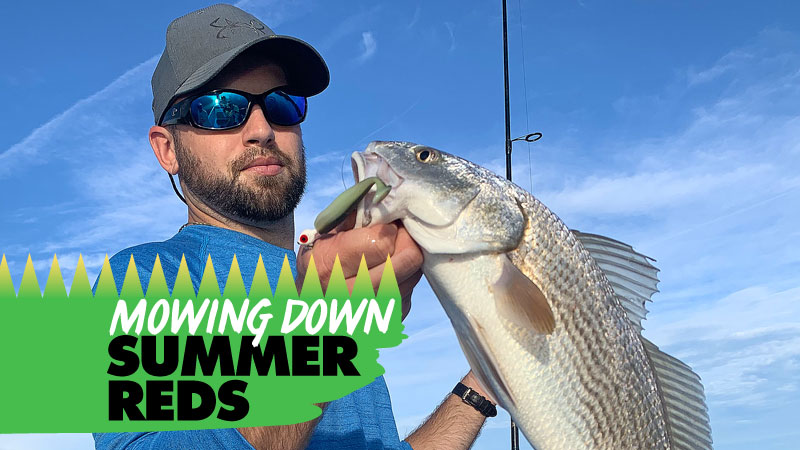
Summer in the Carolinas means fun, sun and lots of fishing opportunities. And one of the largest draws in the saltwater arena is the redfish, aka puppy drum in North Carolina or spot-tail bass in South Carolina. While fall and winter draws a boatload of anglers to the coast, the summer action should never be avoided when you’ve got a line-taming redfish on the brain.
Inshore and offshore species move around and position themselves in various habitats as the seasons change. Redfish will spend the majority of their juvenile lives within the protection of the grass-lined waterways and massive estuaries they call home. For the record, redfish are considered juveniles until they reach 36 inches long. The grassy and oyster-lined bays, creeks and flats are their homes, and these areas are considered their main stomping grounds throughout the year, especially during the middle of summer.
Redfish spend their lives eating, procreating and avoiding being eaten by larger marine species. But the juvies are only concerned with eating and staying away from dolphins. Marshes make for an ideal neighborhood where finger mullet, menhaden, shrimp and other juvenile fishes flourish. During summer, these shallow areas are filled from one end to the other with a buffet of tasty critters.

Jordan Pate of Carolina Guide Service out of Pawleys Island, S.C., fishes from Murrells Inlet to the marshes just north of Charleston in search of redfish, speckled trout and tarpon. But redfish are his staple fishery, especially during summer.
“Our redfish remain in the bay all-year long,” said Pate (843-814-7900). “The fish aren’t as concentrated in the summer as they are in the winter, but once you find them in an area, they will generally stay in that particular area for a while — as long as the bait remains available.”
Redfish are essentially the vacuum cleaners of the inshore territory, where crabs, shrimp, menhaden, mud minnows or anything else with a pulse is on the menu. But these estuaries are flooded with food options that consequently spread many of the reds around the estuarine and brackish waters.
Pate has more than 10,000 acres of flooded marsh in Georgetown County alone that are available to pursue reds in summer. He spends the majority of his efforts in the brackish waters of Winyah Bay and over in the green-water grounds at North Inlet and Mother Norton.
Redfish will be in just about any type of habitat near the inlet to 15 miles upriver in brackish territory. In the summer, they will readily be in all types of areas, as long as food is available.

As a general rule, summer is the nursery season for juvenile fish and shrimp. Any areas with shallow water and cover can serve as nursery grounds, and these same places are essentially cranking out more redfish groceries on a daily basis, which is why redfish can be scattered out some in the summer. But it doesn’t mean some of them won’t travel in smaller groups.
“We find reds in small groups of twos and threes where they take advantage of a good situation that offers easy feeding without a large amount of risk to predators,” Pate said.
Food is the most-important factor for finding redfish in summer. They will frequent an area that offers easy feeding opportunities, along some sort of edge habitat.
“Reds are feeding mostly on finger millet, menhaden and shrimp in the summer,” Pate said. “There is a ton of food available that can scatter the fish around some, but grass edges can be excellent ambush spots. Bait will use the grass edges to hide. I drop my trolling motor and cover some water fishing along the grass edges.”

Redfish will patrol the grass edges on both rising and falling water in search of mullet or shrimp darting in and out of the grass. The best times are often mid-tide on both sides of high and low, because the bait is either working its way back into the grass or leaving the grass before it dries out. In summer, places that hold lots of bait will have seemingly endless streams of bait passing by that catches the attention of redfish, as well as anglers.
Pate typically targets grassy banks with oysters present because the shells give the bait one more place to hide from redfish. In areas where he has recently found reds, he may stake up and fish three to four rods with live mullet or menhaden on Carolina rigs with circle hooks or an adjustable float rig. But his favorite way to find and catch redfish is by covering water, throwing weedless artificial lures into the edge of the grass.
“I like to use weedless soft plastics like Flukes and swimbaits and work them on the grass edges in clear water,” he said. “And when the water is stained or a little off-color, I will use some lures with flash like a Johnson Silver Minnow or a spinnerbait.”
Redfish can’t resist the flash and vibrations spinners and spoons produce. Pate will use different types of spinnerbaits, but they’ll generally have gold blades in saltwater and brackish water.
“Weedless spoons are almost made just for catching redfish in the grass,” he said. “They may not look that great coming through the water over blades of grass, but they can be super effective.”

Weedless topwater makes magic
Every angler who enjoys fishing can appreciate a hookup from a chunk of cut bait, live bait or an artificial lure pulled at just the right cadence. But few anglers can deny that a surface explosion is among the most-exciting moments, and targeting redfish with topwater lures along marsh edges can produce some hot fishing over the summer.
Guide Jordan Pate is a redfish specialist, and topwater fishing is one of his favorite ways to put a fish in the boat.
“When I think of catching reds along the grass in the summer, I can’t help but think about going early and using topwater,” Pate said. “One of my favorites is D.O.A.’s PT-7 weedless topwater lure. It works great in the grass for redfish in summer.”
The PT-7 was practically invented for casting into grass or up under a limb with precision. It is shaped like a typical walk-the-dog lure with rattles and foam embedded, but it lacks treble hooks and is a soft-plastic creation with a single, hidden 7/0 EWG hook.
Pate uses PT-7s almost exclusively in the summer when redfish are patrolling grass flats and marsh edges for a tasty meal.
“One of my favorite attributes of these lures is the castability. You can cast them a mile,” he said.
Other typical topwater lures are laced with lots of hooks and blades that get hung up in the wind. The PT-7 is aerodynamic and has just enough weight to allow anglers to make long and confident casts.
The PT-7 was created in the grassy marshes around Stuart, Fla., specifically for casting for redfish, snook and big speckled trout. The Carolinas’ estuarine playgrounds offer endless opportunities to throw one of the only weedless topwater lures available that will turn a redfish on edge to get to it before something else does. And the summer couldn’t offer better conditions to see it perform.

Be the first to comment