

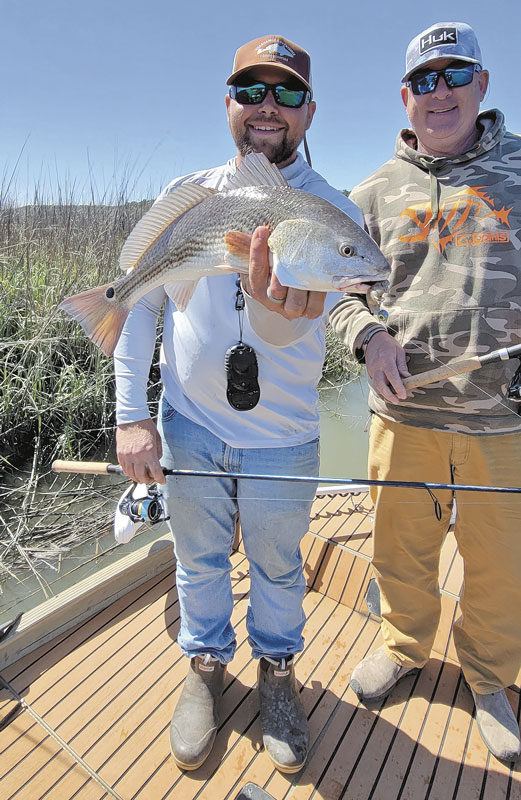
Mixed bag of redfish and speckled trout are abundant and feeding in May
Stability.
That’s what Capt. Stephen Flook of Unashamed Adventures said he — along with inshore gamefish — love about the month of May. He’s mainly talking about air and water temperatures, which usually range between extremes during March and April
“As good as the fishing is during March and April, some days are especially tough because of the fluctuations of air and water temperatures. In May, those temperatures are usually stabilized. This concentrates the bait. And that puts the fish on a much more normal pattern,” he said.
Flook spends most of his time fishing the central part and lowcountry of South Carolina’s coast. But he said the creeks, inlets and main waterways throughout both Carolinas are pretty similar when fishing this month.
“You’ll find redfish in all the normal places this month. Grass lines, oyster beds and feeder creeks are all good spots for redfish. And if you find all three in close proximity, that can be a gold mine,” he said.
Anglers can also catch plenty of reds on flats, especially those that have access to deep water.
Just because air and water temperatures are generally consistent this month doesn’t mean the fish are easier to locate. But they do tend to bite better day after day instead of being hot one day and dormant the next, as can be the case during wild temperature fluctuations of March and April.
Keep at it
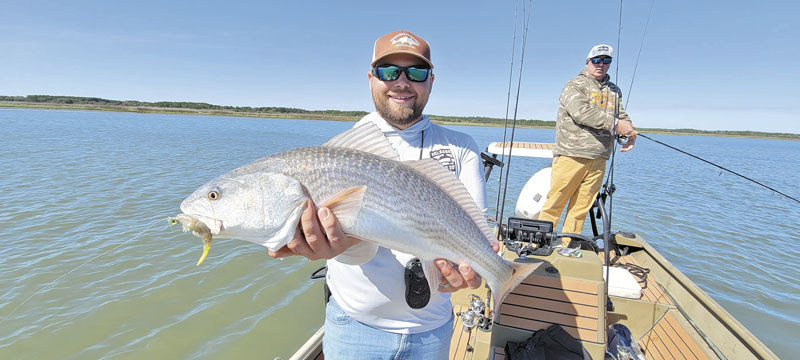
“These fish move around a lot, so every day is different. But the fishing gets better and better each day this time of year. You just have to be willing to search and not give up just because the fish aren’t in the same spot they were yesterday or last week. These fish are hungry and they’re following the baitfish around. This time of year, you’ll find plenty that are willing to bite.
“You might hit one spot first thing in the morning and get nothing, then try a second spot and get nothing. And then you try the third spot and it’s on with non-stop action,” he said. “Be patient but don’t waste time at unproductive spots,” he said.
And when looking for productive spots, Flook will check out likely-looking honey holes, looking for surface wakes, flickering, or boiling water.
“When you see signs of life, that’s a good thing. Even if you know it’s just mullet or shrimp causing those surface disturbances, redfish are often mixed in with them. That’s what the redfish are looking for. So any time I see signs of life like that, I’m going to give that spot a try,” he said.
Get skinny for a mixed bag this month
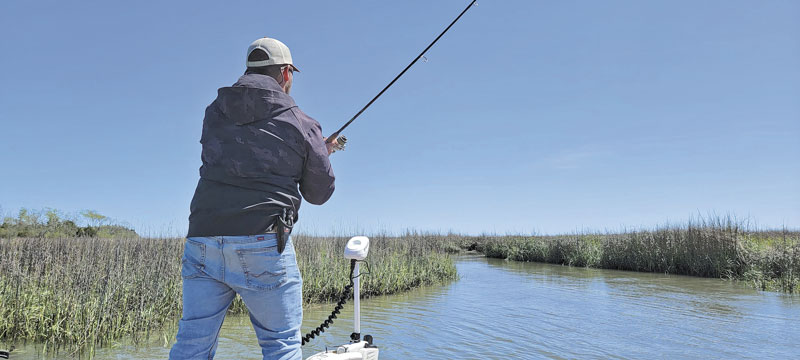
One strategy Flook (864-430-8830) uses for redfish is he gets into the mouth of small creeks as the tide is going out, pitching Z-Man EZ-ShrimpZ into the creek. Lots of redfish are ganged up in those mouths, gorging on baitfish as they move out of the creek just before the tide goes to dead low.
“You have to be careful that you don’t get your boat stuck, but this is a great way to pick up a handful of redfish pretty quickly,” he said.
Those fish like to eat up as the tide is leaving, knowing it will be 6 hours before they can get back in that water. At low tide, they’re relegated to cruising the main channel where it’s tougher to ambush prey.
He’ll do the same as the tide moves in to those same small creeks. The redfish will move in as soon as they can, ready for a meal that’s easy to catch in the shallow pools.
Wading is also effective
Whether on the incoming or outgoing tides, Flook won’t hesitate to anchor his boat and get out to wade fish the small creeks. This can be extremely effective in even the smallest of creeks that get completely cut off from the main channel at dead low tide.
“If the creek keeps enough water in it at low tide, some fish will stay in there. It keeps them protected and it’s also easy for them to find plenty of baitfish and crabs to eat. The skinnier the water is, the easier it is for them to find plenty of food,” he said.
The trick is knowing which creeks hold enough water at low tide for that possibility, and that comes with experience on the water and continually trying new places.
“When anglers go fishing for a day, they should always try to spend some time checking out a place they’ve never fished before. If they find something they like, they can add that to their list of honey holes. If not, they can eliminate it from future trips. Either way, they’re learning,” he said. “It’s easy to get stuck in a rut of fishing the same spots over and over, especially when they continually produce.
“But you’re better off having numerous spots to try. Because on the day that your top spot isn’t producing, chances are good that the fish are biting somewhere. So continually finding new spots gives you confidence in more areas. And confidence is a big part of it,” he said.
Break out the sauce
Another key for Flook that many anglers ignore is the use of commercial scents. He’s a big believer in using Pro-Cure. He applies it liberally to every lure, and he refreshes each lure often.
Once he gets a soft plastic lure on his jighead, Flook dabs the scent up and down all sides of the lure. He said it can make a big difference in a day of fishing.
“On some days, fish are just going to bite better than others. You always want to stack the odds in your favor. Using Pro-Cure can turn a good day into a great day, or a slow trip into a good one. It’s inexpensive enough and effective enough that I won’t go fishing without it,” he said.
 Don’t ignore the specks
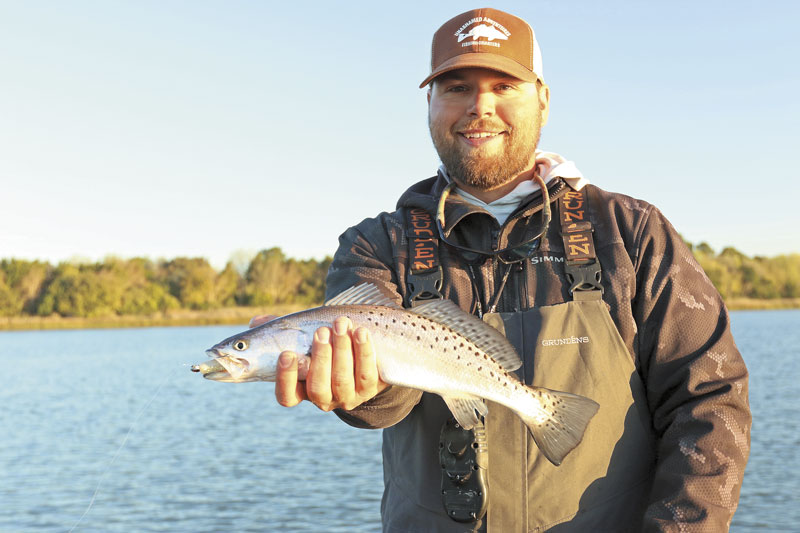
Speckled trout are also in the mix this month, especially during the early morning hours. Flook likes to chase them first thing, mainly staying in smaller creeks and fishing the grass lines and oyster bars.
“You’ll catch both species in the same type spots right now. You can’t go wrong throwing soft plastics on jigheads along grass lines and over and around oyster bars. Sometimes the trout will be right over the top of oysters. Other times, they’ll hang 10 or 20 feet off of them. You just have to pick at it until you see what they’re doing that day,” he said.
Everyone loves to have a fish crash a topwater lure, and Flook said that is definitely possible from the trout this month.
“Especially when a good tide matches up with the sunrise, the topwater bite can be phenomenal. Any of the MirrOlure topwater baits are great. The Heddon Spook and Spook Jr. are also good choices.”
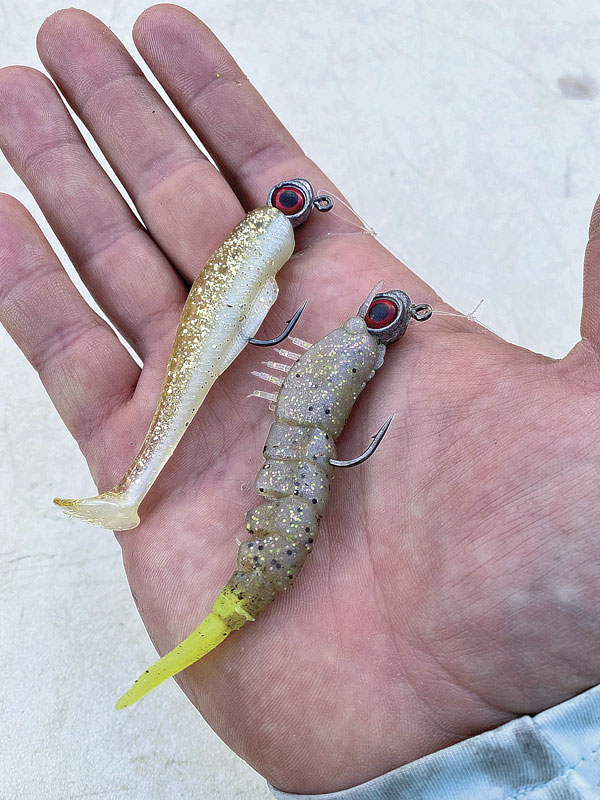
Z-Man lure selection for inshore mixed bag fishing
Capt. Stephen Flook always keeps live bait handy in May, but he really prefers catching redfish and speckled trout on artificial lures. His favorites are Z-Man MinnowZ and EZ-ShrimpZ.
The lures are made of ElaZtech, which is 10-times tougher than plastic used in making many other lures. He rigs them on Z-Man’s Trout Eye and Texas Eye jigheads and slathers them with Pro-Cure scent.
“Anglers have lots of soft plastic lure options, and many of them work great. But I find the Z-Man lures to be more durable than any others I’ve tried. You can put one on and catch fish on the same one all day long,” he said.
When it comes to colors, Flook uses a big variety, but he does have his favorites.
“I like the Beer Run color and the Slam Shady color a lot. But the water clarity really determines what colors I use on any given day. In clear water, I want to use more natural colors. In dingy water, I’ll use a lot of chartreuse-type colors.
Flook said one mistake many anglers make with these lures is fishing them too fast.
“I want to feel the bottom when I’m working these lures. You don’t want it to rest on the bottom because you’ll get hung up a lot that way. But you want to reel slowly enough for it to scrape along the bottom as you work it,” he said.
And it’s not just a straight retrieve most days.
“When I make a cast, I’ll let it sink all the way to the bottom, give it a couple of twitches, reel in the slack, then another couple of twitches. If that’s not working I’ll adjust a little bit. But that’s usually good enough to catch plenty of redfish and speckled trout,” he said.


Be the first to comment