

Casting accuracy is the key
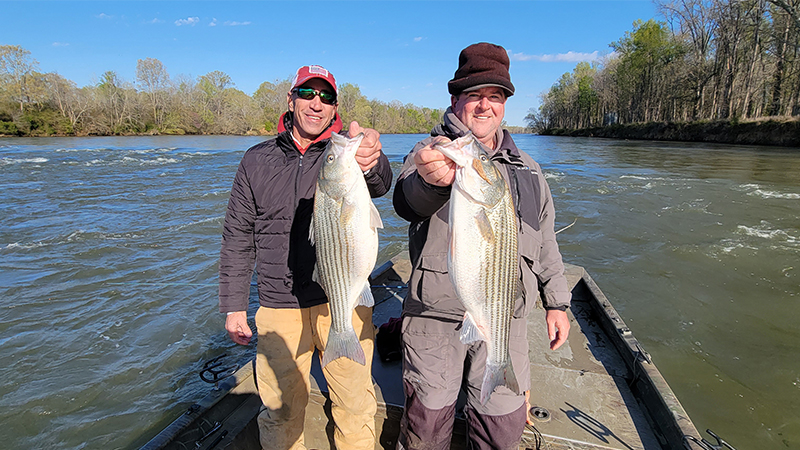
Striper fishing kicks up a notch this month, especially on the Wateree River, where Capt. Jason Wolfe of Wolfe’s Guide Service treats his anglers to one of the most unique fishing trips in South Carolina’s midlands.
“The Wateree River is really a unique river for this part of the state,” said Wolfe. “It starts off at the base of the Lake Wateree Dam, and it’s full of big rocks that make it look like more of a mountain river, and as you make your way down, it flattens out and begins to look much more like a midlands-area river.”
But those rocks are really where it all happens this month. Stripers migrate out of the Santee Cooper lakes and make their annual spawning run. They run up as far as they can go, which in this river is to the base of the Lake Wateree Dam. They wait until the spawning urge strikes, and while they wait, they feed heavily.
Be accurate
Wolfe said the stripers are spread out throughout this rocky area, and the fish can be just about anywhere at any time.
“When you fish it often enough, you’ll see some patterns develop, but many fishing patterns will work because the fish are so spread out, and some of these fish are relating to groups of rocks, some are keying on cuts in the bank, some are swimming in and out of slackwater pools, and some are moving around all of those on any given day,” said Wolfe (803-487-3690).
On some days, Wolfe said anglers can cast anywhere they want and have a good shot at hooking up.
On other days, he said anglers need to be much more selective in where they cast, and they need to be accurate in their casting.
“This time of year, we have cold fronts move in, we have warm fronts move in, we have the potential for rainstorms and on and on. And the fish react to those drastic changes,” he said. “Sometimes it makes them hang much more tightly to cover and structure. And on those days, you’ve got to put the lure right on target, or at least very close to it.”

Gear up
And when it comes to lures, Wolfe said it’s tough to beat a Cotton Cordell Red Fin. These wake baits come in a variety of colors and sizes, and Wolfe said her prefers colors like chrome, bone, and smoky joe. Any size will work, and Wolfe said anglers should experiment with different ones until they see what they fish are in the mood for.
“Some days, they’ll hit any size lure. Other days, you’d be surprised at how picky they can be,” he said. “You can think it’s time to head out because they’re not biting, but then you change the lure from a 5-inch to a 7-inch, and all of a sudden, it’s on like gangbusters.”
One great feature of these lures is that they’re especially easy to fish. All it takes is a steady retrieve to entice these fish into biting.
“Once it hits the water, just start cranking the handle, but you don’t have to twitch your rod or anything. Just retrieve it steadily and let the lure do the work for you,” said Wolfe. “If there’s a striper in there and it’s hungry, it’ll nail it. You won’t have a question in your mind about whether it’s a fish or not. It will be unmistakable.”
And when an angler hooks up, Wolfe said other anglers in the boat need to be ready.
Go for two, or three
“Don’t be shy about casting right where your buddy just got a bite, or even right close to where his fish is while he’s fighting it. These fish run in groups, and on some days, they’re very aggressive,” he said. “They’ll try to take the lure right out of another fish’s mouth. So if you put another lure right next to them, it can get crushed right quick.”
That’s one reason Wolfe said it’s not uncommon for a party of anglers to experience multiple double- and triple-hookups throughout a trip here.
“That’s why, even if there’s been a little lull in the action, once an angler hooks up, I tell the other anglers to be ready,” said Wolfe. “And most are surprised at how often doubles and triples take place. It can get really exciting in a short period of time when everyone in the boat is hooked up.”
Wolfe said spinning gear will work here, but he recommends baitcasting reels on pretty stout rods.
“Spinning reels are okay for anglers that aren’t skilled at using baitcasters, but overall, baitcasters are more accurate and give anglers a bit more control when fighting these fish,” he said. “They are ideal for striper fishing in this river.”

Get the net
It’s important to have a good net, because these fish can be a real handful when trying to get them on the boat without one. These are strong fish to begin with, and once they’ve spent a few weeks in this section of the river, they’re used to fighting the current all day. They don’t give up easily, and trying to deal with them barehanded can result in lost fish at best, and a handful of treble hooks at worst.
One of the most significant details about fishing here is that you need to have the right boat, or rather, the right motor. This river is so full of rocks and boulders, many of which are exposed, and many of which are merely inches below the surface, that a regular outboard motor just isn’t feasible.
Wolfe uses a Yamaha jetdrive motor, and he said he wouldn’t head this far up the Wateree River without one.
Don’t get stranded
“Every year, I see boats stranded up here because they’ve completely destroyed every blade on their prop, or torn the foot off the motor entirely,” he said. “You’ve got to be careful even with a jetdrive that you don’t throw someone out the boat by slamming into the rocks, or that you don’t lodge your boat on top of the rocks and find yourself stranded.”
He also said anglers need to keep a close eye on the river level, which will change througout the day as the dam operators open or close gates, either bringing in an influx of water, or dropping the water level.
“I like to take a close look at the banks, see where the water line is, and then monitor that regularly during each trip,” he said. “If they lower it too much, you’ll end up high and dry before you know it. It’s easy to lose track of that stuff when the fish are really biting good, but you’ve got to keep that in mind and get back downriver when that water starts dropping.”
Weather is a factor this time of year, and not just for the fish.
“March is one of those funny-weather months,” said Wolfe. “It can be sunny and 80 degrees one day, then cold as winter the next. A few years ago, I had a group out here and it was 25 degrees in the morning, then warmed up into the 60s by the time we quit fishing. You don’t need to cancel a trip because it’s cold though. These fish will change their behavior a little bit, but they’ll still bite. Overall, this is probably the best month for fishing here, because the numbers of stripers here is so great. But once they are done spawning, the majority of them head back to the Santee Cooper lakes. This is a unique opportunity to catch them in this setting.”
This is one of the most popular trips Wolfe offers his clients, and his books fill up quickly, many with repeat customer who fish with him here year after year. Book a trip with him at https://wolfesguideservicellc.com, or by calling him at 803-487-3690.
Be the first to comment