

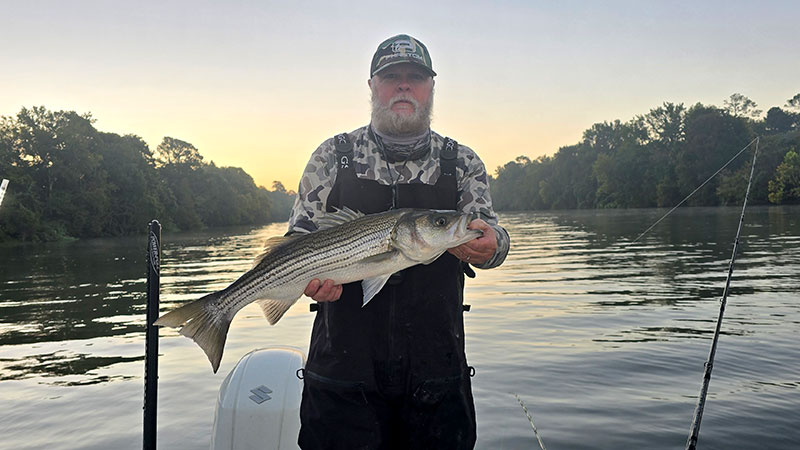
This month, anglers on the Santee Cooper lakes have a few choices when chasing stripers.
One of those choices is when to fish. Anglers who don’t mind skipping breakfast to get on the water super early will have a leg up on anglers sleeping in.
But for those who get on the water a little later, they still have a great chance of catching plenty of stripers, but it probably won’t be the quick-hitting style the early morning anglers generally enjoy.
“Getting out there before the sun even peaks,” said Capt. Joe Dennis of Chasin’ the Wild Outdoors TV, “is usually going to result in you limiting out early enough to get back to the landing in time for breakfast.”
Dennis (843-245-3762) said anglers should look for stripers in fairly shallow water if they’re wetting a line when it’s still dark.
Bonus fish
“But once the sun shows up,” he said, “I find most of the fish have moved into deeper holes and creeks along the main channel.”
Dennis calls those before-the-sun fish “the daily bonus.”

“Most people are surprised that you can catch a few stripers when it’s still completely dark,” he said. “And getting those bonus fish in the boat before the sun rises puts you in prime position to limit out early.”
That’s because, he said, the striper bite starts off fast and furious on most mornings. But then as the sun gets up, the bite becomes more spread out.
“Fishing here in November is great. The weather is usually cooled off enough to do away with mosquitos,” he said. “And the fish really eat a lot as the water temperature continues to cool down.”
Catching the fish is a matter of putting live herring in front of them.
“This is when you really need to be familiar with the capabilities of your electronics,” Dennis said. “You just need to find bait balls with stripers on them, then drop your bait to them.”
But, Dennis said, you don’t want to be sitting still when offering them bait.
Movement
“I want a little breeze, a little current, or I’ll want to drop my trolling motor and set it on 0.4,” he said.
Using a Carolina rig with a fairly long leader, Dennis drops his baits until they’re slightly higher than the fish he’s marking on his graph.
“You need to keep live bait on your hook,” he said. “If you get hit, but the fish doesn’t fully take the bait, reel in slowly and check to make sure your herring is still lively. If it’s not, put a fresh herring on.”
Dennis also insists on putting his rods in his Driftmaster rod holders once he’s got the bait out.
“It’s best to just leave them in the rod holders until the fish has the rod doubled over,” he said. “If you’re trying to set the hook at every nibble, you’re going to lose a lot of fish and go through a lot of bait.”
Once the sun is up good, Dennis said he’ll sometimes abandon his traditional technique of keeping his bait just above where he’s marking fish.
“If the bite is slow, I’ve found that sometimes the stripers want the bait right on the bottom,” he said. “So I’ll have my anglers drop the bait until they feel it hit bottom, then I’ll have them hold the rod as the bait bounces along the bottom.”
Stripers will school here sometimes during November, so Dennis said it’s always a good idea to have a rod or two on board with a topwater lure tied on.
Be the first to comment