



If you want to catch good numbers of trout in the winter, head for a delayed-harvest stream. These streams are heavily stocked in October and November, and fishing remains good throughout the cold months. Streams are stocked again for the spring season beginning in March, and some stockings continue through early summer.
With the addition of two new sections this year, western North Carolina has 38 streams or sections of streams and two small lakes in the delayed-harvest program, approximately 75 miles of water spread over 21 counties, from Macon County in the far west to Surry County in the north-central part of the state.
Initiated in 1992 and patterned after a similar program in Pennsylvania, delayed-harvest is one of the N.C. Wildlife Resources Commission’s most-popular and most-successful fishing programs. Counties that have delayed-harvest streams have enjoyed significant increases in tourism dollars. Guide services and outfitters have proliferated. Studies show that fly-fishers, especially those from surrounding states, spend significantly more money than traditional fishers.
The 1992 pilot program included four streams, and catch-and-release restrictions were in effect only in the spring. As popularity increased, the program was expanded. Streams now are under delayed-harvest regulations from Oct. 1 until the first Saturday in June, offering eight months of prime fishing. The rules are simple: only artificial lures or flies with a single hook may be used, and all fish must be released. Delayed-harvest streams are posted with black and white diamond-shaped signs.
During the summer and early fall, the streams are regulated as hatchery supported waters, allowing fishers to use live bait or artificial lures and keep up to seven fish per day with no size restrictions. Most of the fish usually are caught the first two weeks of the catch-and-keep season. Biologists say concentrated numbers of trout likely would not survive during the summer, when the water warms up. Enough stragglers survive, however, for productive fishing throughout the summer.
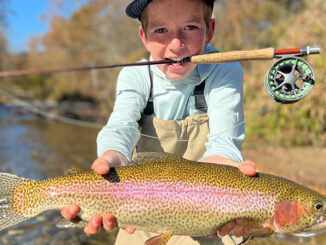
Fishing guides especially like the delayed-harvest streams. They are ideal for learning to fly-fish because even a novice can catch a trout or two, a luxury seldom found on wild trout streams.
The Commission devotes approximately 50 percent of its annual trout production to the delayed-harvest program. Equal numbers of brook and rainbow trout are stocked, along with lower numbers of brown trout, in October, November, March, April and May. A few streams are stocked through July.
The Tuckasegee River in Jackson County was stocked with 7,840 rainbow trout, 7,840 brook trout and 3,920 brown trout in October and November. That’s 19,600 trout spread over 5.5 miles of water. The majority of the stocked fish are at least 10 inches; a smaller number of trout 14 inches and longer also are stocked. Very few streams have that density of trout.
Streams selected for delayed-harvest designation must be accessible and able to contain large numbers of trout. Biologists select and propose streams for the delayed-harvest designation. The proposed streams are presented at annual public hearings, and if the streams get a favorable reception, the proposals are sent to the Commission for approval.
In most cases, streams proposed for inclusion in the program receive little or no opposition. Exceptions have occurred. Several years ago, a section of Big Snowbird Creek in Graham County was chosen for inclusion in the program. Local opposition was so intense that the proposal was quickly withdrawn. A few years later, a 2.8-mile section of Big Snowbird was included in the delayed-harvest program with little opposition.
The newest additions to the program are a 2.2-mile section of the lower Tuckasegee River in Swain County and a .6-mile section of Cane River in Yancey County.
According to the Commission’s posted stocking schedule, the most heavily stocked waters are the Tuckasegee River in Jackson, between the bridge on NC 107 at Old Cullowhee Road to the falls at Dillsboro; Wilson Creek in Caldwell County, the game land section below Lost Cove Creek to Phillips Branch; and the Nantahala River in Macon County from Whiteoak Creek to the Nantahala hydropower discharge canal.
After the fall stocking, the Tuckasegee River will be stocked in March, April and May for a total of 49,000 trout, Wilson Creek will get 23,500 trout in five stockings, and the Nantahala River will get 16,500 fish in its fall and spring stockings. That’s plenty of trout for everyone.
As for fishing techniques and what to use, two area guides offered their suggestions.
Shane Buckner of Hunter Banks Co. in Asheville said stocked trout usually will not bite the first day or two after being put in the stream.
“They’re thrown through the air into foreign territory, so it takes a day or two for them to get acclimated,” he said.
Buckner suggests using egg patterns and girdlebug-type flies.
“Anything with flash, such as a Copper John, will work really well,” he said.
Other recommended flies are a Prince nymph and Woolly Bugger.
Jeff Furman, a guide for Davidson River Outfitters in Transylvania County, suggests rubber-legged patterns and bright attractor flies such as a San Juan Worm or Squirmy Wormy.
“Big egg clumps also work very well,” he said.
For the purist trout fisher, delayed-harvest streams likely will be snubbed, but for the person who delights in catching trout and plenty of them, delayed-harvest is the way to go.

Be the first to comment