


Forward-facing sonar makes finding post-spawn slabs easier than ever
When crappie make their post-spawn move away from the shallows, fishermen are no longer befuddled about their whereabouts as in days of yore.
Veteran crappie stalker Joel Munday of Outdoor Expeditions Guide Service (www.outdoorexpeditionsUSA.com) literally puts offshore crappie in his sights by using his Lowrance HDS Live unit with ActiveTarget that enables him to view schools of crappie inhabiting deep waters at Jordan Lake once the water temperatures reach the lower and mid-70s.
“After crappie complete spawning, they form large schools of 50 to as many as 100 fish. They bunch together in brush piles, either natural or planted, situated off of points in 10 to 14 feet of water,” said Munday. “A sunny day helps push them together in the brush.”
Munday sometimes searches for these places with his side-scan function. But he mostly goes directly to hundreds of waypoints that he has created during years of fishing at Jordan that indicate brush.
For his searches, he makes certain he explores waters above the thermocline.
“I also occasionally devote three or four hours looking for fresh brush piles that fishermen have planted so I keep adding to my list of waypoints that indicate crappie places,” said Munday.
Look forward
Once Munday locates a large school of offshore crappie, he puts the latest forward-looking technology to work by engaging the ActiveTarget function on his Lowrance unit.

“I can use settings on my unit to target fish 50 feet in front of me in live time and examine how they’re positioned,” said Munday. “Then I can cast jigs directly past them and retrieve the jigs over or through them, or lower the jigs in their midst, and watch how the fish react and bite or don’t bite. Each cast is a learning lesson.”
Munday maintains his boat position by employing the anchor lock function on his trolling motor.
Munday credits the forward-facing sonar technology for greatly enhancing his catches.
“I’m catching fish I never could have caught before,” he said. “It’s like targeting them with a flashlight. When the fish scatter as so often happens after I catch a number of them, I can scan the surroundings for suspended fish. The fish usually don’t move too far. With ActiveTarget’s forward-looking feature, I can see the fish move in and out of the brush piles and where they go, and I can follow them.”
The lake’s stable water level aids the technology.
“Jordan’s a flood-control lake. Yet it doesn’t fluctuate much unless there are heavy rains. So the depth of the brush remains fairly constant,” said Munday. “But when the lake rises and puts the brush at greater depths or has fish suspended in the water column, I can use the live sonar to find and catch them.”
The new Live Scope technology lets him use a more stealthy approach.
“I believe over the years, fish have become ‘sonar sensitive,’ that is, sensitive to traditional cone-shaped sonar presentations by fishermen,” said Munday. “Almost every fisherman owns a standard sonar unit. With forward-facing sonar, I don’t have to idle directly over schools of crappie or down scan to see if they are there.”
On the rise
Rising water often dictates additional searches for fish.
“In a situation where you have rising water, the fish will usually scatter and no longer relate to the bottom or brush piles like they do in stable water,” said Munday. “My live sonar enables me to search for schools of suspended crappie in the water column or schools moving from one area to another.”
Rising water may also compel him to fish vertically.
For vertical fishing, he may opt for live bait presented via a dropper rig with 15-pound braid for the main line and with an offset leader of 8- to 10-pound line tied to a 1/0 Aberdeen bait hook. He may also try a vertical presentation with jigs.
But with stable water conditions, he sticks with casting to fish in brush with jigs and minnows.
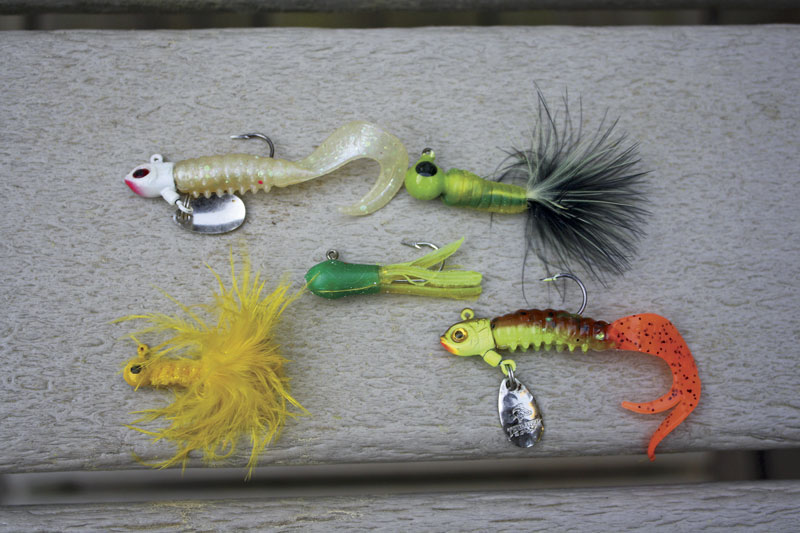
He likes medium to medium-heavy spinning outfits for casting or vertical fishing with jigs, favoring 1/8- or 1/4-ounce models in natural colors for clear water, and chartreuse/white and green colors for dingy water.
“Rods must have enough backbone to pull crappie from the brush,” he said.
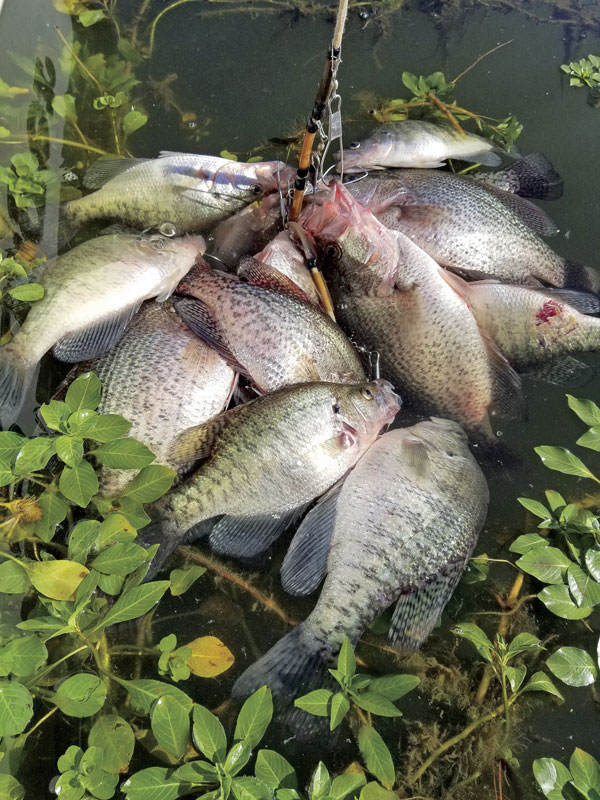
His reels are spooled with 6- to 8-pound line.
Surprisingly, Munday does not slow-troll for post-spawn crappie, preferring to use his ActiveTarget technology to catch them.
His forward-looking unit and other Live Scope technology systems aren’t cheap. They range in price depending upon brand name, display size and other factors. The technology will set you back at least $1000.
What’s more, learning how to set them up and how to use them takes time and effort. Some companies offer online training videos on the various functions built into their systems.
Munday himself offers one-on-one training sessions on their use.
“Unless you’re knowledgeable about sonar units and electronics, you just can’t set up the system and use it overnight. It takes some effort to learn their capabilities,” he said.
Jordan remains top-notch crappie fishery
The N.C. Wildlife Resources Commission has monitored the crappie fishery at Jordan Lake since 1986.
“Biologists sample Jordan Lake for crappie once every 3 to 5 years,” said Danci Guiot, assistant fisheries biologist for District 5.
Over this period of time, Jordan Lake has remained an excellent crappie fishery, ranking as one of the best in the Piedmont Region.
The most recent survey took place in the fall of 2020.
As with prior surveys, trap nets were set out at randomly selected sites to catch crappie of all sizes as they prowled the shallows at dusk and into the night. The nets were not removed until a minimum of 400 crappie were collected, an undertaking that required two nights.
The 2020 sampling revealed that approximately 38 percent of the population was available for harvest.
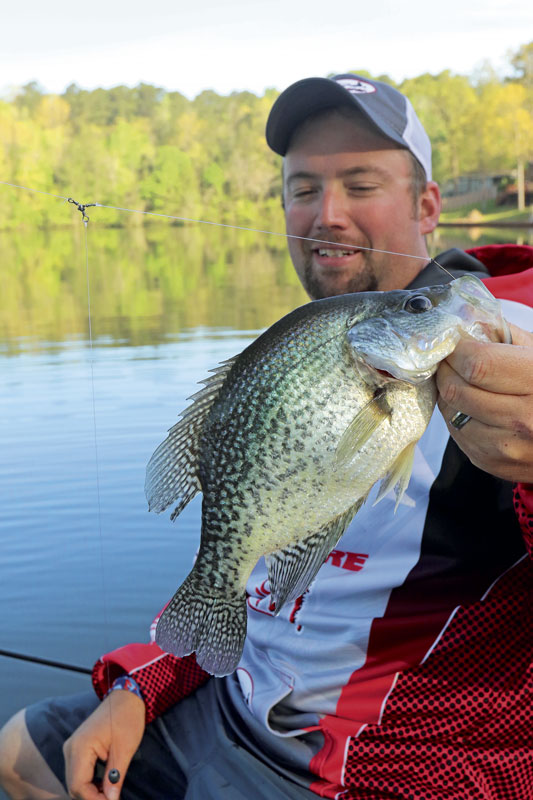
“At Jordan, black crappie reach the harvestable size of 10 inches within two years,” said Guiot.
The sample indicated that black crappie have excellent body condition, a reflection of a healthy population with plenty of available forage.
The biggest crappie caught in the 2020 sampling weighed almost 1.6 pounds, which was typical of previous surveys.
After the NCWRC reviewed the available growth data, a regulation change has been proposed that would reduce the 10-inch size limit on crappie to 8 inches, while maintaining the current creel limit of 20 crappie per day.
Guiot said fishermen will know if this regulation change is accepted by July 2023 following the annual angler feedback on proposals initiated by the NCWRC.
Be the first to comment