


To an angler in the solitude of the bottomland hardwood canopy arching from the banks of the Roanoke River, the catchy rap song, “Getting’ Jiggy Wit It,” by Will Smith throbs into mind. Although the tune is lively in contrast with the surroundings, somehow the opening line, “Bring it, Woo!” seemed an appropriate accompaniment to the rhythmic action of the fishing rod in the hands of guide Mitchell Blake as he danced a jig along a slough.
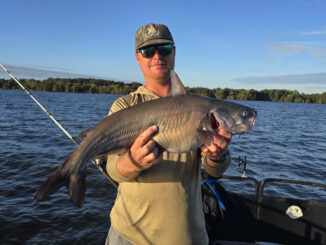
A sudden strike brought an equal and opposite reaction. Blake set the hook hard, and the fish powered a sweeping curve in the rod when it bulldogged toward cover. The blue catfish on the end of the line, Blake’s dance partner, eventually tired from all of its rocking, rolling and spinning. Lipping the fish with his Fish Grip, he admired it for a moment, held it for a photo and gave it respite on a bed of ice.
“It’s that easy,” Blake said. “Find the right slough and you’re going to catch all the blues you want.”
Blake, 42, from Chocowinity, N.C., operates as FishIBX, He grew up in Jamesville and has been guiding on the Roanoke, Neuse and Pamlico rivers and the Pamlico Sound for 22 years. Tagging along on the trip that day in 2020 was his 13-year-old son, Kaden. Anyone watching him match his father, cast for cast, catfish for catfish, would be envious of his opportunities, or according to the song’s lyrics, “Wishing they was dancin’ the jig. Here with this handsome kid.”

“It takes hard-earned knowledge of all three river systems to make a living as a guide, because the fish move around so much and the species change with the seasons,” Blake said. “After April, when the stripers leave, the anglers leave, too. I was catching 70 stripers a day, and it dropped down to two fish a day. I was trying to locate the last of the stripers to see if I could get clients to come back for some catch-and-release fishing. As I was checking out a slough along the edge of the river, I saw marks on the depth finder screen. Thinking they were stripers, I hit them with a jig. But they turned out to be blue catfish. Both fish make marks that look the same.”
Blake had struck the catfish mother lode. The biggest blue he had gotten jiggy at this time last year weighed 28 pounds, and that was only a few weeks after figuring out the new style of fishing. He was hooking and landing as many as 50 to 60 blues during a half-day jigging for them.
Staying in place

Keys to catching Roanoke River catfish are finding them, dropping jigs enticingly in their faces and keeping hooks from snagging submerged roots and fallen trees. Blake uses old technology, watching for floating leaves along the edges to tell him where sloughs are located, as well as the new technology of a finely tuned sonar unit to confirm fish are actually down there. The most important piece of electronic gear is a self-anchoring Minn Kota trolling motor for his 23-foot bay boat.
“Your fishing is not nearly as productive when you use the old method of setting out an anchor, tying it off with a line and casting a cut bait on a bottom rig,” he said. “The riverbed is littered with woody cover that can hang up any anchor. Getting it loose can be a frustrating experience, if you even manage to get it loose. Every fish nearby is going to be spooked by the commotion. Once I find a productive spot, I just program it into the trolling motor and when I return to fish it, the i-Pilot feature holds me in the best position for working a jig into precisely the right spot. It doesn’t take long to figure out where the worst hang-ups are located and where the fish bite best.”
Sensitivity training
Blake uses 30-pound braid, tying it directly to the jig without a leader. The braid is sensitive enough to allow him to feel the most-subtle strike and strong enough to pull the jig free from most snags, although the hook may bend under the pressure. If the hook bends, Blake fixes it with pliers. He also uses pliers to turn a quarter-inch side offset in the hook point in relation to the shank. The offset increases the probability of a hookup. If a catfish has the jig in its jaws and the hook is laying flat without the offset, it can slip out of its grip when the angler sets the hook. As the song says, “I just bite it. It’s for the look. I don’t light it.”

“A catfish strike is not like a striper strike,” he said. “It’s more of a thump, like a speckled trout strike. A striper strike is a harder hit. It’s more like a flick than a thump. I also get strikes from flathead catfish, channel catfish, largemouth bass, crappie, bowfin and gar.”
Blake’s son took to the technique quickly.
“I just started catching catfish on a jig, and it’s fun,” Kaden Blake said. “I think stripers are more aggressive, but catfish are here when the stripers are gone, and the action is just as fast for as long as you feel like catching them.”
Out of the mouths of babes indeed come words of wisdom. All it takes for anyone else to get in on the same astounding action is gettin’ jiggy wit it.
DESTINATION INFORMATION
HOW TO GET THERE — The town of Jamesville is on US 64, a few miles east of Williamston. The NCWRC’s Astoria Boating Access Area is at 1333 Astoria Drive, off Main Street, about 1.1 miles from US 64.
WHEN TO GO — Blue catfish provide a excellent opportunity after the striped bass season ends in April, with great jig fishing extending into May, June and beyond.
BEST TACKLE — Any half-ounce bucktail jig with a soft plastic shad-tail or curlytail trailer that works for striped bass will also catch catfish. Use medium-action baitcasting or spinning tackle spooled with 30-pound braid
FISHING INFO/GUIDES — Mitchell Blake, FishIBX, 252-495-1803, www.fishIBX.com. See also Guides & Charters in Classifieds
ACCOMMODATIONS — Holiday Inn Express, Plymouth, 252-793-4700; Road Trip Motel, Plymouth, 252-741-9486; Holiday Inn Express, Williamston, 252-799-0100; Quality Inn, Plymouth, 252-792-8400.
MAPS — DeLorme North Carolina Atlas and Gazetteer, 800-452-5931 or www.delorme.com.
Jigging up blues from the sloughs
The edges of Roanoke River sloughs between Williamston, Jamesville and Plymouth are submerged, so anglers cannot actually discover their location by merely looking at the banks.
However, there is a way to find them visually by looking for current seams where the water is flowing swiftly but leaves are floating slowly on the surface.

A trout fisherman who enjoys fishing mountain streams in autumn should be very familiar with spotting this type of current disruption. The difference in flow velocity is stark, and a seam may lie parallel to a straight bank, in a cove or at a small nook in the trees.
In most places, the Roanoke River channel is about 20 feet deep; the outer edge of a slough typically rises to within 4 to 6 feet of the surface. The sloughs average 8 to 10 feet deep. Beyond the slough is the bank, which usually has underwater roots, cypress knees, logs, fallen limbs and uprooted trees projecting from it. This woody structure helps hold catfish in the sloughs. Nevertheless, the main attraction is food, which includes eels, baitfish, crawfish and other creatures that are there as a consequence of the underwater anomalies and eddies that allow them to congregate and rest out of the main current flow.
After an angler visually locates a seam that indicates a potential slough, he can move close to the bank to scan the area with a sonar unit. Anyone who has located striped bass with their depth finder will notice that blue catfish make similar marks on the screen. Like striped bass, they form dense schools when they are stacked up in a slough.
An angler can locate several sloughs and return later the same day or on a subsequent trip to fish them. It may be possible to tie the boat off to a tree limb or trunk or drop an anchor to the bottom and fish. However, the most-important piece of the slough-fishing puzzle is using a trolling motor that has an anchoring feature to position the boat in just the right spot for the angler to make short, accurate casts with a bucktail jig and soft plastic trailer.

Be the first to comment