


Clarks Hill’s overlooked monster cats
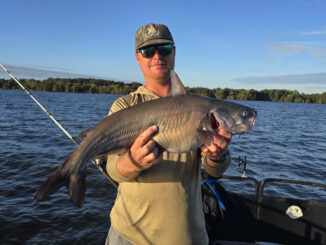
A booming blue catfish population, a sizable and stable flathead population and hordes of chunky channel catfish all combine to make Clarks Hill Lake a great catfish-catching destination.
Yet this huge lake situated on the South Carolina/Georgia border on the Savannah River is an often overlooked catfish-producing hotspot.
This 71,000-acre Corps of Engineers lake is also known as Strom Thurmond Lake. It’s the third largest artificial lake east of the Mississippi River, trailing only Kentucky Lake and Lake Marion in size.
The diversity of catfish habitat at Clarks Hill lends to the excellent populations of the “Big Three” catfish species: the blue, channel and flathead catfish.
Professional fishing guide Chris Simpson has guided on multiple lakes with consistent big catfish-catching success over many years. But for the last 10 years he’s found his fishing home at Clarks Hill.
“I’ve found everything I want in terms of catfishing in one place at Clarks Hill,” Simpson said. “The lake is huge and has an incredible diversity of water and catfish habitat. With blues, flatheads and channels all found in good numbers, the fishing is amazing and it sets up for year-round success.
“Blue catfish are abundant and winter is prime season for excellent action on blue catfish. But we’ll catch channel catfish consistently and flathead catfish occasionally during the winter,” he said. “The water temperature gets low in January, but the catfish bite stays good.”

Big fish month
Simpson, (864-992-2352, Fightin Da Blues Guide Service), said he’ll focus on blue catfish as his primary target during winter. And the big-fish bite is particularly active.
He said the depth pattern trends toward deeper water as the water temperature gets colder. Catfish move to the lower end of major tributaries and along the Savannah River channel, and the blue catfish in particular are often in the 30- to 40-foot depth range and even deeper by late January.
Simpson advises newcomers to understand that unlike the fishing pattern on many lakes, drift fishing is not always the best ‘go-to’ tactic on Clarks Hill.
“It’s not that the drifting technique doesn’t work. But it’s the habitat that dictates strategy,” he said.
“Clarks Hill has a significant amount of underwater woody debris creating very snaggy conditions,” he said. “For long, controlled drifts, I’ve had to study maps and then proof-fish areas to ensure they’re productive. I’ve found plenty of areas for great drifting success. But I recommend fishermen check areas with their electronics before just starting to drift fish.”
Fewer drifting opportunities plays into Simpson’s strong suit, since he’s long been an advocate of anchor fishing for big catfish. And he’s found that technique to be highly effective here.
“The graph is my best friend when searching for places to set up for anchor-fishing,” he said. “I rely on it to target small, specific areas where catfish congregate.”

Deep or shallow?
“Weather conditions are important and often dictate my approach in terms of whether I fish deeper or shallower based on existing conditions,” he said. “A good example is I’ll fish toward shallower areas on cloudy days and deeper during clear post-frontal conditions.”
Simpson said he plans his anchor fishing setups on specific targets including points, humps and creek and river channels.
“Big blues are attracted to these types of areas,” he said. “When anchor fishing, I’m using a basic Carolina catfish rig with up to 2 ounces of weight, plus I’ll also use a Santee drift rig setup as well, but cast to a stationary position. The float on the drift rig causes the bait to be just off the bottom and sometimes that small thing will make a huge difference. Some days both rigs work. But often they prefer one over the other.”

Simpson said before anchoring he wants to graph a lot of catfish, along with ample forage, in a small, defined area. The type that has the potential for a good anchor bite.
Simpson said his basic pattern for drift fishing is to employ the graph and search for a combination of big fish and forage fish scattered in a definable area that’s reasonably free of debris and can be drifted for a considerable distance.
“The difference is that for anchor fishing setups, I want lots of catfish in a well-defined, tight area that I can target from an anchored position,” he said. “When drift fishing, the fish and forage can be somewhat scattered, but still in an identifiable area that I can drift effectively.”
Slow drifting
Simpson uses the standard Santee drift rig with an 8/0 hook. Because of the depth he’s sometimes fishing, he’ll use up to 2 ounces of weight.
“In addition to fishing creeks, I often drift in the Savannah River channel area, along the ledges or in the deep-water of the old channel,” he said. “For larger fish, I’ve found that drifting slow is better, usually less than .5 miles per hour.”
He said time of day can be a factor and occasionally the best bite is early morning.
“I’ll get on the water early, just in case,” he said. “But during winter, a good bite can occur anytime of the day.”
“It comes down to the type of habitat you want to target on any given day based on information you get from your electronics,” he said. “The key for drifting or anchoring is using quality electronics to help find, interpret and pinpoint the areas the catfish are using and the depth they are found. Once you have that information, you can make the drifting or anchoring decision.”

Bait choices
Simpson said catfishing is good throughout the lake but the extreme water depths and woody debris in the lower end of the lake can create issues.
“I’ve adopted the middle- to upper-portion of the lake as my go-to area for much of the year and certainly during the winter,” he said. “The water depths and color in the upper half of the lake are more conducive to my style of fishing.”
Simpson said his bait of choice for blues is typical of most lakes, with cut bait from the primary forage species his primary choice. Gizzard shad and white perch rank high. He employs assorted sizes until he patterns the favored bait for that day.
If you’re looking for great winter catfishing for quality fish that’s often overlooked, consider Clarks Hill as a prime destination this winter.
Blues exploding; channels and flatheads abundant
According to Chris Simpson’s detailed record keeping for catfish caught on his fishing trips, the blue catfish population is actually improving at Clarks Hill.
“I’m convinced that the population of blue catfish is exploding at Clarks Hill,” he said. “Blues have been here a long time, but for the past 10 years, the number and size of blue catfish I’ve caught has expanded exponentially. We’ve got an excellent distribution of age classes, abundant forage and plenty of water.”
Simpson said winter is a peak time for big-fish potential, as well as a pre-spawn period in March and April.

“December and January are dependable months for trophy fish. On one 3-day stretch in late December we had a 60-pounder the first day, a 55-pounder the second and topped both with a 65-pounder the third day,” he said. “And we caught lots of other quality fish. Catching big catfish here is not a fluke occurrence. It’s an expectation.”
Blue catfish are not the only species he targets. Simpson said the flathead population is good and he’ll specifically target flatheads during the spring and summer, and again in October.
“Even at this time of the year we’ll catch big flatheads,” he said. “They’re typically caught around rocky areas near, or in, deeper water. We’ve caught flatheads over 60 pounds and the largest I’ve seen is 77 pounds. So we’ve got big flatheads here.”
Channel catfish are most frequently targeted during the summer but plenty of 5- to 12-pound channel catfish are caught during the winter whether fishing from an anchored position or drifting.
Simpson said a thriving population of channel catfish exists and they’ll stack up on the points and humps off the main Savannah River channel, as well as in the larger tributaries.
“Catching channel cats weighing into double-digit sizes is a realistic goal,” he said. “The channel catfish fishery is strong and is consistently part of the catch year-round.”
Be the first to comment