

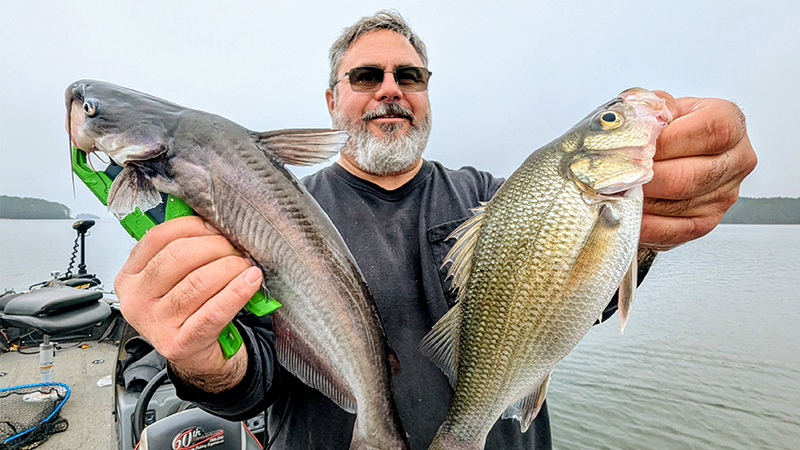
Targeting mixed species at Lake Monticello
Lake Monticello, located in Fairfield County, SC near the Broad River, is an often-overlooked resource for fishing any time of the year, but particularly during the winter. This deep, clear lake encompasses approximately 6,700 acres of surface water and is bowl-shaped with a few feeder creeks.
The lake offers diverse fishing opportunities for February and March despite low water temperatures.
Jay Bruce from Lyman in Spartanburg County is a full-time guide targeting lakes Monticello, Murray, and Clarks Hill. But Monticello is one of his favored winter producers.
“Lake Monticello is an excellent multi-species lake during the winter, and is also a prime target for individual species,” Bruce said. “If a client is looking for a trophy blue catfish, we’ll target catfish with specific tactics. If they want to load the cooler with jumbo white perch, a feisty fighting fish, and great table fare, we’ll target that species differently. The winter bite on big perch is usually fantastic.”
On our trip, we decided to sample the overall fishery by using live minnows. Bruce uses a blend of large and smaller minnows, the huge minnows he refers to as “donkeys,” to target big bass or catfish. Traditional-size minnows are best for smaller catfish, perch (white and yellow), and crappie. By baiting multiple rods, most of the species in the lake worth catching were hauled over the sides of his roomy 24-foot boat that day.

The shad
Bruce said the key to winter fishing in February and into March at Monticello is always the shad.
“Also, the lake is full of humps, points, and ditches where fish tend to stack up in big numbers, so I seek out places where these types of bottom conditions exist, along with lots of forage in that area,” he said.
Bruce is diligent in searching for this pattern using electronics, and once he locks in on an area, the graph will depict plenty of forage in the area. Plus, he’ll usually mark plenty of gamefish around the pods of shad.
“A key to active biting fish is to see the pods of shad that are not solid balls or pods,” he said. “Holes, or indentations, in the overall school of forage typically mean that the pod is being broken up by feeding fish, and they’re usually visible on the sonar unit. That’s where I set up, and typically the action is fast-paced.”
Artificials work too
He said his clients can use artificial lures as well.
Bruse uses his electric motor to move around the general area, stopping on specific spots when the bite is hot.
“Sometimes the weather is cold, but often on those frigid days the hot fishing action keeps us warm, and too busy cranking fish, to worry about a bit of cold air,” he said.
We caught black bass, big white perch, and blue catfish in large numbers, as well as multiple channel catfish on our trip. In addition, we boated about a half-dozen yellow perch, a couple that were large enough to make prime fillets.
To book a guided trip with Jay Bruce, call him at 864-420-8512 or find him on Facebook at Carolina Fishing Adventures with Jay Bruce.

Be the first to comment