

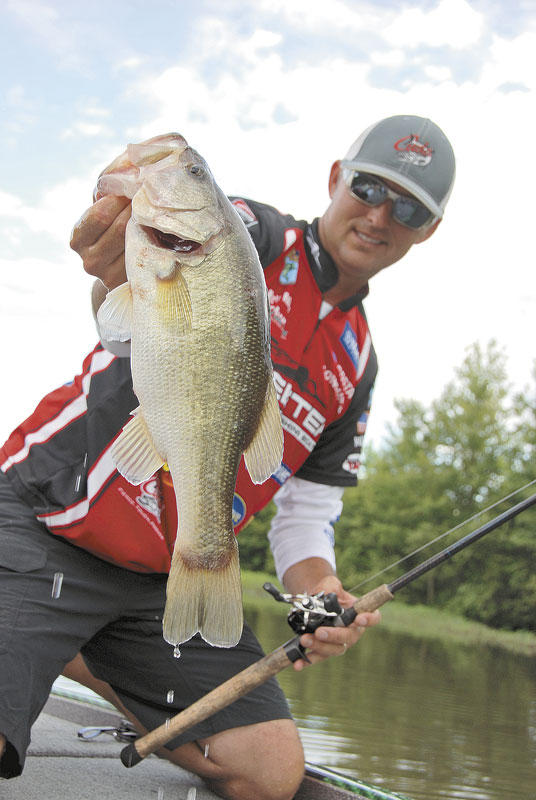
Fish like a pro with these tips from the Carolinas’ finest
Once the spring spawn is over, weekend bass anglers who were catching fish on nearly every cast start to struggle as bass fishing regresses into the post spawn and later, summer fishing patterns. Bass tend to become less predictable. And different variables, other than the need to reproduce, dominate their behavior.
Professional bass anglers face the same situations as any other angler. But what tends to separate the pros from the rest of the field is a deeper understanding of what’s going on in the entire world of bass. And not just during the spring, but year-round.
Here’s a few tips from some of the Carolinas’ best anglers that can help you find your way next time you’re out on the water.
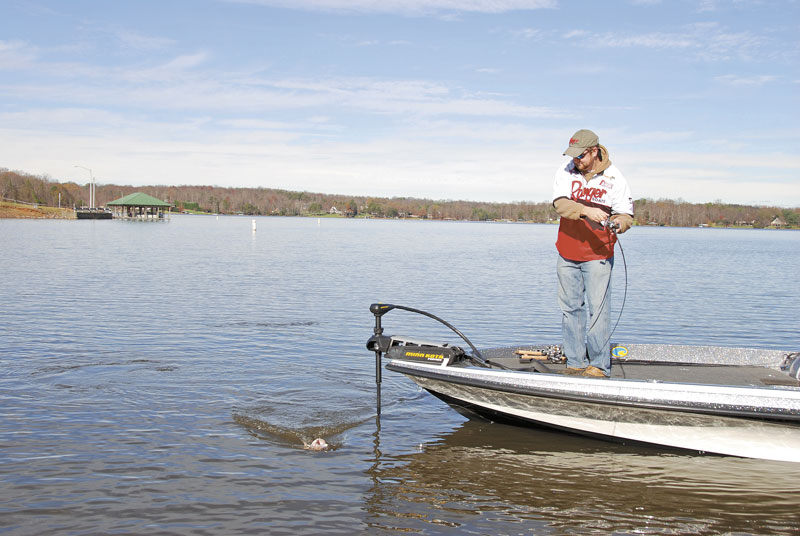
Matt Arey
Fish the Shad Spawn
Bass Elite angler Matt Arey from Shelby, N.C. explained that many bass anglers are aware of the opportunities of the “shad spawn” but are doing it at the wrong time of day and in the wrong places.
“First you need to decide which baitfish spawn you are fishing,” said Arey. “In the Carolinas, a lot of our lakes are herring lakes. When you see guys pulling up to long shallow points and making casts across the points, it’s the herring pattern. Herring roam those points and spawn in the clay and sand.
“On the other hand, shad, and I’m talking about threadfin shad here, may spawn in shallow water. But they want deep water close by. Or they may spawn on shallow structure over deep water. Shad also want some kind of structure to rub their eggs on,” he said. “You can tell you’ve been in the right place for spawning shad if eggs are stuck to the bottom of the boat when you load up. That stuff is like glue.”
When asked how he decides which pattern to fish when both bait species are spawning, Arey said it depends on where the bigger fish are holding on the lake. As a general rule on lakes that have an equal number of both prey, herring will stay in the lower 1/3 of the lakes where the terrain is more conducive.
Shad are more drawn to upper sections of the lake where structure and deeper water mix – creek arms, deep water docks, bridge pilings and deep water rip-rap.
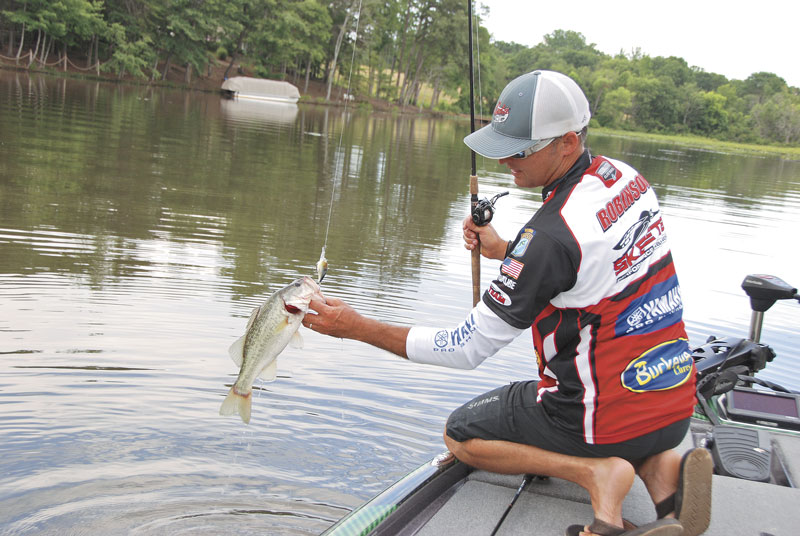
Marty Robinson
Look For Isolated Cover
MLF pro Marty Robinson, from Lyman, S.C. said one of his most dependable post-spawn into summer patterns involves targeting isolated cover. To Robinson, isolation means anything that sticks out as an oasis in otherwise generic landscape. He’s also going to look for deeper water areas. But that doesn’t always mean he’s going to fish deep.
“When I’m talking about an isolated piece of cover, that might be a lone brush pile where bass suspend in the top of it. Or it might be an old roadbed or rock pile. It might even be a lone dock or set of boat docks in the bend of a creek channel,” he said.
To find these areas, he’s going to look about halfway back in a major tributary where the water is deep enough to be comfortable to the bass to escape, or fall back to, during the middle of the day.
“I love to throw a medium running crankbait in the top of a brush pile that’s off by itself,” said Robinson.
Robinson said he’s more likely to find the right combination of stained water and depth about ½ way back in a creek. And those are also the most likely places to find old road beds, isolated brush piles or natural rock piles.
“In this situation I’m going to rely on my electronics a lot more than I would in the back of the creek or chasing schooling bass on the surface out in the lake,” said Robinson. “If I can see something I like hanging on the edge of a channel, then it’s time to go deep and work on them.”
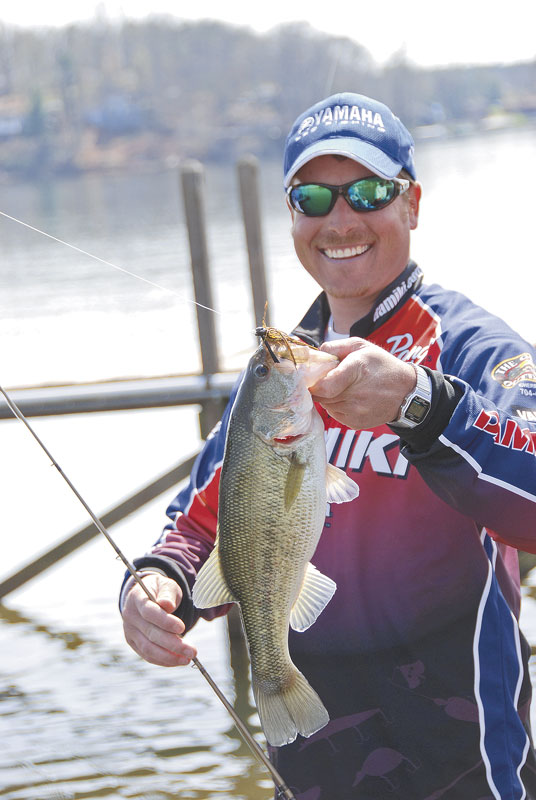
Bryan Thrift
Throwing Topwater
Who doesn’t like fishing topwater for bass? For FLW-turned-MLF pro Bryan Thrift, from Shelby, N.C., topwater fishing during the spring and summer months is not only fun, but also a great way to put good fish in the boat.
When looking for good topwater areas, Thrift will motor to shallow water areas, which might be near the mouth of a tributary or might be further back in a tributary, then cut the motor off and spend 5 – 10 minutes observing the area around his boat.
“I’ll just sit quiet. I’m really not even watching the graph, just looking at the surface of the water watching for a couple of shad to flip or to see some of that nervous water that indicates a school of bait is just below the surface,” he said.
Once he’s convinced the area has the potential for a good topwater pattern, he’s going to pick up a rod with a buzzbait and another with a walking bait. His preference is a Damiki Rambler topwater walking bait and a Damiki MTB Noisy buzzbait. These two baits allow him to cover a lot of water.
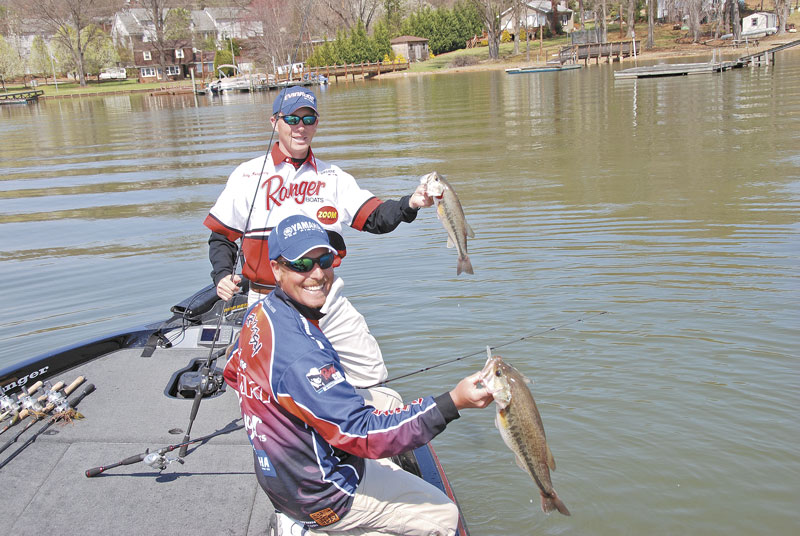 “I’m going to use a white buzzbait and a shad-colored walking bait,” he said. “I’m targeting schooling bass, the first ones that are reacting to the bait moving up.
His typical scenario is to start in the shallows near the mouth of a tributary creek and work his way back. He said the bass he catches on the topwater lures are often fickle fish but also bigger fish.
“Topwater fishing is such an exciting way to fish. Even as a pro, fishing pro tournaments, I get excited seeing a bass blow up on a topwater bait,” he said.
In this excitement, many anglers, and Thrift includes himself in this group, tend to set the hook too quickly. That is one reason he spools with monofilament line on his topwater rods. With braid, the hook set is instantaneous, often leading to lip hooks rather than a jaw hook because the line doesn’t stretch.
“In the excitement of the moment, we all tend to set the hook hard. And on braided line, a hard hookset can tear holes in the fish’s mouth,” he said. “I just feel like the combination of these two things makes me lose too many fish that I would not have lost on mono.”
 Andy Montgomery’s tips on fishing boat docks
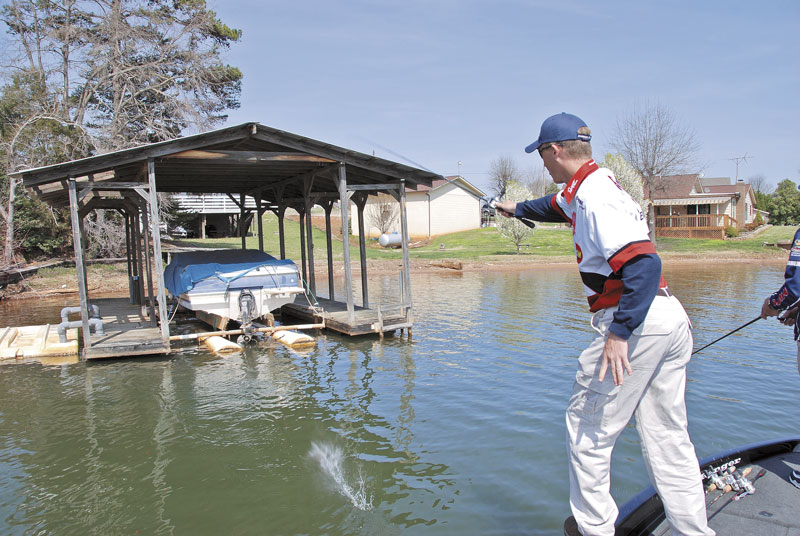
To say MLF pro Andy Montgomery from Blacksbug, S.C. likes to fish docks is an understatement. Montgomery doesn’t have to pick and choose his days for fishing docks like he may have to for fishing, say a wind-blown point or an open water hump. He said docks are good nearly 24/7 and 365 days a year, but especially in the late spring and summer.
“Typically, sunny conditions are better for dock fishing,” he said. “But it seems like every lake we fish is going to have a resident population of bass that find everything they need on a particular boat dock and that’s pretty much where they stay all the time.”
A bit of a surprise, the noted jig-slinger will forego a jig and trailer this month in favor of a Texas-rigged plastic. He said the T-rig on a 5/16-ounce weight, which he typically does not peg to the hook and line, gives him the payload to get the bait where he needs it around the dock while the soft plastic gives him good buoyancy.
“Plastics is a big deal around boat docks,” he said. “My favorites would be a Strike King Rage Bug or a Rage Lizard. You’re pitching plastics at them and you have to work it to get a bite. You’re going to use the same stuff. I like to use natural colors, green pumpkins, black and blue, anything but white. Plastics are, by far, the number one bait.”
Many times bass may be visible cruising boat docks, especially in clear water. But that’s really the last thing Montgomery wants to do around a boat dock. He will categorically eliminate clear water creeks and cuts till he can find an area that has stained water so he can’t see the fish, and more importantly, they can’t see him.
“I’m fishing dirty water,” he said. “Pitch back in there two or three times, you’re going to get a bite. When he bites it, you set the hook. That’s typical dirty water fishing. It’s going to be a pretty good bite. It’s not going to be a light bite. So it’s nothing like sight fishing. You just pitch in there and you catch him.”
Be the first to comment