


Rivers in Northeastern North Carolina produce great bream fishing for anglers who fish both styles of flies.
A layer of fog floated above the water, foreshadowing the humidity that sunrise would bring on a July day. Bob Smithwick manuvered between the pilings on the NC 45 bridge, working the throttle and steering levers on his panfish-model Bass Tracker.
The ramp at the south end of the bridge, which spans three rivers, gave the 77-year-old Smithwick angler access to some of the best and most extensive panfish action found anywhere.
“You can cruise beside the bridge and get to the Roanoke, Middle and Cashie rivers,” Smithwick said. “I’ve fly-fished for bluegills all over the United State, from Florida to Alaska, and this is the best fishing I’ve found.”
Smithwick, a retired teacher, divides his time between his wintertime home in Florida and childhood home in Windsor. He ties flies when he isn’t on the water, which isn’t often.
“I joke that I fish nine days a week,” he said. “To do that, I have to fish two nights.”
Smithwick said catching 100 to 200 panfish in a morning of fishing is no problem for anyone who can keep his or her fly out of the bushes. Snagging a fly costs fishing time.
“You have to fish close to the bank early, then work you way out farther as the sun gets higher and the shadows go away,” he said. “It’s amazing how many bream fishermen use only a dry fly and quit fishing when the strikes stop after the sun gets up. If you switch to a wet fly, the fish keep right on biting.”
Smithwick said there’s no secret to picking a good fishing spot, because panfish are everywhere on the rivers of Northeastern North Carolina.
“Just look for a place that has some stumps, cypress knees, tree limbs that have fallen into the water, sandy places and lily pads,” he said. “You see places like that everywhere.”
After entering Grennel Creek from the Cashie River, Smithwick dropped his trolling motor and began fishing a cove where he had caught dozens of fish there the day before. Several other coves nearby had long stretches of similar cover, so he could fish a long time without firing up his outboard.
“Wind can be a problem,” he said. “If it’s windy, you might not be able to fish the spot you want, but with all of the coves and bends, you can find a bank to fish that is out of the wind.”
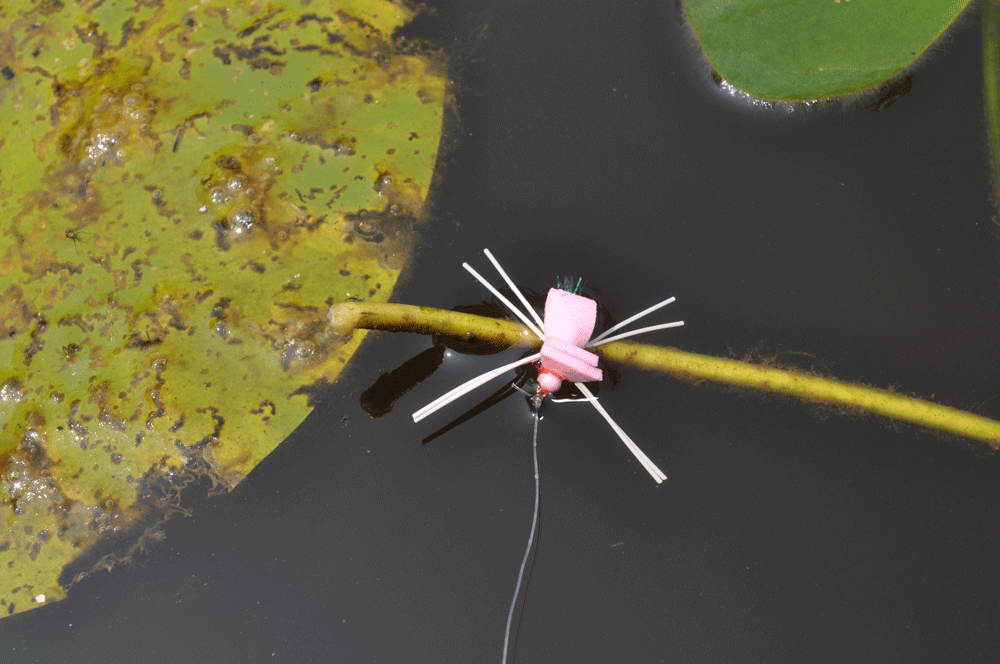
Smithwick ties and uses two basic flies. He created his Foam Buster Popper by tying together layers of craft foam. The flat face of the fly and a hollowed-out rear end create popping sounds and bubbles with a twitch of the line. A tail made of a flashy synthetic material called DNA and a pair of stick-on eyes gives the fly a personality attractive to fish as well as fishermen. He ties it on a No. 4 or 6 hook for catching bass, a No. 8 hook for bass and panfish in combination, and a No. 10 hook for panfish.
“You never know what color popper they are going to hit,” he said. “Pink has been the hot color the past week.”
Smithwick fishes many places in the Cashie River, including Cashie Broad Creek. He also fishes the Roanoke River creeks between the mouth of the river and Conaby Creek. He said Welch, Warnek, Roanoke Broad, and Cow creeks as good fishing spots.
Smithwick uses a 7½- to 8½-foot, 5- or 6-weight Pflueger or Kunan rod, with Martin No. 8A automatic fly reels dating to the 1940s.
“The Martin reel takes in the line when you pull on a lever,” said Smithwick, who is a member of the Roanoke Fly Rod Club, which holds tournaments across the area. “When you’re tournament fishing, not having to manually manage excess line saves tons of time. They haven’t made the reels in years, so I buy them on E-bay.”
Smithwick spools each reel with a level, floating line. He uses 8-pound test leader unless he has a child or novice along.
“I use a double-arm length of leader,” he said. “If I have a kid along, I use 10-pound test, because it usually pulls the fly loose if it gets hung in a tree. I use 8-pound test for most of my fishing because it’s strong enough to pull a hook from a lily pad without breaking.”
A big bluegill sucked in his popper, and Smithwick reeled in the fish, which had swallowed the popper — only a couple of legs protruded from its mouth. He released the fish and caught several dozen more that were just as aggressive before the bite tapered off.
“This is when everyone else heads home,” he said. “The fish are still there, they’re just deeper.”
Smithwick switched tactics and flies. He threaded a strike indicator onto his leader ahead of a fly pattern he invented and named “Tail-End Charlie.”
“I named it after the tail gunner on a World War II bomber,” he said. “It’s on the end of the line, below the strike indicator, so it seemed like a good name.”
The fly is a sinking spider. It has a chenille body, an epoxy coated thread-wrap head and rubber legs. The legs come in a strip and are separated after the fly is tied. Stripes are made on the legs by twisting them and running an indelible pen along them.
“I tie the fly with eight legs because the motion of the legs is what makes fish strike,” he said. “Fish can pull off the legs. With a 4-legged fly, you soon have to tie on another one. A fly that starts out with eight legs can be fished a lot longer.”
Setting the strike indicator at 18 inches, Smithwick began casting. Rather than dropping the fly near the woody cover or bank, he fished it on the outside edges of lily pad beds.
“Wherever you see the pads, the bank juts out,” he said. “That means there is a drop-off where fish go when the sun gets high.”
The water was clear enough to see the black-and-green fly dart sideways when a bluegill interrupted its slow decent. But, whenever the fly had fallen 18 inches and was no longer visible, the strike indicator showed Smithwick that a fish had taken the fly so he could set the hook.
Smithwick fished until 10:30; he lost count of all of the fish he had landed, but it certainly exceeded 100.
Lanny Cowan also fishes the state’s northeastern rivers. At 69, he has fished for panfish most of his life. He was an expert fly tier until he became legally blind due to progressive eye disease.
“I can see the bank and the water on a sunny day, but I can’t see anything on overcast days,” he said. “I fish with Wesley Byrum in his 19-foot Javelin bass boat. He tells me where to cast to stay out of trees. I’m still winning some club tournaments.”
Unable to detect strikes visually, Cowan uses only wet flies because he can feel the strike. He said pink or black-and-green chenille spiders like those tied by Smithwick were the best producers.
“I use Bob’s Tail-End Charlie and a Coyote, which you can find instructions for tying in catalogs. I don’t use a strike indicator, but it’s a good idea for beginners.”
Cowan said flooding from Hurricane Irene in August-September 2011 hurt the fishing in some rivers, including the Roanoke.
“You can’t expect the fishing to be as good in the Roanoke,; it might be off 75 percent,” he said. “But the rivers farther down Albemarle Sound were not hit as hard. We’ve good tournaments on the Perquimans, Pasquotank and Yeopim rivers.”
Cowan said bluegills spawn all summer after the water temperature reaches 72 degrees, usually in May or June. He locates the fish by scent.
“When I could see, I looked for beds along sandy banks,” he said. “I can smell the beds, which have a scent like wet mud. Anytime you find a good bedding spot, you’re going to catch lots of bluegills. Other good places are shorelines with rushes, reeds or sandy banks and under a tree with caterpillars falling into the water.”
Cowan uses a 9-foot, 5-weight, St. Croix rod with a Pflueger President reel. His line is a 5- or 6-weight, weight forward floating.
“I use a 6-weight line on windy days,” he said. “I tie my own tapered leaders, starting with 15- or 20-pound test for first 18 inches, then down to 10 pounds, then 6 pounds. The finished leader is 7 to 9 feet long. In deeper water, I use a longer leader to let the fly sink deeper. My tippet is 6 or 8 pounds because it is strong enough to free the fly if it gets stuck on a lily pad.”
DESTINATION INFORMATION
HOW TO GET THERE/WHEN TO GO — From Raleigh, take US 64 to Plymouth, then turn north on NC 45. The bridge over the Roanoke, Middle and Cashie rivers is 3.1 miles ahead on the left. The best fishing is from June through October.
BEST LURES/TECHNIQUES — Fish foam-body poppers such as the Foam Buster Popper at dawn and dusk. Fish sinking spiders such as the Tail-End Charlie below strike indicators when the sun is high and shade has disappeared along the banks. Best colors for foam poppers are pink, yellow, white and chartreuse. Best colors for sinking spiders are pink, black and green.
FISHING INFORMATION — Bob Smithwick’s Custom Flies, Windsor, 252-794-9364; Lanny Cowan, Roanoke Fly Rod Club, 252-209-7477. See also Guides & Charters in Classifieds.guides elsewhere in this issue.
ACCOMMODATIONS — Shipyard Landing cabins and campground, Windsor, 252-217-9322.
MAPS: Maps Unique, 910-458-9923, www.mapsunique.com.

Be the first to comment