

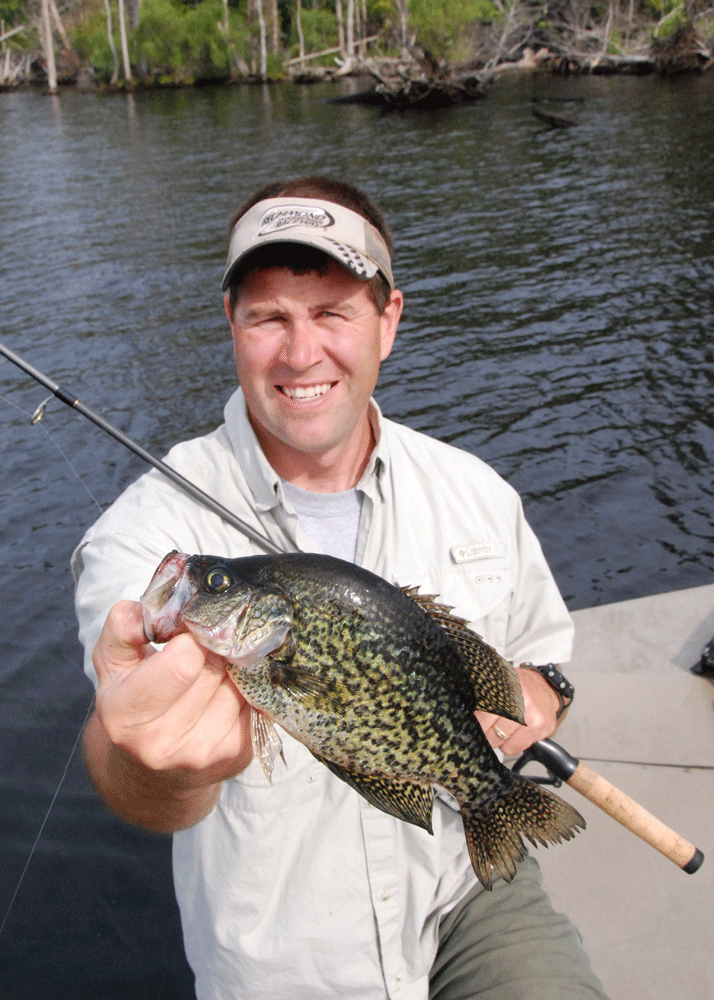
Anglers still have a month to take advantage of great crappie fishing on one of North Carolina’s newest lakes.
As it should have been on a typical hot June weekend, the parking lot at the lake office at Randleman Regional Reservoir was packed with boat trailers and tow vehicles.
As with most new lakes, Randleman’s most-popular initial offering was superior bass fishing. However, one of the boats leaving the ramp was something of an anomaly because it was rigged to seek North Carolina’s second most-targeted fish.
Jim Cobb and Robert Shepherd are crappie fanatics. Although it was long past the peak of the spawning season, they had experienced fantastic fishing.
“We caught at least 70 crappie,” Cobb said. “Sometimes I fish for bass or catfish, but I mostly fish for crappie and I never keep any unless they weigh a pound or more.”
Randleman Reservoir, a water-supply lake, covers 3,007 acres.It opened for fishing in March 2010 after filling for three years. Anglers were quick to pick up on the fast-growing largemouth bass, which were stocked by the N.C. Wildlife Resources Commission.
“We stocked the lake in spring of 2007 with fingerling largemouth bass,” said Corey Oakley, a fisheries biologist for the Commission. “We also stocked channel catfish in summer of 2007, but we did not stock crappie. They were probably in Deep River, Muddy Creek and some old ponds that were flooded.”
The crappie Cobb and Shepherd caught had the same advantage as the lake’s bass. They benefited from an excellent forage base of gizzard and threadfin shad. The fish they caught that measured 10 inches or longer were probably 3 years old, according to Oakley. Like Randleman’s bass, crappie will experience rapid growth in size and number until they reach equilibrium with their forage and cover requirements.
“We fish a lot of different lakes,” Cobb said, “but the reason we come to Randleman is the quality of the fish. Some of the other city lakes have lots of crappie, but you will be hard-pressed to find many longer than 6 to 8 inches.”
The anglers fish from Cobb’s 18 ½-foot Bass Tracker, which is equipped with a programmable trolling motor and an electronic depth finder. To find the fish, Cobb trolls around the pilings of the highway bridges while watching his depth finder screen.
“We can see the fish on the screen,” he said. “In June, they might be stacked up in 15 to 30 feet of water. We might troll around the pilings until we get a few bites before we start casting or we may just start casting right away.
“Sometimes, the fish bite better when you throw the jig against the piling and retrieve it, and sometimes they like it jigged up and down. Other times they might like it fished with nothing but a slow fall. You have to try different retrieves until you find what is working.”
When trolling, Cobb typically uses four rods in his forward rod holders, and Shepherd fishes three rods from the stern rod holders. The boat has two T-bars up front that hold three rods apiece and one bar across the back that holds six rods, so he can fish as many as 12 rods. He varies the rod lengths, line depths and jig styles.
“I fish a different jig on each rod,” he said, “but I might switch up the colors if they are biting one better than the others.”
Cobb prefers Shimano 2000 open-faced spinning reels, and he uses rods of lengths from 8 to 12 feet. Shepherd prefers closed-face spin-casting reels and 7-foot rods. They also like different types of jigs.
“I like Road Runner jigs for trolling and casting,” Shepherd said. “I think the spinner helps draw more strikes. I use different colors for the grub trailers, but my favorite is Acid Rain. I also have good luck with a purple body with a green tail.”
“I like casting the Road Runner jigs,” Cobb said. “But I’d rather use an 1/8-ounce round-head jig with a trailer when I’m trolling. I’m slowly getting Robert to switch to standard jigheads when we’re trolling, but if the fish are biting, it doesn’t seem to matter all that much. Sometimes we have had two or three rods get bit at the same time; we’ve lost some big ones when that happened. I know we’ve lost crappie at Randleman that would have weighed two or three pounds.”
A typical day for the duo starts as soon as the ramp opens. They bounce from bridge to bridge until they locate some fish. Then they troll around the pilings and the nearby shoreline in at least 15 feet of water. They usually haul out before noon. In four hours, their typical catch is 70 to 150 crappie; they keep as many as they want to eat or share with friends. Randleman Reservoir has no bag limit or size limit for crappie.
“Most crappie fishermen quit after the fish spawn in March or April,” Cobb said. “But after the fish spawn, they are still in the lake, they just go deeper. They head for the deep water at the bridges because the shade cools the water. They are also there because that is where the bait has gone. On the depth finder, I can watch the crappie move around, following the bait.”
“Sometimes, Jim will say the fish are heading my way,” Shepherd said. “Pretty soon, I’m getting all the bites where he was getting most of them a minute ago. They move a lot, so you have to keep moving with them.”
They move with the fish using the trolling motor. However, if the wind is blowing, they anchor to hold position.
“Unfortunately, the GPS receiver in the trolling motor won’t work if you are under a bridge,” Cobb said. “But the programmable trolling motor works fine if you are in the open.”
They cast or troll under a bridge then they slowly move along the nearby shoreline on the trolling motor. The banks beside the bridges are unusually steep because bridges are nearly always located at narrows. The banks are also lined with rip-rap, and the large stones also attract crappie.
“A windy day can make it hard to fish under the bridges,” Shepherd said. “But the fish seem to bite better when there is a breeze. The ripple on the water makes the boat rock up and down and that makes the jig bounce, which makes the jig more attractive to fish.”
Crappie can be finicky fish, especially in the summer when water temperatures are on the rise. Cobb said it takes experience to recognize the twists it takes to turn them on.
“One of the best ways to catch them is to throw the jig right at the piling,” he said. “The fish usually eats it when bounces off and sinks, and I count down the seconds until I feel a strike. But if all I can feel is a tap and the fish doesn’t eat it, I cut the tip off the tail because they are only grabbing the tip. Making the lure shorter does the trick. You also have to set the hook at any little tap or hesitation during the lure fall. Most people feel the tap and never realize it’s a crappie strike.”
Besides the five bridges that they fish, the crappie fanatics experiment with other places. An old quarry between the US 220 Bridge and the dam has deep holes and steep cliffs. An island beside the quarry pit is another good spot. Just upstream of the bridge, some flooded standing timber remains; most of the lake bottom was clear-cut before the lake was impounded. Cobb also found an inundated farm pond just upstream of the bridge.
“We’re always looking for new places,” Cobb said. “If we can mark crappie on the depth finder, it tells us they are there. But sometimes, even though you can see them, they just won’t bite, no matter what you try.”
“For times when nothing else works, we always have a few dozen shiners along,” Shepherd said. “Most of the time, jigs will out-catch a live minnows if you know what you’re doing. But if you can’t catch them with a minnow swimming on a hook right in front of their faces, you know it’s going to be a tough day.”
Johnnie Ruff and Tom Siler also fish for crappie at Randleman, even though they don’t own a boat and shoreline fishing is prohibited. They simply rent a johnboat and trolling motor at Guilford County Southwest Park and navigate the half-mile stretch of water where powerboats are excluded to fish at the NC 62 Bridge, which serves as the dividing line between the powerboat area and non-powerboat area. They seldom fish with jigs, preferring live bait.
“We use minnows to catch lots of crappie,” Siler said. “Since we are using minnows, so we also catch some bass and catfish while we’re crappie fishing.”
Siler is from Trinity and Ruff is from Thomasville. They fish Randleman a couple of dozen times in spring and summer. They like fishing beneath the bridge because the shade protects them from the scorching summer sun.
“We usually catch 25 or 30 crappie in a morning of fishing,” Ruff said. “I just tie on a gold hook and a sinker, hook a minnow through the lips and drop it down to the bottom and reel it up, counting the turns of the handle. It doesn’t take long to get a bite if the fish are hungry.”
DESTINATION INFORMATION
HOW TO GET THERE: The lake office is on Adams Farm Road, off Brandon Mill Road, which can be reached by US 220 at the Level Cross exit. The Guilford County Southwest Park is on Southwest Park Drive, which is reached via Drake Road and Wall Road after exiting I-73 at the NC 62 exit.
WHEN TO GO: Crappie head deep and head for the shade of the bridges in June. The bite will last into July before the heat shuts it down.
BEST LURES/TECHNIQUES: Road Runner “chin spinners” or “horse head” jigs with 1½-inch twistertail grubs. Also 1/8-ounce round jigs with 1½-inch twistertail trailers. Popular jig colors are white, pink and green. Popular grub trailers are Southern Pro or Kalin in black/silver with silver flake and Kalin “Acid Rain” (white/yellow). Other colors to try include purple, purple/chartreuse tail, white, blue, yellow and chartreuse. Small shiners fished on No. 4 gold hooks with split shot to take the bait down 15 to 30 feet also work well for crappie.
FISHING INFO: PTRWA Boat Ramp and Marina, 336-498-5281 or www.ptrwa.org; Guilford County Southwest Park, 336-676-7189 or www.southwestpark.info.
ACCOMMODATIONS: Hampton Inn, Asheboro 336-625-9000.
MAPS: A lake map showing the highway bridges, access areas and buoys is available at either of the park offices as well as online at www.ptrwa.org.

Be the first to comment