

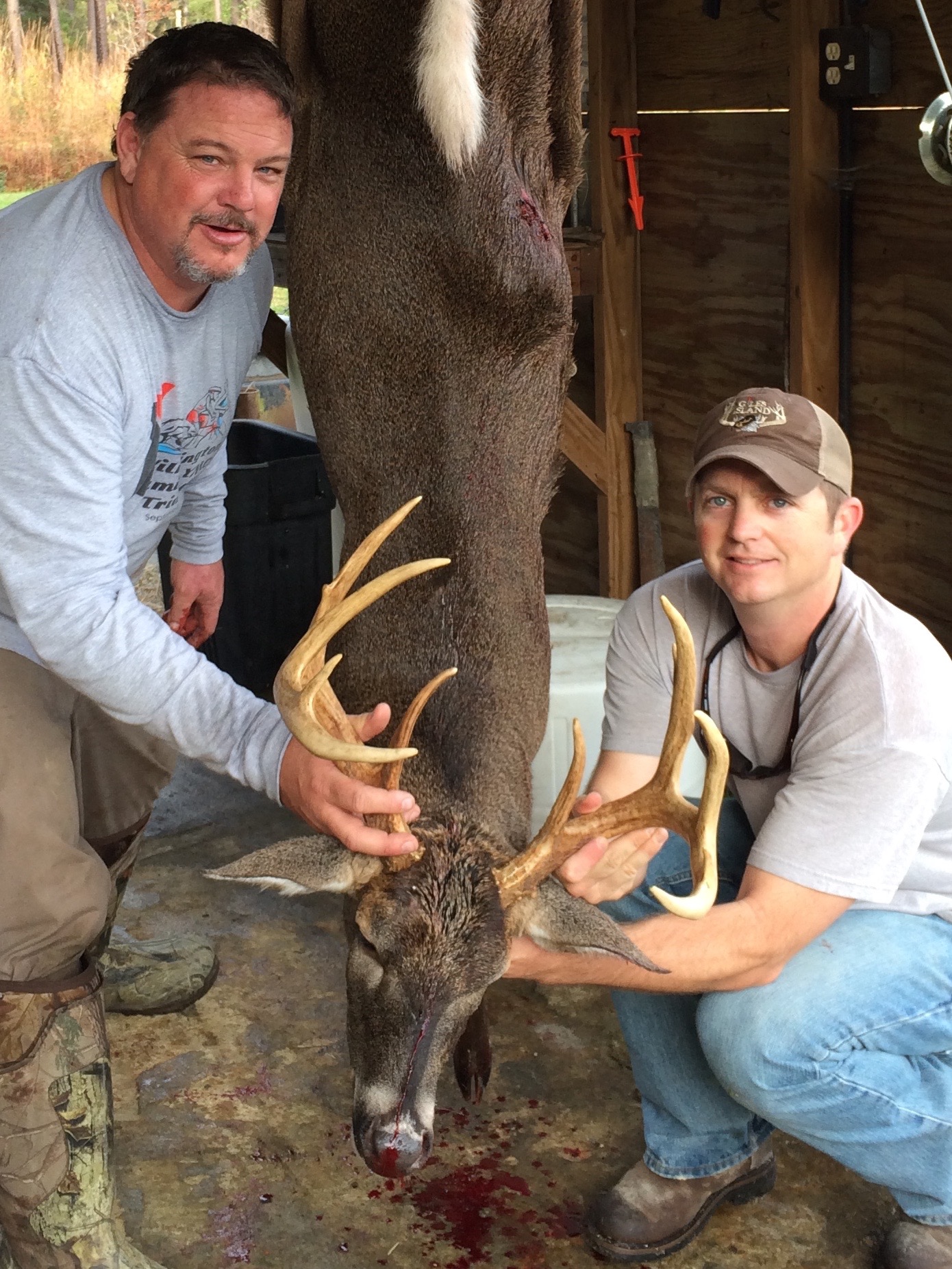

Examine your shot, watch your target and mark his path, and you’ll have venison for the grill.
It takes hours, days, sometimes years to figure out the daily travel patterns of a trophy buck. These grown-ups are scholars in the wilderness, living long enough to sense trouble from most of the average hunter’s tricks. Those that make it to 4 ½ years or older have outlived more than 80 percent of their brethren.
When a sly hunter finally gets his nemesis in range and takes a shot, there is nothing more heartbreaking than to come up short at the end of a blood trail without the trophy of a lifetime piled up next to a sweet gum sapling. If hunters want to have something to take back to their taxidermist, they should take precautions before, during and after the shot.
The first step to taking a trophy buck is to take the perfect shot. It’s the single most-important part of the equation. David Fort, president of the American Whitetail Authority, has his group’s scoring system wholly based on accurate, human shot placement.
The AWA Whitetail Pro Series is a national hunting competition that uses technologically advanced scopes that record digital images at the trigger pull without a bullet leaving the barrel. Blank cartridges add to the realism of the hunt.
“Our scoring system rewards hunters who can consistently make clean, fatal shots on mature bucks that reflect an ethical responsibility towards wildlife management,” Fort said. “I am a firm believer in taking ethical shots and our competitions reflect just that.”
Hunters should know their weapons and understand when an opportunity is worth the trigger pull.
“Mistakes can happen to everyone, especially when the adrenaline is flowing, but hunters should only take shots they are capable of taking,” he said.
The best way to make a quick kill is perfect shot placement. Fortunately, there are several places an arrow or bullet will quickly dispatch an animal. Fort attacks the neck and main components of the cardiovascular system.
“With a rifle, I prefer to shoot the deer in the base of the neck close to where it merges with the body,” he said.
The neck shot eliminates the need for tracking, but it involves a small target area, and deer will not always give the hunter a clean angle. Fort’s second choice is the heart and lung area.
“The heart/lung is a sweet spot and a good place to shoot a deer, as it dispatches the deer quicker than other shots outside the neck shot, but the deer will run,” he said.
Fortunately, a shot to the engine room that goes all the way through the animal will facilitate heavy bleeding that makes trailing much easier. However, a deer can often run more than 100 yards after a solid lung shot, and depending on the terrain and level of cover, that can seem like a walk in the park or a trek through the Amazon rain forest searching for evidence.
But, what do you do? Wait 30 minutes, one hour, or go after the deer right away? It all depends on the shot. A solid shot through both lungs or the heart will extinguish the animal in usually less than a minute, so a long waiting period is not needed. But if you miss the heart/lung area and hit the liver and stomach cavity — otherwise known as a gut shot — the deer will certainly die, but the hunter will need to allow sufficient time for the deer to expire.
After the shot, hunters should look for the impact location on the animal and then around the area where the animal was standing when shot, for evidence. A gut-shot deer will have more stomach contents visible along with blood.
Having a solid blood trail is a must; it can be a treat when looking for a deer at times. Sometimes, however, it can be tough to locate blood, and hunters should expect and be ready to find a deer without the luxury of a heavy blood trail.
Typically, bucks will run in a straight line after hit, and they will often use established deer trails.
Good trailing techniques begin before the hunter takes the shot as well as just after the shot. Hunters should never take their eyes off the deer after the shot. The last few moments the deer is seen will be critical in determining where it is heading.
“Train yourself to mentally mark and identify landmarks around the location of the shot and the last place you saw him. These landmarks will be critical evidence for finding the deer,” Fort said.
Beyond sight, hunters can add to their collection of evidence with their ears.
“Listen to the deer as it runs off to give you an idea of direction it is headed. Is it running in water? Did you hear it crash? All these details can be helpful in locating your deer,” he said.
The first place to ground check is the location of the shot. Hunters can look for hair and blood that will provide evidence if the deer was hit. However, sometimes there will be little to no sign of foul play where the deer was standing. Hunters should look for ruffled leaves, turned up soil, broken saplings or anything that may indicate where the deer ran besides blood.
Fort likes to start at the last point he saw the deer, as long as he felt he made a good, solid shot. He will be very careful not to walk on the path the deer initially used so he doesn’t disturb the droplets of blood on leaves and twigs.
Any time and distance you can save is a bonus, but Fort will work his way back to where the deer was standing at the shot if he doesn’t immediately find blood around the last place he saw him.
A critical thing Fort does when trailing a deer is to mark every place he finds blood with some sort of a highly visible marker like surveyors flagging ribbon, toilet paper or even clothes if he is caught without flagging.
“Flagging makes it easy to look back and see the direction the deer traveled; that gives you a great idea of the most likely direction the deer is headed,” he said. “You can always come back to the last marker if you lose the trail. Flagging is incredibly helpful.”
Quite often, the blood trail will be tough to locate depending on terrain and cover. If the deer is traveling through open woods, he can pick up speed, and droplets of blood can be tough to see. Hunters should never give up and should not be afraid to get down on all fours to look for blood.
“Trailing a deer is a skill every hunter must learn, to some degree, as you owe it to the animal to make every attempt to find it if you are going to shoot it,” he says.
If the shot was accurate and in the right place, the blood trail should lead right to the deer’s final resting place. Shooting a wall hanger is something that all hunters hope for each and every season. Care must be taken before, during, and after the shot to insure a positive outcome.

Be the first to comment