

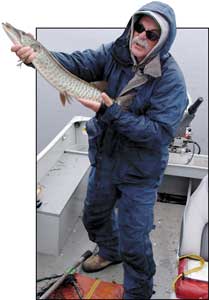
Western N.C.’s premier river has muskies that can make any northern angler jealous — and they’re just waiting to be caught.
A large, brown torpedo appeared under the bow of the small john boat, then sank slowly toward the stern. The submerged missile was a 15- or 20-pound muskie. It followed my lure and disappeared when I lifted the plug into the boat. In retrospect, I hope the fish was as disappointed as I was.
The situation didn’t occur during an exotic fishing trip to a northern state or Canadian wilderness. I was fishing the French Broad River, just south of Asheville.
Don Funderud, long-time president of the Western North Carolina Muskie Club, was my partner for the day. Though many don’t know it, there is pretty good muskie fishing in the mountains of North Carolina, especially at the French Broad River.
In the 1940s a major chemical spill cleaned the French Broad River of muskies. Virtually every species of fish were eliminated, including the native muskellunges.
A River Recovers
Over time, particularly after passage of the federal Clean Water Act in 1972, the French Broad recovered. In the early 1970s, the North Carolina Wildlife Resources Commission began to stock muskies in the French Broad.
Brood fish were obtained from Ohio, Pennsylvania and Kentucky in an effort to get fish suited to a river habitat. Many believe river muskies, originally from the Ohio River basin, are different from the lake muskies from the region stretching from the St. Lawrence River, through the Great Lakes and into western Ontario.
“We picked the French Broad because of the quality of the habitat,” said Mallory Martin, a WRC fisheries biologist and supervisor of the Mountain Region. “Above Asheville, there are long, deep pools, and spring floods have jammed lots of logs together to provide cover.”
Further, the gradient changes sharply near the Asheville Airport. Above the airport, the river flows deliberately and provides habitat suitable for muskies and largemouth bass. Below the airport, the gradient becomes much steeper and smallmouth bass become the principal gamefish.
When water levels are up, the section below Asheville is popular among white-water canoeists and rafters.
Field assessment of the WRC stocking program is the responsibility of biologist David Yow. Yow said he believes there is significant natural reproduction of muskies in the French Broad.
“Though it’s pretty hard to tell for sure,“ Yow said, “we think about half of the fish we shock up were born in the river. As a sport fishery, the muskie program in the French Broad has been highly successful.”
Most of the fish that Yow and his crew shock to the surface measure between 25 and 30 inches in length.
While this range is less than what an angler would catch during muskie fishing trips to Michigan and Ontario, to visit the French Broad I don’t have to drive 2 1/2 days one way.
Muskie fishing at the French Broad is catch-and-release upstream of the U.S. 64 bridge near Etowah and a 30-inch minimum and a two-fish limit applies below U.S. 64.
When I told Yow about the big fish that followed my lure, I also said there was a story going around among western N.C. muskie anglers that a 43-inch fish had been measured at that pool.
“Yeah, we got one like that there,” Yow said. “Each summer we measure a couple of fish that size.”
The WRC stocks muskies in the French Broad during alternate years. Fish are released into the reach each fall when they are 6 months old, usually 11- to 14-inches long.
Martin said raising muskies of that size in hatchery ponds is labor intensive — the fingerlings are fed live minnows and goldfish which are also raised by the WRC hatchery crews.
Yet the biologists believe stocking larger fish leads to greater survival rates. Roughly 1,300 muskies are stocked every other year.
Winter Patterns
Mid-winter may be the best time to pick up a Tar Heel musky on the French Broad.
Josh Guthrie fishes for muskies at the French Broad year-round. He is an active member of the Western North Carolina Musky Club.
“Fishing muskies in December usually means colder water temperatures, although winters over the past few years have been somewhat mild,” he said. “The weather that I deal with most in December is usually high skies with cold, crisp air. When you’re dealing with rivers such as the French Broad, you have to change your tactics to fit the season, but location of fish doesn’t change that much.”
Where are winter muskies at the French Broad?
“Muskies are still going to use structure such as timber and drop offs, but they may isolate themselves to deeper holes and smaller territories,” he said.
“Baitfish location is a key factor, and I think the larger, deeper holes tend to be the best places to find them. Search for the deep holes that also have timber and shallow water nearby.”
Derek Argotti, also a member of the WNC, agreed.
“Fish really seem to stack up in certain holes,” he said. “It’s not uncommon to see three or four muskies in one area. Bait will also stack up, so keep an eye out because the muskies will be nearby. I even sight-fish for them when conditions are right, but when the water is clear, the muskies can be quite spooky, so fish the pools with stealth.”
Especially good pools are found at the mouths of the Mills River, Mud Creek, Cane Creek and below Butler Bridge.
Lure Presentation
As often the case in fishing, presentation is critical.
“Presentation is probably more the factor than anything else in December,” Guthrie said. “Muskies are going to be more lethargic in the colder water than they would be in the summer time.
“I feel that a slower presentation is more effective. Slow cranking a crankbait of choice or using a glide bait can be productive.”
Bass anglers won’t know what a “glide bait” is, but they are large lures that glide underwater in a sort of “walk-the-dog” fashion. Favorite musky glide baits include the Reef Hawg and Squirrely Burt. Long sweeping pulls with the rod tip make these lures glide first to one side, then the other.
“Deeper diving crankbaits are good to use for getting to less-active fish that are hanging out on the bottom,” Guthrie said. “This is the most opportune time to use a deeper-diving lure because the presentation is slow, which allows you to work your lure across the bottom avoiding snags.”
A jointed Pikie Minnow, one of the muskie and pike lures of my youth, is a good choice. Recently another lure from long ago, the Hellbender, has been re-issued and is a top-notch deep diver. A more recent suitable deep-diving crankbait for muskies is the Fat Free Shad.
Argotti agreed on the importance of presentation for winter muskies at the French Broad.
“These colder water temperatures cause the fish to be a little more sluggish, so presentation needs to slow down,” he said. “Crankbaits, jigs and soft plastics should be the ‘go-to’ baits.
“Work them slow in the deeper pools. Slow, straight cranking seems to work the best. This, however, makes it difficult to cover water, so pick your spots wisely.”
Among muskie anglers, a popular soft-plastic lure is a Bull Dawg. It comes in a variety of colors and a couple of sizes.
Try the smaller size, about 6-inches long. The Bull Dawg looks a lot like a bullhead (catfish). It has an internal weight, so it drops to the bottom quickly and can be fished with a lift-and-drop retrieve.
Mann’s has a Hard Head series of plastics suitable for fishing with either a Texas-rig or with a jighead.
“I have been more successful with natural colors like sucker, perch, and black due to the clear water conditions,” Argotti said. “However, bright colors have produced an occasional fish.
“Topwaters, bucktails and spinnerbaits don’t seem to produce fish in winter, since the muskies are reluctant to move far in the water column for a bait.”
The Right Stuff
Most Tar Heel largemouth bass anglers have the gear needed to fish for French Broad muskies, with a couple of modifications.
Bait-casting rigs with line between 15- and 20-pound test should suffice. While I have specific muskie gear, a good 6-foot jig-and-pig rod should have sufficient backbone.
Muskies are “toothy critters,” so anglers shouldn’t try to land one of these fish by grabbing its lower lip — unless they want to be known as “Four Fingers.”
Use a braided steel leader or a fluorocarbon leader of 80-pound test. Leaders should have top-quality hardware, snaps and swivels. If anglers compromise on the hardware, they’ll be among those at the barber shop talking about the “one that got away.”
Muskies bust up cheap tackle.
Steep Accesses
At any stream, the two-pickup-shuffle is a common means of operation.
When I fished with Funderud, we used this method. We left one truck at a downstream spot. We drove upstream with the second truck and put the boat in there.
Funderud uses a john boat with a shallow draft that allowed maneuvering around rocks and logs in the river.
At the take-out spot, we loaded the boat in the pickup truck there and went back upstream to recover the truck.
Though I don’t have a john boat, I use a canoe for a similar purpose.
Many of the put-in or take-out spots are at bridges that span the river and the slope of the bank is often steep. Boats to fish for French Broad muskies can’t be launched from trailers. And a heavy boat is a challenge to maneuver down and later up a near-bluff bank.
Guthrie and Argotti concentrate on the portion of the French Broad south of Asheville.
“I like to fish the waters south of the US 64 bridge in Etowah,” Guthrie said. “These waters are catch-and-release for muskies, which is what draws me to them.
“The best areas to catch muskies in the French Broad are from Fanning Bridge near the airport to the headwaters. Basically the southern half of the French Broad is the best place to catch a muskie.”
Argotti explained why.
“Likewise there are some good areas north of Asheville with some very large muskies, but there are more rapids and fewer holes, which can be harder to fish in the winter,” he said.
“I almost always launch and run upstream to a certain point in case of motor failure. This is so I am able to get back.
“Westfelt Park near the airport is a popular area and probably has the best launch on the river. You can usually navigate all the way to the catch-and-release waters from that launch if no trees are obstructing the river. Lots of good water in that section and some of the biggest muskies in the whole river can be found there.”
Words to the Wise
Argotti also offered some winter wisdom with regard to apparel.
“The French Broad in the winter runs clear and cold,” he said. “Water temperatures range from 36- to 42-degrees, depending on the time of the month and day.
“The river never freezes due to current and water temperatures never reach freezing. However, it’s cold enough to ruin an outing. Extra gloves are a must, since hands get wet from handling boat ropes and fish.”
Neoprene gloves with fold-back fingers have served well during such outings. Fingers usually can work gear and neoprene keeps digits warm, even when wet.
“Warm clothes are a necessity,” Argotti said. “Overdress; clothes can be shed, but you can’t add more clothes you don’t have.
“Be careful not to fall in from slipping on icy boat surfaces since hypothermia can set in quickly; it’s best to fish with a friend.”
When I explained seeing the brown torpedo to my son, he admonished me.
“Dad, how many times have you told me to watch the water around my bait — to be ready for such a thing?” he said.
I didn’t have a good answer to those questions, but I did have a possible solution: call one of the guys at the Western North Carolina Muskie Club, go back to the French Broad River and try again for a trophy muskie.
Be the first to comment