


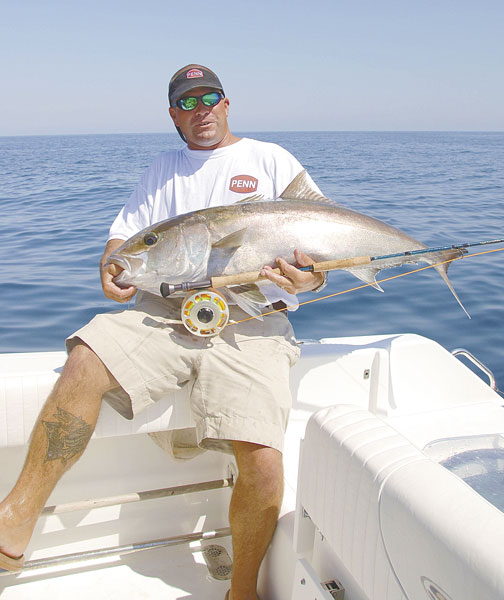
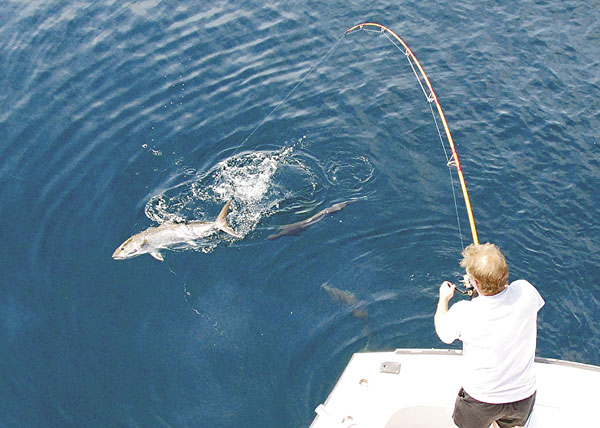
Outer Banks amberjack can provide some muscle-straining action
In the world of sportfishing, there are certain classes of fish. At the tippy top of the elite A-list are billfish, those fish that must be reeled in with the pinky of the reeling hand outstretched just so. Billfish are released to fight again, garnering a swell of pride and an immediate need for a mobile status update to Facebook.
The next class is meat fish, a lower rung of the piscatorial social hierarchy, but still good for respectable talk at the marina clubhouse. Meat fish are released to the fish box, to later rendezvous with either crab stuffing or mango salsa, depending on who did the reeling.
Bottomfish are further down the ladder, although surprisingly not at the actual bottom. These fish put up a great fight for the first 15 feet, then dutifully flop in the fish box the rest of the day, eventually winding up in the fryer.
Somewhere down the list are amberjacks. If you’ve ever watched one of the stunts in the movie “Jackass” and thought “That’d be cool,” then you’d probably like catching an amberjack. It looks like fun now but hurts like hell later.
North Carolina’s Outer Banks are home to some great amberjack fishing. Problem is, boats seldom leave the dock with the intent of targeting them. Often, during the course of fishing for one of the other classes of fish, amberjacks just show up or are a stop-off point on the way to of from other fishing grounds.
However, with their notorious fight and generally large sizes, many charterboat captains are getting requests for jack-fishing trips. Capt. Bobby Smith of the Fish N’Fool out of Oregon Inlet Fishing Center charter boat is one of these.
“Amberjack start showing up on the Outer Banks around the middle to end of May when everything else shows up,” he said. “We usually start seeing them around the wrecks that are seven or eight miles off the beach, and there will be some as far out as 30 miles.”
Other jacks – lesser amberjack, almaco jacks, and jack crevalle – can also be found during the summer, but by far the most common and most sought-after are greater amberjacks. Greater amberjacks migrate up from Florida waters along the eastern seaboard during the summer and may travel as far north as Nova Scotia. They are schooling fish as adults but become more solitary the older they get. “AJs” are rarely found anywhere other than areas of hardbottom structure, and they show a special affinity for reefs and wrecks.
“We start the season out jigging for them around nearshore wrecks,” Smith said. “Early on, they will readily take a bucktail or diamond jig; we don’t have to use anything too fancy because they are so aggressive. Later, when fishing pressure gets up and they’ve been fished a while, they’ll get finicky, and we’ll switch over to live bait.”
Smith is a big fan of releasing most amberjack because the fishery is such a good resource. Even on an off-day, he can usually find some amberjacks willing to cooperate. He said most of his clients are usually not interested in keeping jacks to eat, but he admits they are gaining popularity as a food fish.
“An amberjack has to be 28 inches to keep,” he said. “Fish that big will have parasitic worms in the tail section, and there’s a lot of strong red meat, but I have eaten them, and they can be really good if they’re fresh. I wouldn’t think they would freeze very well.”
Another boat docked at Oregon Inlet Fishing Center is the Poacher, captained by Devin Cage. Like Smith, Cage loves to put his clients on a school of feisty amberjacks and has several key spots where he knows he can find them. In fact, he’ll start many of his full-day trips trolling tiny Clark Spoons just outside the inlet to catch bluefish for bait when he gets to an amberjack hole.
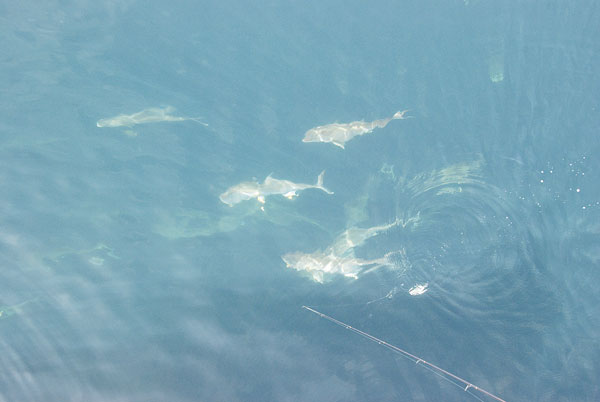
“You’re a fool to go amberjack fishing without live bait,” he said. “Amberjacks are curious fish, and many times I’ll be motoring over a wreck looking for them on the graph, and my mate will spot them on the surface right behind the boat. Topwater plugs will work in that situation if you are the first or only boat on that wreck. Once you get one hooked up, you can often keep the school on top for a long time. But it’s still fishing, and they aren’t always so cooperative, so I make sure we have some live bait before we go.”
Cage said a live bluefish is hard for amberjacks to resist; he’ll hook a 12-inch snapper blue on an 8/0 hook connected to a weighted rig. He uses a simple 2- to 3-ounce in-line sinker tied in front of a 10- to 12-foot section of 50- to 60-pound leader for the rig. The trick in live-bait fishing, he said, is to start shallow and try to keep the bait away from whatever structure you’re fishing, be it reef, wreck or tower.
“You drop that bait to the bottom, and you’ll get bit, but getting him to the boat is a different matter,” he said. “They will wreck you in a hurry. A big amberjack is going to go where he wants, and he’ll fight you the whole way. Amberjacks are the perfect adversary: they harder you pull on them, they harder they pull back.”

Be the first to comment