



Speckled trout are on the rebound, flounder on the slide; most other species fall somewhere in the middle.
It’s a mixed bag of good news and bad news for fishermen who target various species in North Carolina’s coastal waters.
This season could harbor some better results for anglers who target speckled trout and black sea bass, good seasons for Spanish mackerel and red drum, and maybe not as good fishing for flounder, striped bass and gray trout.’
Here’s what biologists with North Carolina’s Division of Marine Fisheries expect for fishermen in 2015:
Seatrout
The good news is that despite having a winter that was brutal at times, North Carolina’s speckled trout population came through it largely unscathed, even though some local cold-stun kills were reported.
“There will be some pretty significant changes in the stock-assessment report we send the Marine Fisheries Commission in May, and that’s good,” said Michael Loeffler, the NCDMF biologist who tracks trout trends. “Fishing should be good for this year and the next several years.”
Loeffler said cold-stun kills that devastated the fishery in the winter of 2013 will likely have been overcome in another year or so, thanks to successful spawns over the past two summers.
“We’re on the path to recovery,” he said. “If we hadn’t gotten a good spawn in 2013 from the fish that were left, it might have been different, but we haven’t had a poor reproductive class in a number of years.
“The trout we’re seeing in the 1 (year-old) and 2 (year-old) year classes are very good; we’re still not seeing the 3-, 4- and 5-year-old classes, but we’re seeing more of them — just not great numbers yet,” he said. “But if we get the right conditions, if we get a good spawn, we could be heading to some great spotted seatrout fishing.”
Loeffler doesn’t know what to expect from the Commission as far as regulation or management changes, but he said the 4-fish recreational creel limit and the 75-fish commercial catch limit — instituted after a short season closure that followed the 2013 cold-stun kills — helped the fishery recover as quickly as it has.
The “other” seatrout, the weakfish or “gray” trout, is not in any kind of good shape, and the one-fish daily creel limit isn’t likely to change anytime soon.
Landings have been almost nil compared to 20 years ago, and biologists agree that “environmental factors” and not overharvest are almost certainly the key to the crash of the fishery.
“We saw some areas in 2014 where people were catching some gray trout again,” Loeffler said. “We’re hoping for a better spawn in the next year or two to see if we can recognize a trend.”
Red drum
One absolutely tremendous spawning class of red drum has made for unbelievably good fishing the past two or three years,. Those fish spawned in 2011 will still be out there in good numbers this year, but most of them will have grown past the state’s 18- to 27-inch slot limit. They’ll still provide some rod-bending action, but catch-and-release will be required.
“We had a really good year last year, close to the highest landings ever for slot-sized fish,” said biologist Lee Paramore of NCDMF. “But those fish will probably be out of the slot this year, 30 to 32 inches. Those big fish may benefit the surf fishermen a little bit, because they are more likely to get out in the ocean.
“But we should have a lot of smaller fish in the creeks. We’ve picked up a lot of 14- and 15-inch fish that should grow up into the slot, so we’re expecting what I’d call an average year, but it will be somewhat of a dropoff compared to the past year or two.”
Paramore said the 2012 year class looks fairly good, and that’s the big slug of fish that will grow up into the slot this summer. He expects them to be 18- to 22-inch reds in time for most of the summer and fall harvest. The 2013 year class is thought to be fairly small, and the 2014 year class isn’t old enough to judge yet.
“Typically, we’ll have a good reproduction year followed by a couple of low years,” he said. “There is a lot more variability in recruitment at the northern end of these fish’s range. Virginia has seen what we’ve seen the past couple of years.”
Flounder
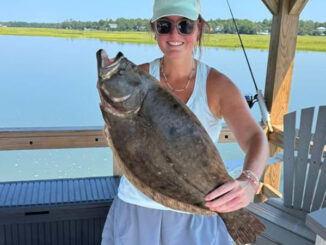
North Carolina’s waters hold two mainly two different subspecies of flounder, the summer flounder and southern flounder.
The summer flounder is more tolerant of higher levels of salinity and is generally found in the ocean and around inlets along the coast. The southern flounder is the flounder of the creeks, estuaries and sounds, the inside waters that aren’t quite as salty as the ocean.
One subspecies is doing great, the other, well, not so great. Summer flounder are listed as “viable” meaning the species is in good shape. Southern flounder is listed as “depleted” — the stock is down in numbers, too many are being landed and if things don’t turn around, they’re in real trouble.
Patricia Smith, the public information officer for the NCDMF, explained that recruitment, the number of young flounder being added to the fishery, hasn’t kept up with harvest since the 1990s.
“What we’re seeing in the data is declining recruitment, and it’s been declining since the 1990s,” she said.
Fishermen should expect some changes, perhaps big changes, on the way flounder are managed in North Carolina waters later this summer, after the N.C. Marine Fisheries Commission’s August meeting.
“There are no proposals yet, but our fishermen could be looking at season structure and bag limit changes,” she said, noting that since the Commission’s February meeting, biologists have been looking at ways to reduce the annual harvest by 25 to 50 percent.
The restrictions are likely to affect both commercial and recreational fishermen, even though recreational catches make up a relatively small percentage of landings, perhaps 20 percent or less. Recreational landings by weight have been relatively stable over the past half-dozen years, while commercial landings have plummeted.
Mackerel
Randy Gregory, the biologist who monitors king mackerel and Spanish mackerel for NCDMF, said the population of Spanish mackerel that moves up and down the South Atlantic coast is in very good shape, and that fishermen shouldn’t expect to see numbers much different than in past years.
King mackerel, however, are another story. He said the stock has not rebounded as expected from tighter catch limits, but that there’s no evidence that fishermen are catching too many — in fact, the concern in recent years is that they haven’t been catching enough.
“Our stock assessment is not as clear as we’d like it to be; we see a few things that concern us,” he said. “We haven’t been catching what we should have been. The harvest hasn’t rebounded like we think it should have, but we’re still looking for the stock to improve.
“But the fishery isn’t being overfished; there’s no evidence of overfishing, and there’s very little probability that it will be overfished.”
Striped bass
The famous Roanoke River/Albemarle Sound population of striped bass has fallen on some relative hard times compared to the amazing fishing in the 1990s and early 2000s.
Fishermen may not notice it that much this season, because huge year-classes from 2010 and 2011 are largely driving the fishery, according to biologist Charlton Godwin of NCDMF.
“We’ve got a lot of 4- and 5-year-old fish out there; they’re doing pretty well,” Godwin said. “Those 2011 fish are 20 or 21 inches long, and those 2010 fish are 22 or 23 inches long — good-sized fish.”
However, he said, other year-classes have largely been absent from the population, pointing to poor reproduction that’s generally thought to be caused by environmental factors, such as a lack of flow in the river during the spring spawning season.
Godwin said the success of the 2014 spawn can’t be yet determined, but 2013 was a poor year. Flooding caused a poor spawn in 2009.
The population of ocean stripers continues to be excellent, but it’s been several years since those fish have come within legal range of North Carolina fishermen, opting either to remain in waters off Virginia or showing up more than 3 miles off North Carolina beaches, where targeting them is illegal.
“If they come down and stay 15 miles offshrore, there’s nothing we can do about it,” Godwin said.
Striper populations in other coastal rivers are having various amounts of success.
“We’ve stocked natural, wild stripers to augment populations in the Central and Southern regions,” he said. “But we have to get past some issues we have related to water flow in those rivers. But the fishing has actually been pretty good in the Neuse and Cape Fear rivers.”
Dolphin/Tuna
Biologist Randy Gregory said that the stock of dolphin in the South Atlantic remains good, and fishermen should expect these hungry, colorful fish to remain the No. 1 target of most bluewater fishermen.
As far as tuna, Gregory said yellowfin tuna remain a little bit of a mystery to most. The tuna that have been a big part of catches along the entire coast have mostly showed up north of Cape Hatteras the past several years. Boats heading out of Oregon Inlet have caught plenty, and boats out of Hatteras have had good catches, but to the south, they’ve been few and far between.
“We saw a pretty good showing of fish last year, not as strong as in the past, but better than 2012 and 2013,” Gregory said. “Really, fishing between 2010 and 2013 was not very good. But we saw a pretty good showing of fish at Oregon Inlet and Hatteras Inlet last year. But we still haven’t seen many from Morehead City south.”
Gregory said that fortunately, blackfin tuna have been around in good-enough numbers that bluewater anglers have added them to the dolphin and wahoo in their fish boxes. The yellowfins have been missed, but tuna aren’t missing altogether.
Bottomfish
The bottomfish that most North Carolina fishermen target, black sea bass, should be out on wrecks and reefs in good numbers again this year, according to biologist Michelle Duval — at least south of Cape Hatteras.
“We’ve had a good past couple of years,” Duval said. “We haven’t had any season closures, and the quotas have been doubled. From our stock assessment and from anecdotal reports (from fishermen), it looks good.
“I’m looking for a good year; there are a lot of fish out there.”
Duval expects the South Atlantic Fisheries Management Council to take a look at the 5-fish daily creel limit and 13-inch size minimum for recreational fishermen sometime this year, maybe looking at changes that might allow more fish to be taken home, perhaps anywhere from six to 10.
North of Cape Hatteras, however, the population is still well below average and the fishery is closed.
As far as other popular bottomfish species are concerned, Duval said gag grouper are not being overfished and have not been overfished in the past handful of years, but the creel limit will remain at one fish per day. She said data shows that a lot of undersized gags, which will grow into legal fish and provide good fishing in the next several years.
Vermillion snapper, aka beeliners, still look good, with no recreational closure last fall. The creel limit is still five fish, but Duval feels like chances are, it might increase over the next year or two.
She expects fishing for gray triggerfish to remain fairly good and said biologists don’t have enough data on hog snapper to ease restrictions.
Details on this year’s red snapper season should be available in June; the last two years, fishermen have been allowed a limited harvest on several late-summer weekends.

Be the first to comment