



Fishing should be decent, but changes may be coming
Saltwater fishing in North Carolina, offshore and in coastal waters, shouldn’t be much different in 2012 from the recent past.
Changes may be coming, with the state legislature’s Committee on Marine Fisheries studying a number of changes in the way North Carolina’s saltwater resources are being managed. Any changes that are made — if any are made — will likely be phased over several years and won’t have an immediate impact on the fish you catch this year, and how many.
In any case, fishing this hear will likely resemble the past two years, with the major exception being this year’s mild winter.
As an overview, the N.C. Division of Marine Fisheries’ stock-status report for 2011, which includes 2010 information about individual species, shows mixed news.
Ten species of fish and/or shellfish are listed as viable, meaning they’re in good shape. They include striped bass, bluefish, dolphin, summer flounder, Spanish mackerel, striped bass (in the Atlantic Ocean and Albemarle and Roanoke Rivers), striped mullet, scup, spiny dogfish and shrimp.
Red drum and monkfish are listed as “recovering.”
Listed as “concern” are black sea bass north of Hatteras, striped bass in the central/southern regions, Atlantic croaker, gag grouper, king mackerel, Atlantic menhaden, yellow perch, reef fish, American shad, sharks, spot, blue crab, Eastern oysters and bay scallops.
In the officially worst shape — “depleted” — are black sea bass south of Hatteras, southern flounder, Albemarle Sound river herring, spotted seatrout, Atlantic sturgeon and gray trout.
Listed as “unknown” are saltwater catfish, American eels, river herring outside Albemarle Sound, kingfishes, white perch, hickory shad and hard clams.
This preview will concentrate mainly on the species that recreational and commercial anglers target.
Spotted seatrout
The NCDMF lists speckled trout as “depleted,” overfished and overharvested for the past 19 years.
But Chip Collier, the agency’s biologist for spotted seatrout, acknowledged that specks may not be in as bad a shape as “depleted” would seem to indicate, because they’re prolific breeders. And the way the agency is forced to measure speckled trout stocks doesn’t account well for cold-stun events, which occurred in 2009 and 2010.
So a rare, deadly cold snap can cause the stock to be listed as “depleted.”
Not only that, Collier said, the agency hasn’t figured out a way to conduct accurate samplings to determine a Juvenile Abundance Index, and no money has been sought by the N.C. Marine Fisheries Commission to conduct samplings, even though it’s available through from saltwater license sales through the Marine Fisheries Trust Fund or could come from a grant.
“The hard part is attributing a value for the mortality of a population during a (cold-stun) event,” he said. “In the general model, you see an increase in the catch and can decide a stock is healthy. Then all of sudden (a cold-stun event occurs), there’s a change in the mortality, so the model sees that as (the species) as being overfished. It has a hard time (accounting for such mortality). Usually when we do (an assessment), the model doesn’t do the least-flexible parameters. And one of those is natural mortality.”
So NCDMF, which knows specks were hammered by cold stuns the past two years, really doesn’t have a good handle on stocks, yet they it go with the numbers forced upon it by mortality figures that swing widely away from the norm when a cold-stun event occurs.
Collier said cold-stun events affect all ages and sizes of specks. Survival is mainly dependent upon which fish can get to deeper, warmer holes inshore or can escape to the ocean.
So what does this all mean?
“(Anglers) had really good catches (of specks in late summer, fall and early winter), and we’re hoping the 2- to 4-year-old fish will have a good spawn in the summer,” Collier said. “Hopefully, those fish will be in the population (later).”
Collier noted the drop in the recreational creel limit from six to four fish daily and a 14-inch minimum length, along with an incidental commercial daily trip limit of 75 fish, should let more spawners survive and reproduce.
He also said joint waters, the management of which is shared by the NCDMF and N.C. Wildlife Resources Commission — normally headwaters of creeks that are off-limits to netting also should produce more trout.
Collier noted that these waters being off-limits to netters may create more conflict in shallow, spawning creeks where netters and recreational anglers are likely to interact.
Flounder (Summer/Southern)
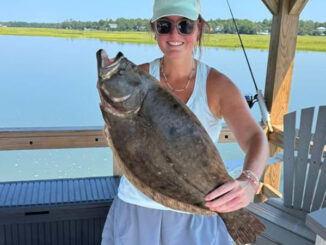
The NCDMF studies flounder as if these fish exist in separate biological spheres and classifies the two types of flounder commonly found in North Carolina waters as southern (inshore) or summer (ocean). However, recent information seems to indicate southerns and summers trade habitats regularly, and that inshore-to-offshore movements are more common than vice versa.
No doubt southerns appear different. They’ve got randomly-scattered spots on the side facing the sun, while summers also have spots but also have three larger, dark-brown circular spots surrounded by white rings that form a triangle on their backs.
The real keys to understanding flounder abundance or lack thereof it is knowing their Juvenile Abundance Index, which is basically an average of how many small flounder NCDMF test trawls capture in a net after several drags in set time limits. NCDMF trawls to determine JAIs inshore and in the ocean, usually each spring.
The JAI for summer flounder in 2010 was 14.3, and the JAI for southern flounder was 1.9.
“We look at how it tracks over time, and that gives the relative abundance,” said biologist Chris Batsavage, the NCDMF’s flounder expert. “We track it at nursery areas during May and June.”
However, Batsavage said a 1.9 JAI “isn’t bad” for the 2010 survey. “The average is 1.4,” he said. “Some years, it’s 2.0 or more, and that’s good.”
Yet the stock-status report classifies southerns as depleted., and Batsavage said the main problem is overfishing.
“We’re taking out more flounder than can replenish themselves,” he said. “(Inside) flounder have been overfished since 1991. Commercial fishing really ramped up in the 1980s.”
With netters allowed to take 14-inch flounder, they’ve dominated the catch. The 2011 stock-status report shows that netters landed 77 percent of all flounder taken in North Carolina.
Batsavage said that increasing the recreational size minimum to 15 inches has helped, after 2005’s Fishery Management Plan that increased the size limit from 13 to 14 inches. Meanwhile, the recreational bag limit has dropped from eight to six fish per day.
He said some areas in the western part of Pamlico Sound and rivers are exempt from the FMP, but “further impacts (removing nets) because of sea turtle interactions” had reduced flounder harvest.
The NCMFC also has applied for a federal permit for the commercial gill net fishery to allow “incidental take” of sea turtles after re-opening regions closed to flounder netting.
Another concern is the recent listing of Atlantic sturgeon as an endangered species. A lot of incidental catches of sturgeon in flounder nets also could force a closure of netting in state waters. An exception may be requested for sturgeon.
As for summer (ocean) flounder, Batsavage said a long series of restrictions, including increased size minimums, have bumped this species to the “viable” classification.
“They’re no longer listed as overfished, and overfishing isn’t occurring,” he said.
Ocean flounder now are managed for both recreational and commercial fishermen based on a total poundage allowance.
“The stock has stabilized, and the quota has gone up the last few years,” he said.
Batsavage said some of the factors in boosting the ocean flounder stock, including a commercial quota, included “less effort by recreational fishermen” that he said was “a downward trend since 2008.” He agreed the depressed economy and rising fuel prices in particular likely had an impact on less fishing pressure for ocean flounder.
King mackerel/Spanish mackerel
Biologist Randy Gregory said he and others in the South Atlantic region noticed less-successful harvests of king mackerel last year, but biologists haven’t come to concrete conclusions about why that happened.
“The main thing is, we think the stock remains healthy,” he said. “It looks like there was a lot less offshore fishing, and I’m sure it will continue this year with fuel prices so high. “There’s also not as many commercial guys (king fishing), and there may not be as much (consumer) demand. There appears to be some weird stuff happening with commercial mackerel (effort and harvest).”
Anglers concentrating more on other inshore species may explain fewer recreational catches of kings as well.
Even with NCDMF listing kings in the “concern” category, “The main thing is the stock is healthy,” Gregory said, “but we’re watching it closely.”
The NCDMF also is keeping a close eye on Spanish mackerel, which are listed as “viable.”
Kings and Spanish spawn offshore, where eggs are fertilized at random. Managed as pelagic fish by the South Atlantic Fishery Management Council, the SAFMC wants more information on “by-catch mortality estimates (of kings) in the directed shrimp fishery.” In other words, ocean shrimp trawlers could be responsible for baby kings being caught and killed as incidental landings. This information has been needed but not officially sought for analysis for many years.
“We had a few (recent) years of really good fishing for summer kings, the smaller ones at inlets, but they were hard to come by (in 2011),” Gregory said.
Gregory said SAFMC is preparing a stock assessment of king mackerel. At the present time, the SAFMC said even though it’s uncertain if overfishing of kings is occurring, it’s happening at a low level.
A permit to sell kings caught during the winter by captains who are fishing recreationally but hold commercial licenses is being considered by SAFMC.
Gregory said he doesn’t think commercial king mackerel netters have turned to other species because of a scarcity of kings.
King creel limits are three per day, while 15 Spanish per day may be kept. Minimum size is 24 inches for kings and 12 inches for Spanish mackerel.
Gray trout (Weakfish)
Gray trout are listed as “depleted” by the NCDMF, which blames the decline on unknown factors. However, it’s likely that trawlers decimated weakfish along the entire Atlantic coast, particularly in Pamlico Sound. They continue to work off the beaches near Morehead City.
Chesapeake gray trout numbers, once the pride of the Atlantic, are down, but fish still average between 12 and 24 inches long and between two and five pounds. A 2-pound weakfish caught in North Carolina waters is considered rare.
Groupers/reef fish
The major bottomfish that fishermen target include groupers and black sea bass.
The National Marine Fisheries Service has reduced harvest to three total grouper per trip per angler, including one black or one gag, but not both. That creel also includes one speckled hind and one Warsaw grouper. Golden tilefish harvest was closed Feb. 17, 2012, and reopens Jan. 1, 2013.
But black sea bass remain closed south of Hatteras until June 1. In 2011, the season opened June 1 and closed 4½ months later. It’s expected to follow the same format in 2012.
Chip Collier, the NCDMF biologist who handles groupers and black sea bass, said the black bass closure has drawn the most criticism. Anglers catch plenty of sea bass accidentally while bottom-fishing for other species and have to release them.
“I’m hearing fewer complaints on the (grouper) spawning season closure for blacks and gags,” he said.
The grouper limit is likely to stay in place because grouper live much longer than black sea bass but also take longer to reach large sizes.
Other species
• Red drum. Although listed as “recovering,” red drum are mostly in good shape. Reds are ubiquitous along North Carolina’s coastline and make up a large part of the state’s winter recreational fishery. Named the state fish years ago, commercial netters are restricted to 10 incidentally-caught reds, a limit that was raised from seven fish in April 2010. Recreational fishermen are still limited to one fish per day, in an 18- to 27-inch slot limit.
• Striped bass. Based on the 2010 stock assessment, the Albemarle Sound-Roanoke River stock isn’t being overfished, and biomass is high. The stock age structure is broad and includes fish up to age 17.
The Atlantic Ocean migratory stock, based on the ASMFC 2009 stock assessment, shows coastal rockfish also aren’t being overfished.
Along North Carolina’s southern coastline, stripers remain a species of concern. The Cape Fear River is open only to catch-and-release fishing. Size and age distributions lack older age-classes in the Cape Fear. However, Pamlico Sound and Tar/Neuse/Trent recreational river fishing is robust, although most fish weigh less than seven pounds.
• Bluefish. The Atlantic stock of bluefish remains plentiful. At times, central-coast piers have experienced runs of “chopper” blues as well, something rarely seen since the glory days of the late 1970s and early 1980s at Ocracoke and in the OBX surf.
• Croakers. NCDMF lists croakers as “concern,” which may be too optimistic. Roller rigs and trawls have devastated croakers in Pamlico Sound and up and down the state’s beaches. Anyone wanting to catch a nice croaker had best head for Virginia Beach,
• Sea mullet. Collier said NCDMF hasn’t looked at the sea mullet population “in great detail, but their numbers seem to be increasing. We have a fairly decent commercial fishery. They’re also generally in the top 10 of recreationally-caught species.”
• Atlantic menhaden. Called “The Most Important Fish in the Sea” in author Bruce Franklin’s book, the NCDMF lists menhaden — the predominant baitfish of most saltwater predator species and a target of “reduction” fisheries that have landed millions of pounds of these small fish — as “concern.”
The NCMFC and legislature is in the process of deciding whether to open state waters to Omega Protein of Reedville, Va. Omega’s trawlers catch millions of pounds of pogies, and its factory cooks them, rendering them into Omega-3 fish oil sold as a dietary nutritional supplement. Omega trawlers currently stay at least 3 miles off North Carolina. beaches after a deal worked with Dr. Louis Daniel III, director of NCDMF.
• Dolphin. Because they are so prolific and fast-growing, dolphins continue to provide offshore anglers most desirable and active sportfish. The ASMFC, however, is watching dolphin to make sure they don’t become over exploited.
• Spiny dogfish. These sharks, once protected by stringent catch controls, now have proliferated to the point they are almost super viable. They’re used mainly as restaurant fare in England, France and Germany, but the fins become less-expensive versions of shark-fin soup in China. Spiny dogfish also are used as pet food, fertilizer and liver oil.
The stock has decreased because of commercial overfishing by 95 percent in European waters.
Blamed in some quarters for gamefish population declines because of their voracious appetites, dogfish eat just about anything, including herring, menhaden, crabs, cod and haddock.

Be the first to comment