



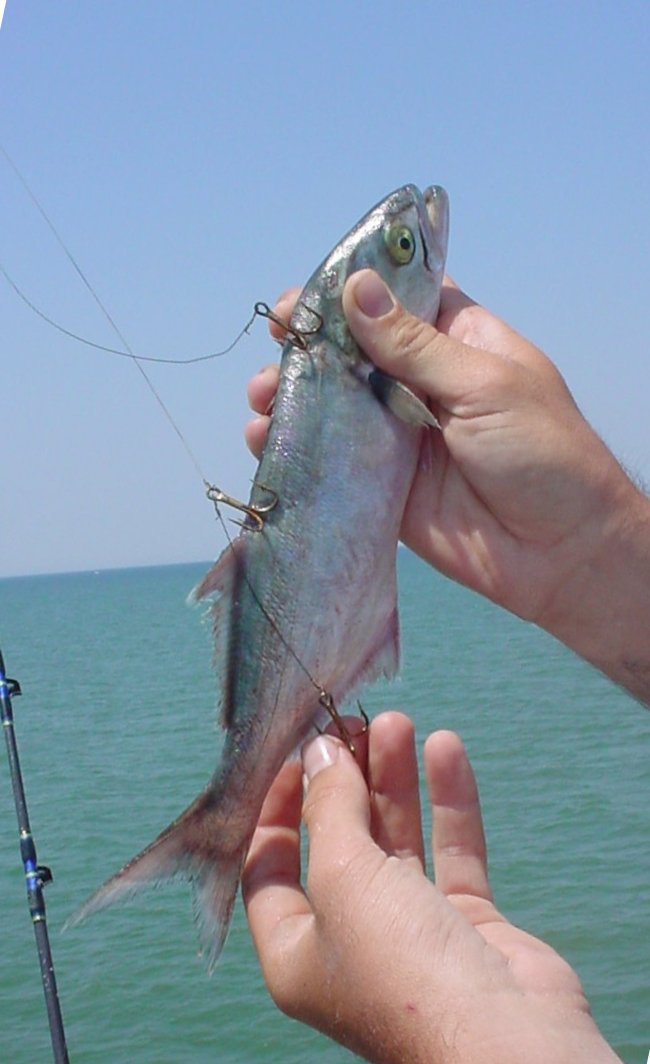
Bluefish are great live bait for spring king run
After a winter as mild as we just experienced, fishermen across North Carolina are waiting with eager anticipation for the word that king mackerel have returned inshore.
All winter, kings were reportedly caught at the edge of the Continental Shelf, and with such a warm, early spring, the tension has been growing with every warm day. The first report of kings close to the beach will bring an onslaught from the mosquito fleet, and marinas, motels and tackle shops will be filled with smiling faces and tall tales.
Many dedicated fishermen do not have large boats to make the trip to the edge of the Continental Shelf, where the kings spent the winter; they must wait until the schools move within their range off the beach. Another group of dedicated fishermen have no boats at all and are limited to floating baits from the ocean piers.
Thankfully, fishermen have two distinct groups of king mackerel to fish, and one stays close to the beach. In the late 1980s, biologists with the N.C. Division of Marine Fisheries proved that two groups of migratory kings visit North Carolina waters, one migrating inshore and offshore and one migrating north and south from Florida, and that the inshore-offshore group didn’t intermingle with the Florida group during the winter.
One population of kings is around all year, moving inshore and offshore as the water warms and cools and baitfish move to and fro. The other group moves up the coast from Florida as the water warms and bait moves north in the spring, then returns south to warmer water as the water cools and baitfish head south during the fall.
Techniques and baits needed to catch these fish can be surprisingly different. Kings that overwinter offshore compete for food and readily strike spoons and sea witches rigged with strips trolled behind planers and heavy trolling weights at speeds ranging from four to seven miles an hour. This requires heavy tackle and isn’t very sporting, but it is very productive until the water warms. It is primarily a commercial technique.
The offshore kings feed on cigar minnows, sardines and chub mackerel and will usually readily hit them even frozen. Many recreational fishermen forego the long leaders and lures used by commercial fishermen and slow-troll these packaged and frozen baits on what is essentially a heavier live bait-style rig that usually sports a small skirt or duster to pulse in the water and help create the appearance that the bait is moving on its own.
Many fishermen believe catching kings closer to shore requires live baits. That isn’t absolutely correct, but it is a strong truism. Kings are only inshore from late spring to fall, and such a variety of baitfish is available, they can be more selective about what they eat.
When kings first show up on the beach, my bait of choice is a bluefish. They vary in size early in the year, but from about 12 ounces to three pounds, they make excellent live baits. Of the fish that nearshore kings prefer, bluefish are the first to arrive, so it’s only natural they make good baits.
Every year, the first word of kings arriving comes from fishermen between Cape Fear and Little River on the South Carolina border. This run is special and happens so regularly that some fishermen plan their vacations around it. Not only is this the first nearshore run of kings each year, but there are good numbers of larger fish.
When this run begins — usually between the third weekend in April and Mother’s Day — the first word is often from the piers. These kings migrate right along the beach and are usually found from the ends of the piers out a couple of miles. Sometimes, the Cape Fear River sea buoy is too far offshore. Because the water is warming quickly this spring, it’s shaping up to be an early run.
When this run begins, word spreads quickly, and fishermen head to the Oak Island’s piers and the waters just off the beach. Some menhaden may be around, but lots of bluefish will be, and kings are feeding on them, so they are the best bait.
Kings heavier than 50 pounds have been caught during this spring run from two Oak Island piers. Kathy Davis set the IGFA Women’s 16-pound class world record with a 53-pound, 3-ounce fish caught from now-defunct Long Beach Pier on April 27, 1991. Bo Crump caught the heaviest king taken from an Oak Island Pier on May 7, 1998 — a 53-pound, 6-ounce fish caught on Ocean Crest Pier. Crump caught a 41-pounder and a 36-pounder on that same day. Davis and Crump both caught their kings by suspending bluefish on trolley rigs.
Bluefish are plentiful in the spring and pier fishermen take advantage of them. They regularly break out their jigging rods and catch blues to stock bait tanks on the ends of the piers. The lure of choice is a Got-Cha plug. Fishermen have different color preferences, but all Got-Chas have gold hooks. Spanish mackerel may also be around and will beat the blues to the lures if they are retrieved too quickly. The secret to catching more bluefish is to slow the retrieve a little.
Boat fishermen were stubborn for a while, but now many are switching to bluefish for spring baits or at least mixing a few into their spread. Sure, they like the convenience of cast-netting several dozen menhaden in a single throw, but they also like the increased number of strikes when fishing with bluefish. It has taken a while, but most now agree they catch more spring kings trolling live bluefish, which really shouldn’t come as a surprised.
Don’t allow yourself to be lulled into thinking that any live bait is fine for kings. That just isn’t so, especially during the spring. Bait matters, and strong evidence exists that the large kings of the spring run prefer bluefish. Whether fishing from a pier or a boat, breaking out the Got-Chas and putting a few blues in the bait tank is the first step to having a good day and bolsters the odds of catching a large spring king.

Be the first to comment