

Droughts are a drag for anglers
Weather conditions play an integral role in the success of most fishing trips. Sometimes it can be high water, or worse, the lack of it. The window of perfect conditions is truly narrow, and when things are right, I am forced to go fishing. This magnetic pull of a fighting fish has almost cost me several jobs, but the fishing was spectacular.
At times, conditions are terrible, yet I still must go fishing. This year, the Carolina mountains have been extremely dry. For a fly fisherman who has grown up half-drowning in rivers chasing trout, the lack of rain has forced me to be somewhat apathetic about it. But somehow, I manage to work through the stress and still go fishing.
Seems anytime a group of senior trout fishermen gather, two main topics of discussion are health issues and the weather. Lately, the discussion has been more weather-related, focusing on how low water conditions are affecting the trout.
The only place that seems to have any water is the ocean, and that doesn’t bode well for my beloved trout streams.
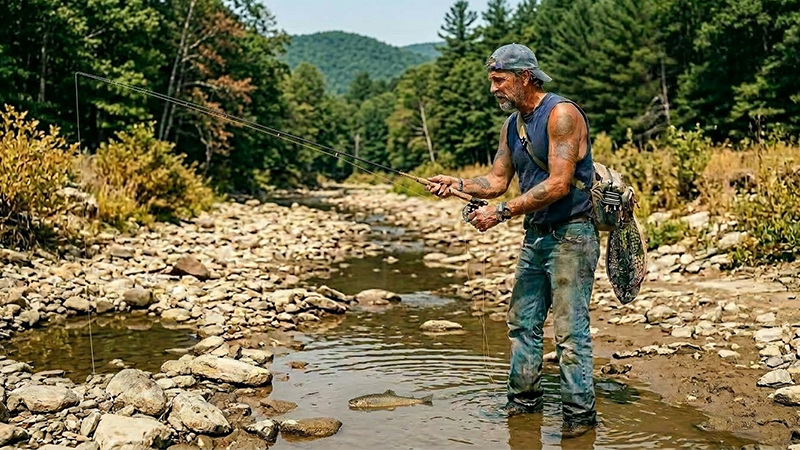
Lessons learned from infancy prevail; fish need water. Trout streams flowing with their volumes of cold water are dwindling in this drought. A couple of years ago, the water was knee- to thigh-deep, but now it barely reaches my ankles. The fish that were once scattered, hidden behind boulders, tucked in pockets between rocks, are now congregating in the few deep holes.
It’s Still exciting
I drove up to the Davidson River in Brevard, NC a few weeks ago and reminisced about past summertime evening trips. Sometimes these wonderful memories can lead to disappointment. The weather that day was less than perfect, but the level of excitement was the same.
Driving up Highway 276 into Pisgah National Forest, I stopped several times and looked at the river. The water level was extremely low. Even if I thought about the conditions beforehand and had not been impulsive about fishing that evening, I would have probably come anyway.
Pulling up and parking at one of my favorite spots, I got ready and unenthusiastically began to amble through the woods toward the river. Hurricane Helene had made it difficult to get to my favorite spot. Climbing over fallen trees and brush and crashing through piles of broken limbs kept my senses alert. Looking down carefully to make sure none of the sticks were coming to life was important. Thinking I would have to climb back over this debris after dark cast doubt on my original plan.
Staying alert
How many high-highs and low-lows can a person take in the span of two hours? The lack of water can do that to a fisherman, a lesson I learned long ago. Being ever the optimist, I thought, this still beats sitting at home tying flies, watching the 6 o’clock news and wishing I was fishing.
Easing around the edge of the river was easy now because all the side rocks were dry. This river should now be considered a large creek based on current conditions. I stood there wishing I had brought enough five-gallon buckets of water to pour and create a pool for me to fish in.
The currents, riffles, and pocket water were now all different from the way they used to be. I found one pocket of small rainbows and felt sorry for both trout caught and released. But I kept fishing despite my feelings. Anyway, I needed the “catching” practice.
Deciding to stay and fish until dark, I kept thinking about walking back over all that debris as the pucker factor started to rise. Yes, I had indeed brought my flashlight, and the batteries were good.
Optimism is the key
One spot with a deeper hole was just above me, so I quietly eased up toward it. I hoped whatever fish lurked in its depths would feed this evening. Standing and waiting for a rising fish can cause self-doubt about your fly choice. As dusk took over, I almost waited too long to change flies, which forced me to hold the fly toward the dimly lit sky so I could see the hook eye and run the line through it. Even with 2.75 readers, it was difficult.
Standing in an ankle-deep riffle and waiting for any sort of bugs to hatch on the surface to be met with a welcoming committee of hungry fish was tormenting. Nothing to do but stand there and whine to myself about the extremely low water conditions. Suddenly, dimples on the far side of the pool marked a feeding fish.
“How hungry was he? What bug did he just eat?” I thought out loud. Optimism kept me hoping that the fish would be larger than six inches. Whatever size it was, it was mine. Concentrating on the fish’s location, I surmised a nice, gentle roll cast with a slight upstream mend would allow the fly to land and float gently over the fish. I could see the hookup in my mind.
Never too late
“Man, it got real dark quick,” I said out loud to myself, quietly hoping I wouldn’t answer my statement. I find it comforting to talk to myself after dark.
I could barely see the pool, and the dimple reappeared. “This is what I came for,” I said as I readied my fly line to make the cast.
That one fish started rising more frequently, and its splashes became louder and more aggressive as it broke the water’s surface chasing a bug.
I finally made my last cast in the faint evening light. As I rolled the line toward the feeding fish, it rose again, and I felt my fly line tighten. I immediately focused on the water marks where the fish was supposed to be and forcefully lifted my rod tip, bending it as I tried to set the hook, looking for the fish to splash with anger.
When I felt the pull back on the rod, I excitedly reset the hook again, and it pulled back, shaking the entire tree. Three feet below my fly, a nice fish continued to inhale insects. I will never understand how one small twig can cause such enormous disappointment.
Despaired and broken-hearted, I broke the fly off and headed back to once again crash through all the woody debris in the darkness, too upset to even talk to myself. Sometimes a person needs a few quiet moments. ■

Be the first to comment