

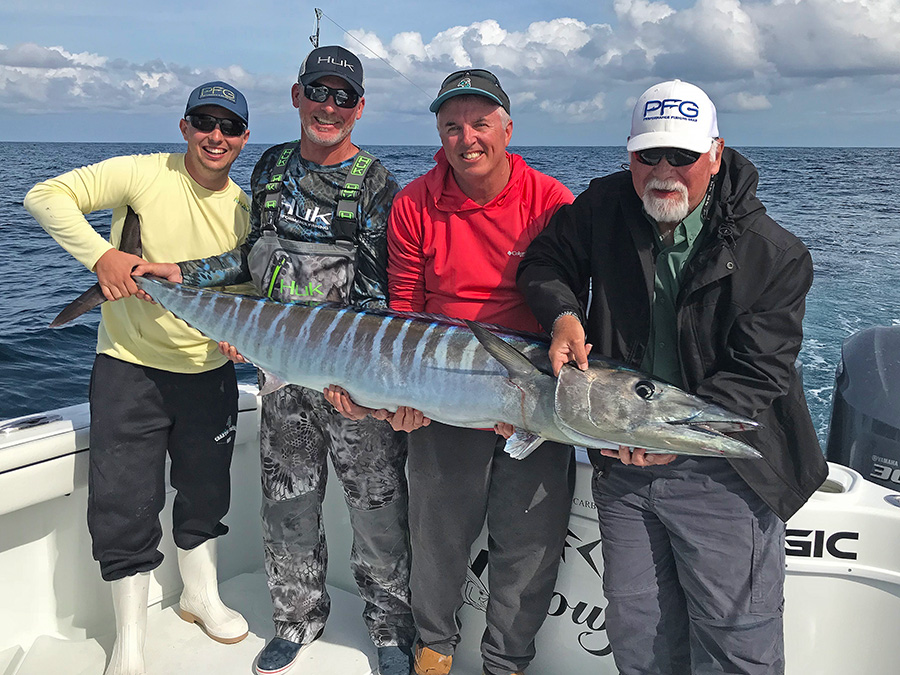
It’s a beautiful thing when pelagic fish bite trolled baits on the surface all day. It’s also a rare occurrence.
When you are in water deep enough to hold tuna, dolphin, and wahoo, the fish can be in a lot of places other than in the first few feet of the water column. If they are feeding deep, then you have to get a bait down deep in order to catch them. Otherwise, you’re just driving over them all day. So often it’s the deep rod, or “meat rod” that turns a dull trip into a productive one.
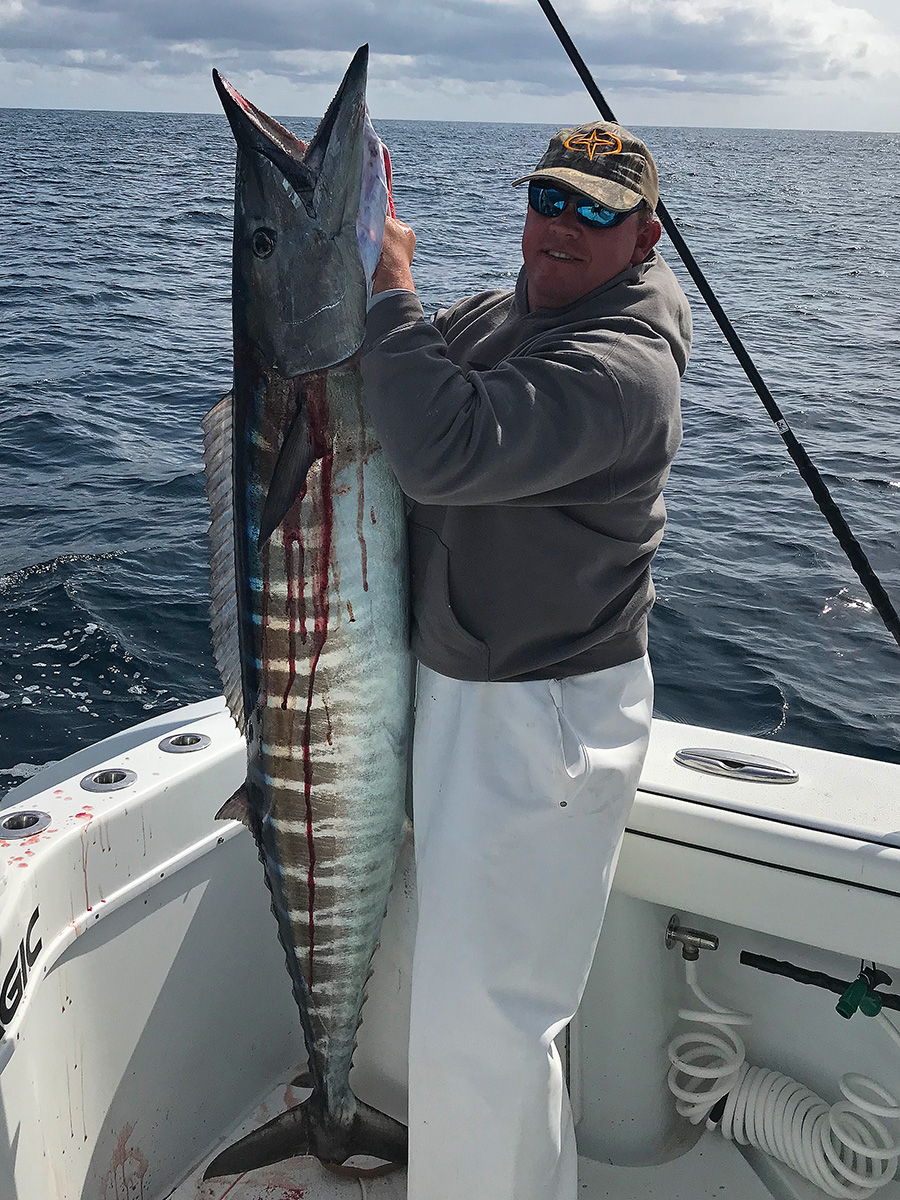
Wahoo, especially big ones, are particularly famous for being caught down below. An Ilander or Sea Witch (in purple/black or blue/white) in front of a medium or large/medium ballyhoo is my “go to” combination when it’s time to send a bait down deep.
I always rig a few of these on a 25-foot shot of No. 9 piano wire with a needle eye hook. It’s a tried-and-true setup, and the darker colors definitely work better on the deep rod. The question that always comes up, though, is concerning the best way to get it down while trolling. At 6 or more knots, a downrigger and lead ball is practically worthless, as the water resistance on the ball just swings it back, almost to the surface.
Planers
The simplest method for getting a bait down is with a trolling weight, a long cylinder (often torpedo shaped) lead with snaps or swivels at either end. I have fished trolling weights up to 64 ounces, and they come in even heavier weights than that. Their shape, coupled with the fact that they are pulled in-line, will allow them to get much deeper than a traditional downrigger setup. It has limitations, though. You are still fighting against the speed of your spread. The faster you pull your baits, the higher in the water column your deep bait will ride. I have scored some quality fish with trolling weights, but I believe there is a better way to go deep. Enter the planer.
The beauty of the planer is that the harder you pull it, the deeper it goes. Just like the little No. 1 and No. 2 planers that you use for Spanish mackerel, only much deeper with a larger planer. The No. 8 Sea Striker planer is my “go to” for offshore trolling, but I have seen peers use the larger “Old Salty” planers very effectively. You need a strong enough trolling outfit with enough drag on the reel to stop the planer in the water. With the No. 8 that I favor, a Shimano Tiagra 50W and a bent butt short rod work perfectly together. I want the drag set just high enough to keep the planer in place. When a big wahoo smashes my bait, I want it to be able to pull some drag off of the reel. Otherwise, you run the risk of ripping the hook right out of his mouth.
Set it up
The easiest way to set the planer up is to simply snap your main line (braid) to the ring on the front of the planer, then snap a long mono leader to the back, followed by a snap to your wire. This setup doesn’t lead to the easiest fight with a good fish, because someone has to wire about 30 yards of mono before they even get to the wire, leading to a mess on the deck of any size boat.
If you happen to get multiple hookups, it gets even trickier. I went to a planer bridle many years ago, and I like this setup best to this day. I make my bridles out of 200-pound Momoi X-Hard Mono, wind-on swivels, and a few high-quality crimping sleeves. I put a wind-on swivel on each end of the bridle, then crimp the line twice on each side, leaving a gap in the middle on both the top and bottom.
This gap allows me to insert a snap swivel that is attached to the front and back of the planer and gives the snap swivels just a bit of room to slide around. You have to play around with the lengths of the gaps and the length of the bridle overall so that you come up with a distance that allows the planer to be tripped on the bite and actually do its job.
This way, you can take the planer on and off of the rig at will. You simply crank the bridle onto the reel. I still have about 30 or so yards of mono after the bridle, leading to another snap swivel. It stores just like any other rod, but it’s easily accessible when you want to pull it out.
You let your bait out, and when the bridle comes through the guide at the top, you clip the planer on to the front and back. Then you set it out. When it gets bit, you fight the fish per normal, then someone unclips the planer and you crank the bridle back onto the reel. No line on the deck to trip or get tangled up in.
Location
On some days, the planer rod is the only rod that gets bit, and sometimes, it is the rod that gets bit the most frequently. On other days, it seems to start the bite. A school of wahoo, or tuna, or even dolphin can see one of their own get hooked and start ascending with the hooked fish.
Depending on where they pop up, it’s advantageous to have them in the area with the rest of your baits. Where you position your planer bait is very important. I like to have it set just inside of the length of my long rigger baits, allowing for a bit of a run on a bite, even against heavy drag. So many times, I have seen that planer rod tip bounce, and then a short while later, one or both of my long rigger baits gets smashed. I’ll take a double or triple header of just about anything that swims in that blue water, any day of the week.
Be the first to comment