

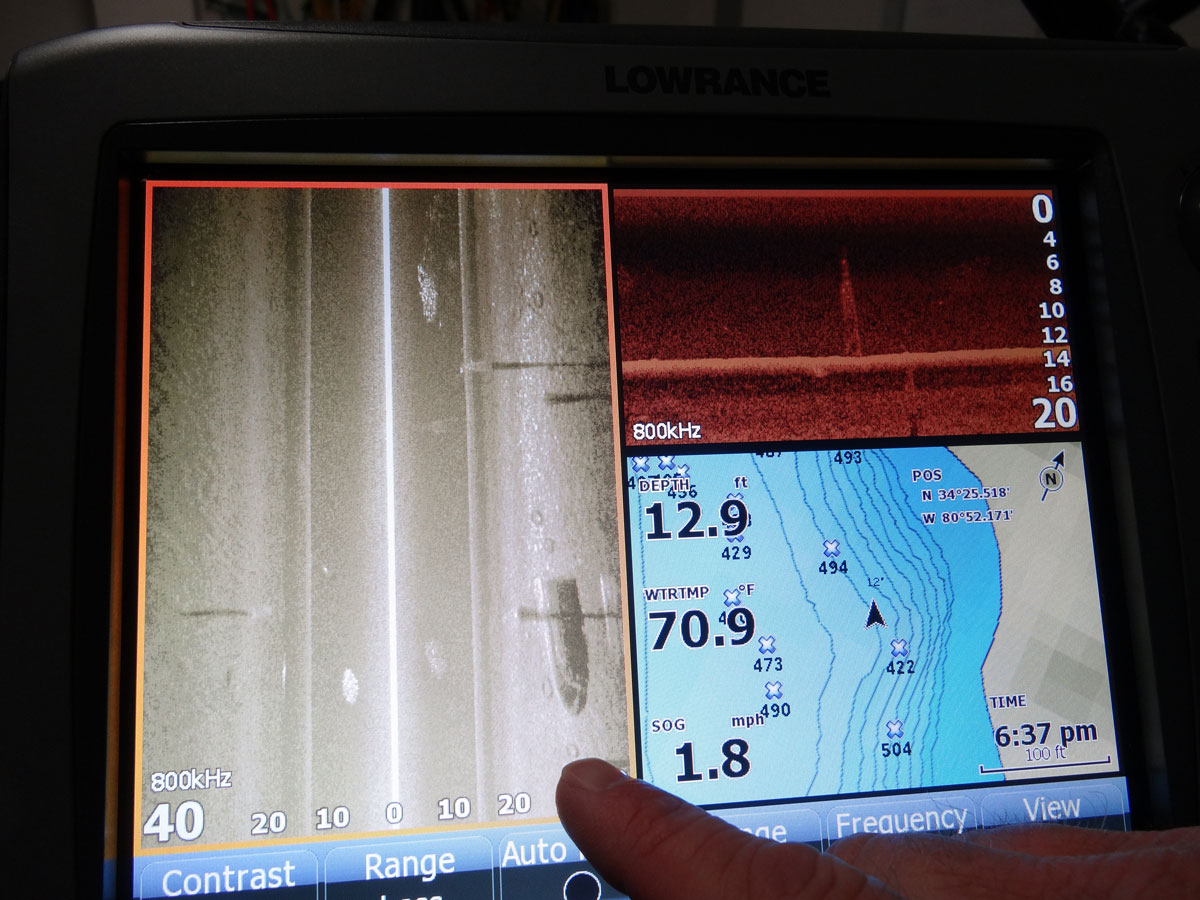
Ken Boone and Rick Ingle, regular fishing partners, use a side-scan graph that Boone said that has opened up a whole new underwater world for him.
“Rick got the unit and learned how to use it,” Boone said. “Once we began to understand what we were seeing, it was simply amazing what we now see under the lake that we didn’t know was there. I’ve fished here over 70 years and had no idea what was out there we were missing. I knew where some brush piles were, had found some underwater logs and old stump rows through the years, but this side-scan enables us to find things like fallen trees that lay partially on a flat and overhang into the river, for example. That’s’ a prime March or year-round type structure.”
Ingle said the unit takes a bit of patience to learn, but is well worth the effort.
“I’ve discovered so much underwater cover that is almost scares me what’s out there,” Ingle said. “I have found over a dozen sunken boats, a single-wide house trailer, lots of rock piles which are very good for holding crappie, as well as prime sunken logs and downed trees, not visible by other means. It has improved our knowledge of the otherwise unseen underwater hotspots throughout the lake, and our fishing has improved tremendously. We’ve been able to catch plenty of fish in the past, but we now have a lot more options. When one plan doesn’t work, we have a lot more things we can try.”
“These units are not cheap, but the investment in being able to learn about crappie and other species is certainly worth it,” Ingle said. “It makes an already excellent crappie fishing lake even better.”
Be the first to comment