

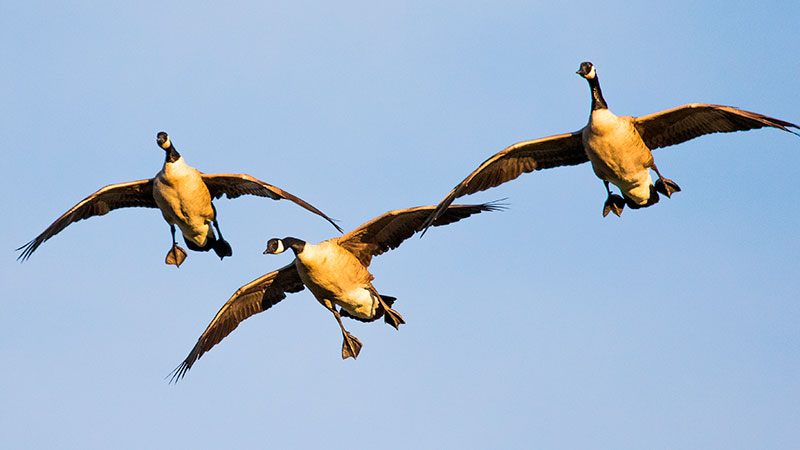
Don’t miss out on the early Canada goose season
When September arrives, many sportsmen across the Carolinas are focused on dove season, and in some areas, deer hunting season is already open. One of the most under-hunted seasons in both states is the early Canada goose season, which runs the entire month of September.
And this early season is special. One reason is because the daily bag limit is three times that of the later seasons for Canadas. So instead of packing it up after downing five geese, a hunter can bag 15 during the September season. That’s a hunter’s dream.
But that’s not the only reason hunters enjoy this early foray into shooting Canada geese. In North Carolina, unlike the later seasons, hunters can use unplugged guns, and even electronic calls. Compared to the regulations for the later seasons, the September season is kind of like the Wild West of goose hunting for hunters in the Old North State.
Resident geese
In South Carolina, the bag limit is also 15, but hunters must use plugged guns and can not use electronic calls.

Stacking them up like cordwood is reason enough for many hunters to break out their camo and shotgun, but of course, that’s not the only reason. With the right goose recipe, a pile of geese can make a fall cookout quite a gathering. And of course, if you’re a land owner, especially land with a pond, you’re probably well aware of how much of a nuisance Canada geese can be, so hunting to thin out the herd has its own merits.
The early season is often referred to as “resident goose season,” because migratory birds don’t arrive here until later in the year. The big honkers that are here this month stay here year-round. That means, among other things, that these geese are accustomed to people and pets, so they aren’t nearly as skittish as their migratory counterparts, at least not until the shooting starts!

Hunting these early-season geese requires some knowledge of their daily patterns. They have routines, just like any living creature that isn’t taking part in a major migration. But that doesn’t mean their schedule is completely rigid. These birds have a number of places that they visit regularly, but it doesn’t mean they go to the exact some spots day after day, or at any certain times during a given day.
Decoys, or no decoys?
Local conditions often dictate their daily patterns. Weather conditions, be they rain, wind, or uncommonly hot or cold temperatures can keep them from visiting certain areas they’re accustomed to for a day or two. So hunters will do themselves a favor by paying attention to what their local geese are doing, and the approximate times they are showing up at certain fields or ponds. This gives them a good starting point, but isn’t foolproof.
Many hunters will notice some of these geese are broken up into very small groups, sometimes as few as five or six geese. Other groups are much larger. Which ones you hunt depends largely on how much land you have access to.

And it’s important to note that most groups of geese, no matter how small or large, often congregate with other flocks, at least on some days. This is especially true in large, open fields.
Speaking of fields, this is where many hunters set up during the early season. Decoys placed in these fields can be effective in convincing geese to land when they otherwise may bypass an area that’s vacant of other geese. Layout blinds that match the terrain are essential, and this can be a time-consuming process that may be fruitless on those days the geese don’t show up. However, it can be a fun-filled day of blasting away and stocking the freezer too. That’s just the nature of early-season goose hunting.
Cast and blast
Small ponds are also great options, especially for the small groups of geese. They are often even accustomed to anglers fishing a pond, so a hunter in a kayak or small boat, or even one standing on the bank is usually of little concern to them.
Decoys are generally not needed on these small bodies of water. They can even be a deterrent, as even just a handful of them can make a small pond look overcrowded to geese flying overhead. As long as geese are coming in to a pond regularly, it’s probably best to go without decoys.

Many hunters enjoy chasing geese on these ponds by bringing along a fishing rod. In a kayak, canoe, or other small boat, it’s easy to keep a shotgun tucked safely beside you, ready to grab at the first sound of an approaching honk.
It’s tough to beat catching bass while waiting on the geese to show up, and if they don’t show up that day, it’s just another day of catching bass on the pond. And one day closer to the geese showing up there. That’s a great way to approach the early goose season.


Be the first to comment