


Capt. Shane Walser shows us the ropes
High Rock Lake in August is no place for casual fishing. With surface temperatures climbing into the 90s and little relief from the Carolina sun, many anglers hang up their rods until fall. But for Capt. Shane Walser of Yadkin Lakes Crappie Guides (336-978-3737), this is prime time to find some of the lake’s biggest crappie, if you know where to look.
“Brush piles in deep water are where crappie go when the water gets hot,” he said. “They’re looking for shade, cooler temps, and food. And those brush piles have all three.”
He searches out downed trees, submerged brush, and man-made structures in depths ranging from 10 to 20 feet. That’s where the action is once the sun starts to bake the surface.
Brush piles are key
Walser marks these locations using GPS and returns to them throughout the season. He’s spent years building a mental and digital map of High Rock’s underwater landscape.

“You learn which piles hold fish year-round, which ones dry up in the heat, and which ones really light up in August,” he said.
While many anglers cast blindly, his approach is surgical. Using real-time sonar, he doesn’t just guess where the fish are. He sees them.
“Electronics have changed everything,” he said. “You can see the fish, see how they’re behaving, and even watch how they react to your bait.”
This has made fishing more efficient, but also more exciting. Instead of drifting and hoping, Walser guides his clients straight to the fish, showing them on the screen before a single jig hits the water.
“When you drop a jig and a crappie swims up to it and hits, and you watched the whole thing happen in real time, that’s next-level fishing,” he said.
In August, his primary tactic is single-pole jigging, which is simply lowering jigs vertically into brush piles and holding them steady. His preferred jig color? Bright green.
“Bright green is my go-to,” he said. “It just works.”
He rigs his jigs on 1/8-ounce heads, but he’s not afraid to change things up.
“Some days they want plastics, some days you have to break out the live bait,” he said. “If the fish are just staring at the jig and not committing, I’ll tip it with a minnow. That usually does the trick.”
Success in August often comes down to finesse and timing.
Use precision
“It’s not about casting far or covering water,” he said. “It’s about getting your bait right in front of a fish and convincing it to bite.”

Walser typically targets depths between 12 and 20 feet, depending on the lake’s conditions and the clarity of the water.
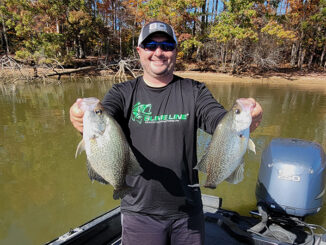
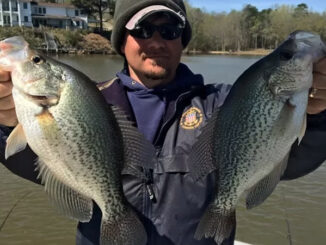
“By mid-summer, the crappie are done spawning and have put on some weight. You’ll find some real slabs down there if you’re patient and precise,” he said.
The key structures he focuses on include deep brush piles, creek channel bends, and the edges of submerged flats.
“You’re looking for that vertical edge,” he said. “Fish will hold just off the drop, right where the cover gives them security.”
Get an early start
A trip with Walser starts early. Launching at first light gives him a jump on boat traffic and access to the calmest water. By 6 a.m., his electronics are up and running, and he’s scanning for fish.

“It’s not always fast-paced, but when it’s on, it’s on,” he said. “You’ll get into a pile where there’s a dozen crappie stacked up, and they’ll bite one after the other.”
His favorite rods are long Crappie Precision jigging poles with light action from Catch The Fever, giving clients a sensitive feel but enough backbone to pull fish from deep cover. He reminds everyone not to set the hook too hard.
“Just a firm lift. These rods will do the work,” he said.
August crappie fishing isn’t about luck. It’s about reading the screen, understanding fish behavior, and making the right move at the right time.
“If they’re not biting, it doesn’t mean they’re not there,” he said. “It just means you need to change something. It could be depth, bait, color, or presentation.”
He watches how the fish react on screen. If a fish comes up and turns away, he might drop a jig two feet lower, or switch to a minnow.
“You can’t force it. But if you watch and adjust, you’ll figure out what they want.”

High Rock is a 15,000+ acre reservoir
High Rock Lake was built in 1926 by the Tallassee Power Company, a subsidiary of Alcoa. At the time of completion, High Rock was the largest reservoir in North Carolina, and one of the largest in the nation.
Its surface area covers 15,280 acres, has 360 miles of shoreline, and is 59 feet deep at the dam. It’s one of the Yadkin River chain of lakes, and sits 624 feet above sea level when full.
Named after the nearby outcropping of rocks sitting on a ridge of the Uwharrie Mountains, the lake is the highest point in the Uwharries.
This lake is considered one of the best fishing lakes in North Carolina, and has hosted numerous Bassmaster Tournaments and other competitions for several different species of fish.
Be the first to comment