

How to catch flatties during the spring
Thanks to the explosion of the blue catfish into the catfish population throughout the Carolinas, the flathead is now an often-forgotten whiskered target. Flatheads thrive in excellent numbers in many lakes and rivers and grow to trophy sizes throughout the Carolinas. And their apex-predator attitude anchored with a brute-force super-power tests even heavy tackle.
Knowledgeable flathead fanatics are feasting on outstanding fishing throughout both states by May.
 Flathead Features on Lakes
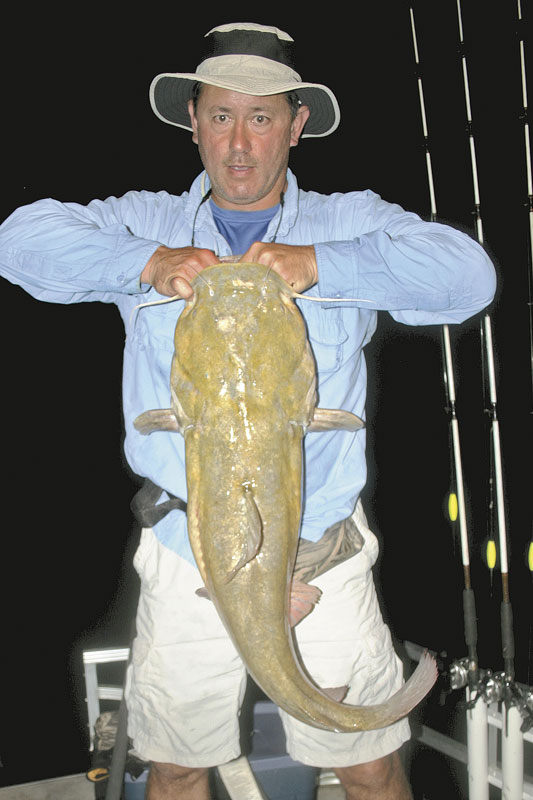
Rodger Taylor from Rock Hill, SC guides for catfish on multiple lakes including Lake Wylie, a Catawba River impoundment straddling the North and South Carolina border. He often targets flatheads from May through the summer months.
Taylor (803-517-7828) said not all catfish hotspots are created equal. He often catches flatheads while he’s targeting blue catfish. But getting to the next level in flathead fishing requires focusing on specific targets and techniques.
“I’ve found that certain features and situations seem to produce the most consistent action,” he said. “Flatheads are caught by day or night. Flatheads are more of an ambush hunter so they prefer to setup near heavy cover such as brush, logs, fallen trees and rock formations. Depth-changes from deep to shallow near this structure are important.
“If an angler isn’t comfortable fishing at night, then I’d suggest focusing on the deeper areas along drops, points and humps during the day,” he said. “Flatheads typically do not move as shallow by day.”
Using electronics to mark specific underwater targets can be an excellent setup for anchoring during daylight he said. He may also fish a large, general target such as a channel ledge loaded with woody cover by drift fishing.
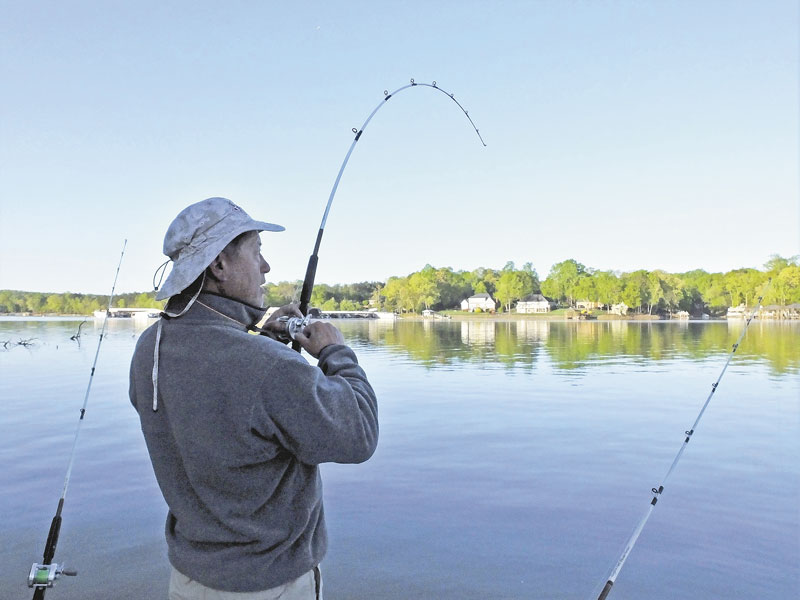
Flatheads love the night life
He said his personal preference is night fishing because fat flatties move shallow and feed aggressively after dark. He prefers to be rigged and fishing by sunset because the last hour of evening can be productive.
“A good tactic is to go up a large tributary searching for shallow flats in channel bends or near deep holes,” he said. “I’ll anchor in shallow water and fan cast several rigs into a variety of depths.”
Taylor said angler should consider the natural forage that flatheads eat in the water you’re fishing as prime bait. And for most of the lakes he fishes that list includes white perch, bream and shad.
“Big, live, bream is my all-around favorite big flathead bait. But white perch are excellent too,” he said. “It doesn’t have to be live bait. Fresh cut bait is productive. I target some of my baits right on that break line that drops into deeper water.”
Taylor said he primarily fishes on the bottom. But suspending bait under floats just off the bottom is an excellent nocturnal technique.
If a long break line exists across the mouth of a creek or cove, Taylor utilizes his sonar to look for logs, brush, stumps or any structure perpendicular to the main break line.
“They’ll key on that difference in depth as a travel route, even if it’s a minor difference in depth,” he said. “Targeting the woody cover along that break can provide a specific flathead target. That’s where they’ll set up their ambush.”
Taylor said flatheads generally bite different than a blue catfish. And understanding the difference is crucial to ensure a good hookset.
“The bite of a blue is typically aggressive and occurs in a heartbeat,” he said. “A flathead takes the bait and slowly swims off, pulling a deep arch in the rod in almost slow-motion compared to a blue. Don’t react too quickly. Let the big flattie load up and then crank down on it and the hookup is usually solid.”
Rocky and woody cover
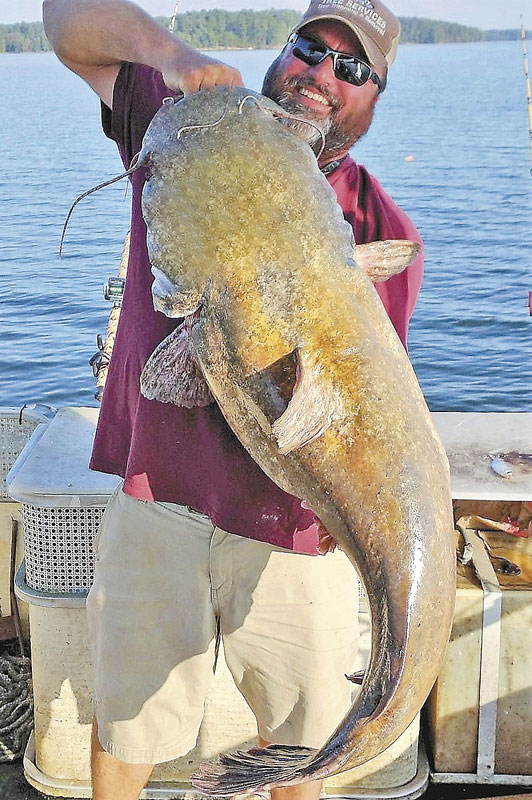
Chris Simpson from McCormick, SC guides for catfish on Clarks Hill Lake and targets flatheads seasonally. His most productive flathead fishing comes from late spring to fall.
“One of my favorite targets for flatheads on big lakes like Clarks Hill is deep, rock bluffs,” he said. “These quick drops into deep holes are the ideal hideout for big flatties by day. Other key areas include where the river forks around underwater islands and at creek and river junctions.”
Simpson (864-992-2352) said in all of these fishing scenarios he graphs the area to ensure wood or rock cover is available for big flatheads to use as concealment. And he’ll anchor-fish specific targets when flathead fishing.
“It’s the nature of a big flathead to nestle up to an object that provides cover to ambush their next meal,” he said.
“Productive depths vary from day to night, seasonally and from one lake to another,” Simpson said.
Rivers Are Flathead Faves
River fishing for flatheads in the Carolinas offers a prime opportunity to hook big flatties during May. And both states have multiple rivers loaded with flatheads.
One avid river flathead angler is Tyler Schultze from Rock Ridge, NC.
Schultze primarily targets the Neuse and Tar rivers in North Carolina but said his river experience and tactics are applicable throughout the Carolinas.
“River fishing requires planning to be successful and I target specific places on every setup,” he said. “It’s not random fishing but the targets are often easy to identify. I search for bends in the river, logjams, eddies, junctions of feeder creeks and natural rock bluffs. Any feature creating unique situations with deeper water, current and eddies are immensely attractive to flatheads.”
Schultze said the common denominator of all of these scenarios is the ability to attract flathead forage. Flatheads are eating machines and are caught where they can find food.
“By May, bluegills are a favorite bait and I’ll use them live or cut,” he said. “I’ve also had great success on flatheads using eel. And I’ll cut them into five-or six-inch baits. In the current they look lively and the scent attracts flatheads. I’ll also use shad, cut or whole, and pick up an occasional flathead. But the shad increases the odds of hooking bonus blues and channel catfish.”
Go heavy on tackle
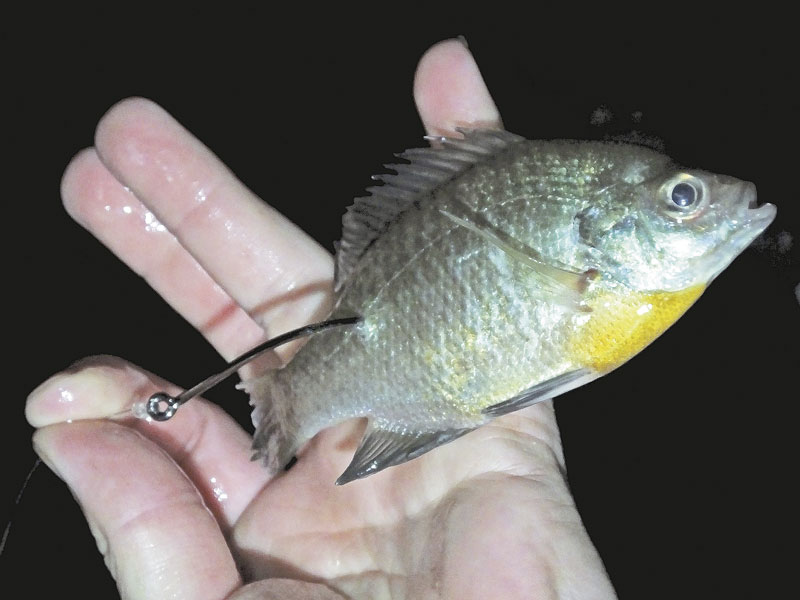
Schultze strictly fishes from anchor fishing setups and his tackle is designed to handle big fish. He uses 7½ foot medium rods and 6500 ABU reels loaded with 100-pound test braided line.
“Fishing around heavy cover for flatheads requires strong line with no stretch to bully them out of the structure,” he said. “I also use a no roll sinker above a swivel and a 12- to 16-inch leader of heavy monofilament and an 8/0 circle hook.
“The sinker weight is crucial and varies from 5 to 8 ounces,” he said. “That’s big, but if I’m fishing a large, live bait I want to cast it right next to a specific target such as logjam, treetop or some form of structure. And I don’t want that bait to be able to pull my rig into the brush.”
Schultze said the inside bend of a channel turn can be productive because of a backwash current creating an eddy.
“The eddy attracts baitfish and if wood or rock structure is available nearby it’s a prime flathead target,” he said.
Whether fishing lakes or rivers, the Carolinas are full of flatheads. Targeting these fish is akin to big-game-hunting by scouting, identifying and catching specific catfish. Rig for big fish, target the right spots and generously dust the process with patience and you’ll discover why flathead fanatics will never forget the flathead catfish.
Top tips when river fishing for flatheads
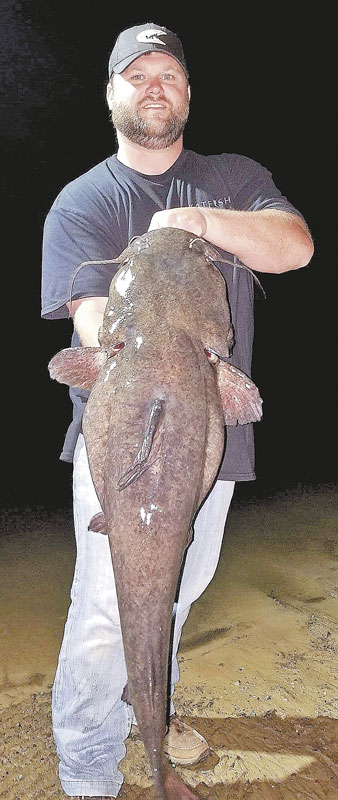
Veteran river catfish angler Tyler Schultze said he has three primary tips for working a river for flatheads.
“One is to focus on deep holes and the second is to fish around woody cover or structure,” he said. “Both are flathead magnets. Also, read the current in the river and target eddy currents. Eddies attract forage and flatheads follow.”
“River fishing is productive day or night but the nocturnal hours are often best,” he said. “If the bite is good, I’ll stay in one place until the action stops. If a spot doesn’t produce a bite in 30-45 minutes, I’ll change locations.”
Schultz said on many lakes the upper reaches often revert to a river-type environment and these tactics will also produce flatheads in that situation.
Be the first to comment